What is buprenorphine?
It may seem strange to treat opioid addiction with an opioid medication. But buprenorphine was designed to give the brain just enough to stop withdrawal and cravings, without the surge that drives a person toward the next dose. That is why it has become one of the most important addiction treatment tools in the world.
Buprenorphine is a semi-synthetic opioid, classed by MedlinePlus as a “partial agonist-antagonist” at opioid receptors. It is used as tablets or films that dissolve under the tongue or inside the cheek to treat opioid dependence, and other forms exist for pain. According to the StatPearls review, the US Food and Drug Administration approved it in 2002 for opioid dependence, alone and combined with naloxone.
The World Health Organization’s guidelines for treating opioid dependence recommend medication combined with psychological support, and name buprenorphine and methadone as the two main options for substitution treatment. In other words, when buprenorphine is used with a prescription and a plan, it is a medication with a clear place in medicine, and calling it a “substitute drug” is inaccurate.
How does buprenorphine work in the brain?
Buprenorphine binds to “mu” opioid receptors, the same receptors that heroin and morphine act on, but it activates them to a lesser degree. The US National Institute on Drug Abuse (NIDA) explains that it can also block other opioids from attaching to these receptors. This gives it four characteristics:
- Partial activation: enough to ease withdrawal and cravings, without the strong high in someone accustomed to opioids.
- Strong binding: it competes with other opioids for the receptor, weakening their effect if they are used on top of it.
- Ceiling effect: the StatPearls review notes that its effect on suppressing breathing has a ceiling, which makes it safer than methadone in substitution treatment, but this ceiling does not protect someone who mixes it with sedatives or alcohol.
- Long-acting: the average half-life is about 38 hours after taking it under the tongue, according to the same reference, so taking it once a day is often enough, as the doctor directs.
What are the medical uses of buprenorphine?
The patient stays stable on it for months or longer while rebuilding their life and receiving psychological therapy.
Easing withdrawal symptoms while stopping opioids, then reducing it gradually under a medical plan.
Special forms such as patches and buccal films for some cases of chronic pain.
NIDA notes that it may be started in the emergency department to ease withdrawal and cravings and to encourage longer-term treatment.
Forms of buprenorphine and its brand names
MedlinePlus notes that buprenorphine comes as sublingual tablets, and that its combination with naloxone comes as sublingual tablets under the name Zubsolv and as films placed under the tongue or in the cheek under the name Suboxone, while Subutex is the best-known brand name for buprenorphine alone. NIDA adds newer forms such as long-acting injections and implants. Available names differ from country to country.
Naloxone was added to Suboxone for a protective reason: it has almost no effect when the medication dissolves in the mouth as directed, but it causes unpleasant withdrawal if injected. For this reason, the StatPearls review notes that buprenorphine alone has a higher potential for misuse than its combination with naloxone.
Is buprenorphine effective for treating opioid addiction?
Yes, and the evidence here is strong. A Cochrane review published in 2014 included about 31 randomized trials with more than 5,400 participants, and found, with high-quality evidence, that buprenorphine is better than placebo at keeping patients in treatment, and that at sufficient doses it reduces illicit opioid use. When the dose was adjusted to the patient’s needs, methadone was slightly better at retention, while the two medications were close in reducing use among those who stayed in treatment.
NIDA sums up the picture by saying that medications for opioid use disorder reduce the risk of death from overdose and of behaviors that spread infections, and that methadone and buprenorphine may be equally effective at reducing use. The choice between them is a medical decision that takes into account the severity of dependence, the person’s health and what is available.
Precipitated withdrawal: why buprenorphine is not taken right away
Because buprenorphine binds tightly to the receptors, if it is taken while a full-strength opioid such as heroin or methadone is still in the body, it pushes that opioid off the receptors and replaces it with a weaker effect. The result is sudden, severe withdrawal called “precipitated withdrawal.” The StatPearls review notes that giving it too soon after a full agonist can cause this, which is why the doctor decides when to start based on the substance and the last use, usually after clear withdrawal signs appear.
Why is buprenorphine misused?
- Trying to treat withdrawal on one’s own, without assessment or follow-up, using tablets obtained outside the medical system.
- Using it by injection or in larger amounts than prescribed in search of a stronger effect, especially in people not accustomed to opioids.
- Believing it is completely safe because it is a “treatment medication,” and so mixing it with sedatives, pregabalin or alcohol.
- Selling or sharing a prescribed medication, which MedlinePlus warns against because it may be targeted by people who misuse medications.
MedlinePlus explicitly warns against injecting the tablets or films because this can cause severe reactions, including withdrawal symptoms, and the StatPearls review links injecting it to liver damage in patients with hepatitis. A medication that protects under supervision becomes a danger when used in a way it was not designed for.
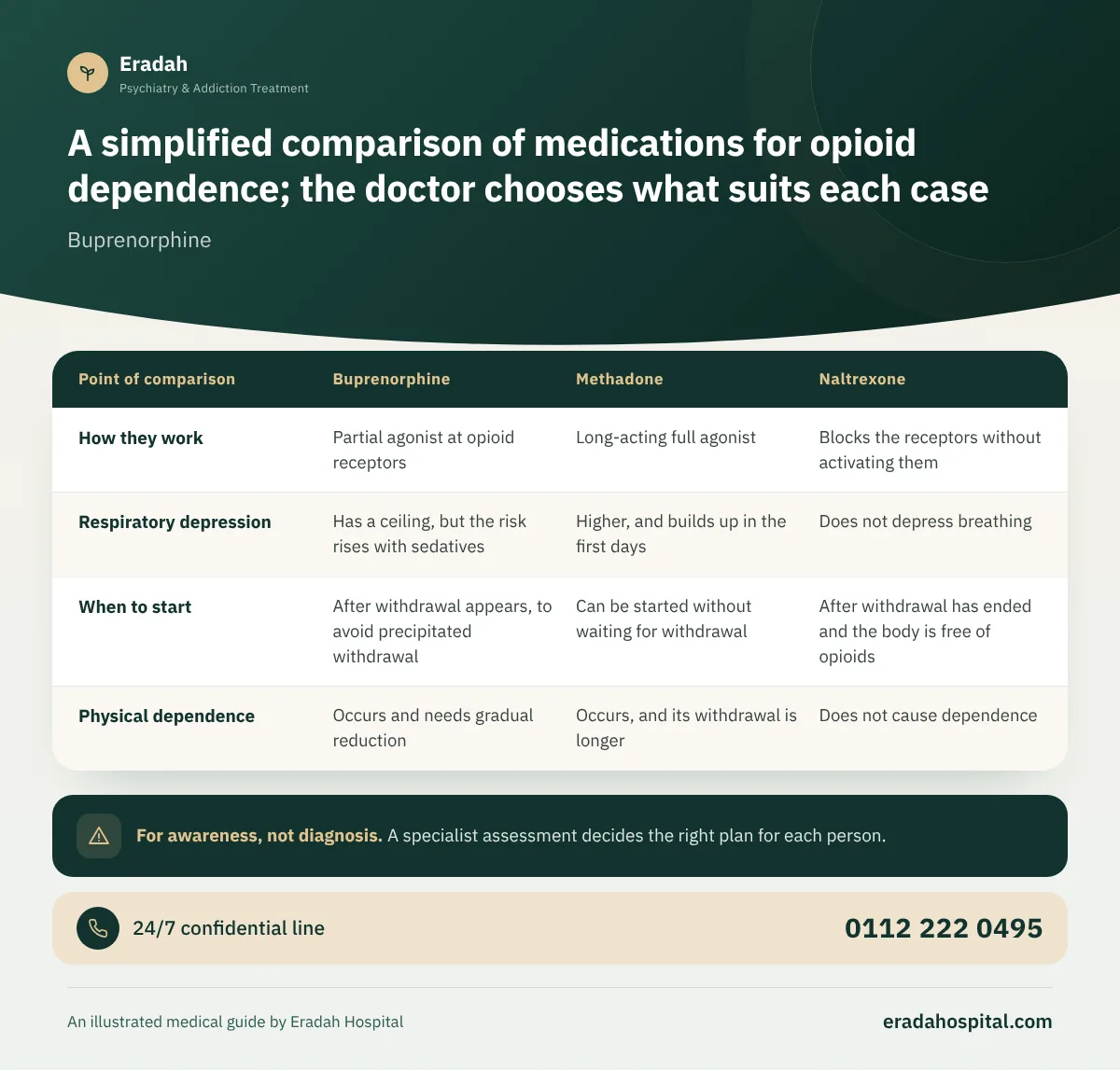
Buprenorphine compared with methadone and naltrexone
| Point of comparison | Buprenorphine | Methadone | Naltrexone |
|---|---|---|---|
| How they work | Partial agonist at opioid receptors | Long-acting full agonist | Blocks the receptors without activating them |
| Respiratory depression | Has a ceiling, but the risk rises with sedatives | Higher, and builds up in the first days | Does not depress breathing |
| When to start | After withdrawal appears, to avoid precipitated withdrawal | Can be started without waiting for withdrawal | After withdrawal has ended and the body is free of opioids |
| Physical dependence | Occurs and needs gradual reduction | Occurs, and its withdrawal is longer | Does not cause dependence |
Learn about naltrexone and the other addiction treatment medications; each suits a different patient.
The legal status of buprenorphine in Egypt
Buprenorphine is a controlled opioid medication, dispensed only with a medical prescription and within a medical setting. Possessing, trading or using it outside this framework is an offense that exposes the person to legal liability. The availability of its forms and treatment programs varies from place to place, and the addiction physician determines the appropriate option available for each case. The Fund for Drug Control and Treatment of Addiction offers free, confidential treatment through the hotline 16023.
This is general educational information and not legal advice.
Buprenorphine in numbers
Sources: the StatPearls review on buprenorphine, the Cochrane review (Mattick et al., 2014), and the US National Institute on Drug Abuse (NIDA). The last figure applies to the United States.
Buprenorphine harms, withdrawal and how long it stays: in brief
Harms: the most common are constipation, headache, insomnia and drowsiness. Among the most serious are respiratory depression when mixed with sedatives, dental problems the Food and Drug Administration has warned about, and liver effects in some patients. Details are in the guide to buprenorphine harms.
Withdrawal: stopping suddenly causes symptoms similar to opioid withdrawal, though usually slower and milder, which is why stopping should be by gradual reduction decided by the doctor. After stopping, tolerance falls, so returning to heroin at the old amount becomes a deadly risk.
How long it stays: the usual opioid test does not detect it; it needs a specific test for the drug and its metabolite. Details are in the guide to how long buprenorphine stays in the body.
Buprenorphine guide: everything you need to know
We have gathered everything about buprenorphine into 4 pages, each answering one question in detail. Choose what you are looking for:
Harms of buprenorphine to the body and mind
Learn about buprenorphine harms: common side effects, the danger of mixing it with sedatives and alcohol, dental, liver and hormone problems, and the harms of injecting and misusing it.
Buprenorphine withdrawal symptoms and how long they last
What are the symptoms of buprenorphine (Subutex) withdrawal and when do they start? The difference between withdrawal from stopping and precipitated withdrawal, why reduction is gradual, and the risk of relapse and overdose afterward.
Heroin addiction treatment: stages and duration
How is heroin addiction treated? The stages of treatment from assessment and detox to approved medications, psychotherapy, rehabilitation and relapse prevention, and how long each stage takes.
How long buprenorphine stays in the body and drug testing
How long does buprenorphine (Subutex) stay in the body? Its half-life, how long it shows in urine, why the usual opioid test does not detect it, and what to do if you take it by prescription.
What should the family do if a member is taking buprenorphine?
- If it is part of a treatment plan, support their attendance at appointments and do not pressure them to stop suddenly; the decision to reduce is made with their doctor.
- Keep the medication locked away from children and visitors; a small amount can be dangerous to a child.
- Tell any doctor or dentist that they are taking it before prescribing sedatives or painkillers or performing surgery.
- If they are getting it without a prescription, treat it as opioid dependence that needs a specialist assessment. You can start with the guide to persuading a person with addiction to accept treatment.
- Memorize the emergency signs and the ambulance number, 123.
Danger signs after taking buprenorphine: call the ambulance (123) immediately
- Severe drowsiness, difficulty waking the person, or no response when called
- Slow or weak breathing, or unusual snoring, especially with alcohol, sedatives or pregabalin
- Very small, pinpoint pupils with bluish lips or fingernails
- Severe confusion, slurred speech or loss of balance
- The medication reaching a child or someone not accustomed to opioids, even if they seem normal
Call ambulance (123) immediately. If the person is unconscious but breathing, place them on their side so they do not choke on vomit. Stay with them and do not leave them alone. Do not give them food or drink, and tell the paramedics everything they took or used, and the amount and time if you know them.
Call the ambulance 123