What is methadone?
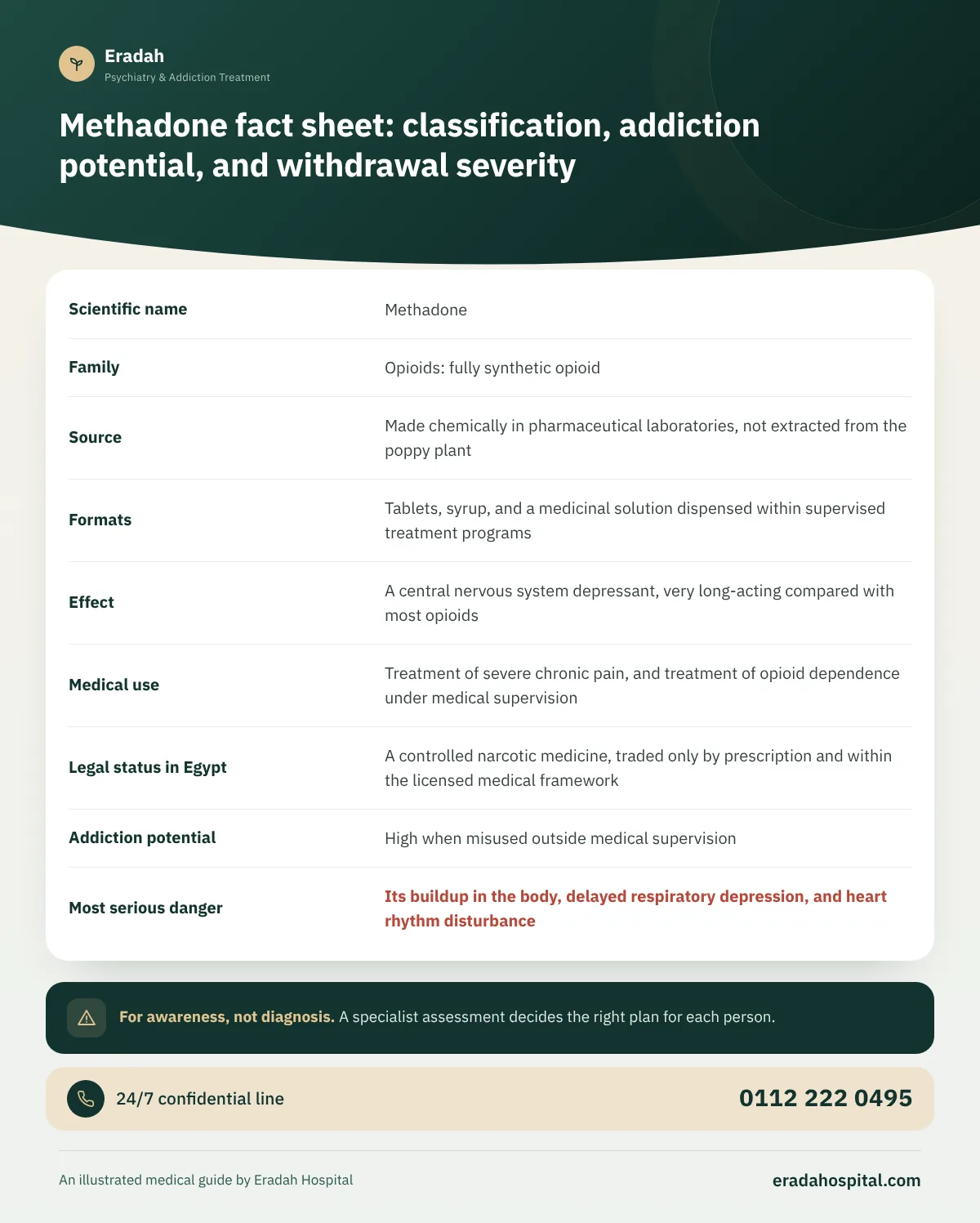
Methadone is a fully synthetic opioid medicine, meaning it is not extracted from the poppy plant like morphine and codeine, but is made chemically in pharmaceutical laboratories. Even so, it works in the brain in roughly the same way as other opioids.
Methadone was developed in Germany in the 1930s as a pain reliever, and in the 1960s doctors discovered that its long, steady effect made it suitable for helping people with heroin addiction stabilize, away from the cycle of use and repeated withdrawal.
For this reason methadone has two faces: it is an essential medicine that the World Health Organization lists among the treatments for opioid dependence with the strongest scientific evidence, and at the same time it is a powerful narcotic substance that can cause addiction and death if it leaves the medical setting. What separates the two faces is medical supervision, careful assessment, and regular follow-up.
Where does methadone come from, and what forms does it take?
Methadone is produced in licensed pharmaceutical factories and is dispensed in different dosage forms depending on the medical purpose. Treatment programs in countries that use it take care to dispense it under direct observation at first, to reduce the risk of it leaking into the illegal market.
The form most used for chronic pain treatment, dispensed by prescription only.
The usual form in opioid dependence treatment programs, because it makes dispensing under observation easier.
In many countries it is dispensed for addiction treatment only from licensed centers and under strict protocols.
How does methadone affect the brain and body?
Methadone binds to “mu” opioid receptors in the brain and spinal cord, the same receptors that heroin and morphine act on, so it relieves pain and causes calm and drowsiness. It also blocks other receptors called NMDA, which may explain its usefulness in some kinds of nerve pain.
- Slower onset and longer effect: It does not cause the quick “rush” that heroin does, and its effect lasts a long time, which is what makes it useful in treatment.
- Long and variable half-life: The half-life ranges roughly from 8 to 60 hours depending on the person, meaning the body takes a long time to clear it, so it builds up with repeated doses.
- Delayed respiratory depression: The peak of respiratory depression comes late and lasts longer than the peak of pain relief, so a person may feel the effect has “worn off” while the danger is still there.
- Effect on the heart: It may lengthen an interval called QT on the heart tracing, raising the risk of a serious heart rhythm disturbance in some patients.
What makes methadone a successful treatment, namely its slowness and long action, is the same thing that makes it a silent danger when taken outside medical supervision.
What are the medical uses of methadone?
| Use | Goal | Who decides |
|---|---|---|
| Severe chronic pain | Relief of pain that has not responded to non-opioid painkillers | A specialist doctor after careful assessment |
| Treatment of opioid dependence | Preventing withdrawal symptoms, reducing cravings, and long-term stability | A licensed treatment program and a multidisciplinary team |
| Gradual detox | Easing withdrawal, then gradual reduction until stopping | The addiction doctor, following a written plan |
In all of these uses the doctor needs to know the medical history and other medicines, may ask for a heart tracing before starting and during follow-up, and starts cautiously then adjusts slowly, because methadone builds up gradually over the first days.
How does methadone help treat opioid dependence?
The World Health Organization describes replacement therapy with methadone or buprenorphine as having the strongest evidence of effectiveness for treating opioid dependence. It is commonly said to be “replacing one drug with another,” but the truth is that it replaces chaotic, short-acting use of unknown origin with a medicine of known composition and long action, dispensed under follow-up.
- It prevents the harsh withdrawal symptoms that push many people back to heroin.
- It reduces cravings, allowing the patient to focus on psychotherapy, work, and family.
- It lowers the risk of death by overdose compared with continuing to use heroin.
- It reduces injecting and sharing equipment, and with them the risk of viral infection.
- It gives time to stabilize before thinking about gradual reduction, a decision made jointly with the doctor.
The availability of this type of treatment varies from country to country, and each patient has a plan that suits them; replacement therapy suits some patients, while detox followed by relapse-prevention medicines suits others. Learn about the options on the page on heroin and opioid addiction treatment.
When does methadone turn from a treatment into a risk?
| Aspect | Under medical supervision | Outside medical supervision |
|---|---|---|
| Assessment | Assessment of tolerance, medical history, and other medicines | No one knows the body's tolerance |
| Heart | Heart tracing and follow-up when needed | Heart rhythm disturbance can go undetected |
| Mixing | Warning about sedatives and alcohol, and adjustment of interacting medicines | Common mixing with sedatives, pregabalin, or alcohol |
| Storage | Instructions to keep it away from children | It may reach a child or another person by mistake |
| Expected outcome | Stability and gradual improvement in life | Addiction and a delayed overdose that may be fatal |
The most dangerous situations of all are the first days for someone not used to opioids, mixing with any depressant substance, and trying to “strengthen” the effect by repeating the dose because it did not appear quickly; methadone builds up slowly, and by the time its full effect shows it may be too late.
What is the difference between methadone, heroin, morphine, and tramadol?
| Substance | Source | Medical use | Duration of effect |
|---|---|---|---|
| Methadone | Entirely synthetic | Severe pain and treatment of opioid dependence | Very long, and it builds up |
| Heroin | Semi-synthetic, made from morphine | Not permitted medically in Egypt | Short, with a fast onset |
| Morphine | Extracted from opium | Severe pain in hospitals | Moderate |
| Tramadol | Synthetic | Moderate to severe pain | Moderate |
What is the legal status of methadone in Egypt?
Methadone is a controlled narcotic medicine under Egyptian Drug Control Law No. 182 of 1960 and its amendments, so it is dispensed only by prescription and within the licensed medical framework, and possessing or trading in it outside this framework exposes a person to legal liability. The Fund for Drug Control and Treatment of Addiction offers free, confidential treatment through the hotline 16023.
This is general educational information and not legal advice.
What should a family do if one of its members is taking methadone?
- If it is part of a treatment plan: Support his commitment to appointments and follow-up, and do not pressure him to stop suddenly; the decision to reduce is made with his doctor.
- Store the medicine safely: In a locked place away from children and visitors, because even a small amount can be fatal to a child or to someone not used to opioids.
- Watch for mixing: Tell any other doctor that he is taking methadone before they prescribe sedatives, antibiotics, or epilepsy medicines.
- If he is taking it without a prescription: Treat it as opioid dependence that needs specialist assessment, not a moral problem to be solved by punishment.
- Learn the danger signs: Severe drowsiness and slow breathing hours after taking it call for an ambulance immediately.
Common myths about methadone
| The myth | The truth |
|---|---|
| Methadone is just a substitute addiction | Replacement therapy under supervision reduces deaths and relapse and restores stability, and it is fundamentally different from chaotic drug use. |
| As long as it's a medicine, it's safe for everyone | It is relatively safe only for those a doctor has assessed; for anyone else it can be deadly, especially in the first days. |
| If I don't feel its effect, it's weak | Its effect appears slowly and builds up, and respiratory depression can come late, hours afterward. |
| It can be stopped at any time without a problem | Stopping suddenly causes prolonged withdrawal, and reduction should be gradual under a doctor's supervision. |
The methadone guide: everything you need to know
We have gathered everything about methadone into 3 pages, each answering one question in detail. Choose what you are looking for:
Methadone harms
From delayed respiratory depression and heart rhythm disturbance to drug interactions and its effect on pregnancy and hormones, and why mixing with sedatives is deadly.
Methadone withdrawal symptoms
Withdrawal starts more slowly than with heroin, often within about 30 hours, but it lasts longer. The timeline and why gradual reduction under medical supervision is necessary.
How long methadone stays in the body
How long it remains in urine, blood, saliva, and hair, and why it does not show up on the usual opioid test and needs a special test.
Signs of methadone overdose: call an ambulance (123) immediately
- Pupils that are extremely small, like pinpoints
- Very slow, shallow or irregular breathing
- Severe drowsiness and difficulty waking, or loss of consciousness
- Blue lips and fingernails and cold skin
- Slow heart rate, fainting, or irregular palpitations
Call an ambulance on 123, place the person on their side so they do not choke, and stay with them until help arrives. Naloxone, available in emergency departments, reverses the effect of an overdose, but the effect of methadone lasts much longer than naloxone's, so the patient must stay under observation in hospital even after improving.
Call the ambulance 123