What are the core signs of gaming addiction?
The World Health Organization bases the diagnosis of gaming disorder on three core features that must occur together, cause marked distress or impairment, and usually last a full year:
- Impaired control: starting to play at inappropriate times, playing longer than intended, and failing to stop or cut back despite repeated promises.
- Putting gaming ahead of everything else: hobbies, responsibilities and daily activities fade until gaming becomes the center of the day.
- Continuing despite harm: gaming continues or increases even as grades fall, arguments flare up or work suffers.
The duration can be shortened if the signs are severe and all the conditions are met. The pattern may also be continuous or episodic, for example a young man who sinks into gaming for months over the vacation, calms down a little, and then returns.
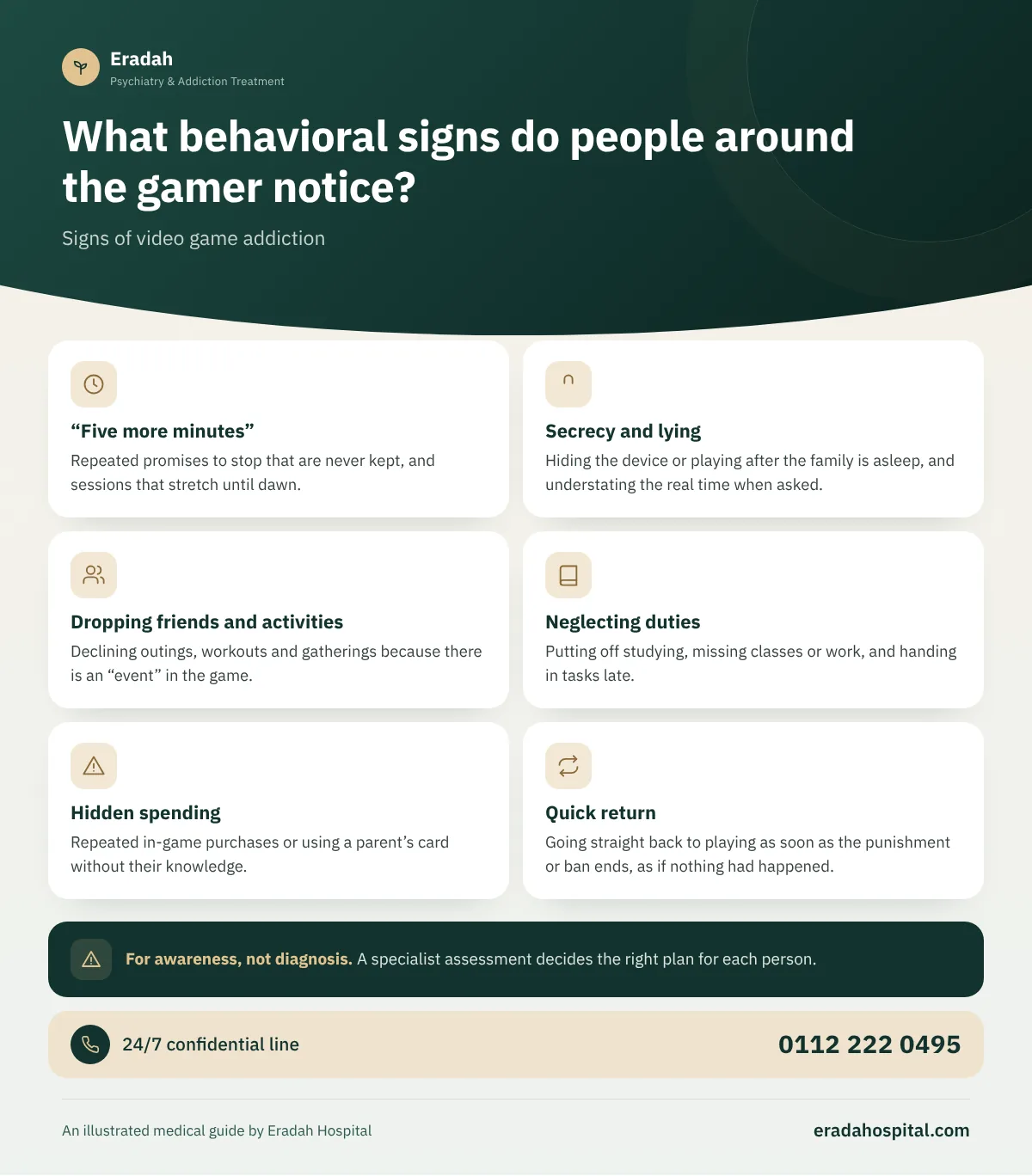
What behavioral signs do people around the gamer notice?
Repeated promises to stop that are never kept, and sessions that stretch until dawn.
Hiding the device or playing after the family is asleep, and understating the real time when asked.
Declining outings, workouts and gatherings because there is an “event” in the game.
Putting off studying, missing classes or work, and handing in tasks late.
Repeated in-game purchases or using a parent’s card without their knowledge.
Going straight back to playing as soon as the punishment or ban ends, as if nothing had happened.
A change from the person’s usual self matters more than any single behavior: the son who loved football and no longer goes out, or the husband who now spends every evening alone in front of a screen.
What are the psychological and emotional signs?
- Intense irritability, sadness or anxiety when kept from playing or when the internet goes down, easing as soon as he is back in the game.
- Constant mental preoccupation with the game: thinking about it in class or at work and planning the next session.
- Turning to gaming whenever he feels distressed, bored or tense, as if it were a “painkiller” for feelings.
- Guilt or distress after long sessions, followed by more gaming to escape that feeling.
- Loss of interest in activities that used to be enjoyable, and little enthusiasm for anything outside the game.
- Extreme sensitivity to losing in the game, reaching angry outbursts out of proportion to the situation.
Are there physical signs in someone addicted to gaming?
| The sign | What it looks like in daily life |
|---|---|
| Constant fatigue | Dark circles under the eyes, drowsiness in the morning and in class, and difficulty waking up |
| Disrupted sleep schedule | Staying up until dawn and then sleeping for long stretches in the daytime, especially on vacations |
| Neglected meals or eating in front of the screen | Skipping lunch or relying on fast food and caffeinated energy drinks |
| Neglected personal hygiene | Putting off showering and changing clothes because “the game won’t wait” |
| Complaints about the neck, wrist and eyes | Recurring pain, dryness and eye strain after long sessions |
| Inactivity | A clear drop in physical activity and a change in weight |
These physical signs alone do not mean addiction, but they complete the picture when they come together with loss of control. The long-term effects compulsive gaming can cause are covered on the page about the harms of gaming addiction.
What are the nine criteria proposed in DSM-5?
The American Psychiatric Association proposed nine criteria for what it called “internet gaming disorder,” requiring five or more within 12 months along with marked distress or impairment. We present them in simplified form:
| Criterion | What it means in simple terms |
|---|---|
| Preoccupation | The game occupies his thoughts most of the time |
| Withdrawal symptoms | Sadness, anxiety or irritability when away from gaming |
| Tolerance | Needing more time to feel the same satisfaction |
| Failed attempts to cut down | Repeated attempts at control that do not work |
| Loss of interests | Giving up hobbies and activities he used to enjoy |
| Continuing despite problems | Knowing that gaming harms him and carrying on anyway |
| Deception | Lying to family or the therapist about how much he plays |
| Escape from feelings | Playing to relieve sadness, anxiety or guilt |
| Risking important opportunities | Losing, or jeopardizing, a job, studies or a relationship because of gaming |
How do the signs of gaming addiction show up in children and teenagers?
In children and teenagers the signs usually show up through school and home life more than through words: a sudden drop in grades, refusing to go to school after late nights, sharp angry outbursts when the device is taken away, withdrawing into their room, and losing friends outside the game. Their way of speaking may also change, filling up with the game’s terms and events.
Other signs worth noticing include secret night-time gaming, spending all their pocket money on in-game purchases, and talking about the game as if it were the only place where anyone “understands” them. That last sentence in particular may reveal loneliness, bullying or social anxiety that needs care.
How do the signs show up in adults?
In adults the picture looks calmer on the surface but is no less harmful: repeated lateness to work, lower productivity from lack of sleep, excusing themselves from family commitments, marital arguments about time wasted in front of the screen, and growing spending on games and add-ons that is hidden from a partner.
Adults often justify their gaming as a “way to blow off work stress.” That is sometimes true, but it becomes a warning sign when gaming turns into the only way of coping with stress, and when it steals sleep night after night.
Self-assessment questions about your relationship with games
- Do you often play for much longer than you intended?
- Have you tried to cut down more than once without success?
- Do you feel irritable or distressed when you cannot play?
- Have you given up sleep, studying, work or meeting friends in order to play?
- Do you hide from your family the real time you spend playing or what you spend inside the game?
- Do you play to escape sadness, anxiety or problems?
- Have you kept playing even though it has caused you a clear problem at school, work or home?
If several answers have applied to you for months, talk to a specialist instead of beating yourself up. Learn about ways to treat gaming addiction.
How can a family notice the signs and start the conversation?
Start by observing calmly for two weeks: when he plays, how much he sleeps, how he behaves when he stops, and whether his grades or friendships have changed. Write down the facts without commenting; they are more useful in a conversation than general accusations such as “You’re on the game all day.”
- Choose a calm moment away from game time or an argument, and ideally let the conversation be between the child and one parent he trusts.
- Start with concern, not judgment: “I noticed you’ve been going to bed late and your grades have dropped, and I’m worried about you.”
- Ask him about the game itself and what he likes about it; this lowers his defensiveness and reveals his needs.
- Agree on one small step instead of a long list of prohibitions.
- If the conversation is met with violence, a breakdown or talk of death, seek specialist help right away.
Suicidal thoughts, violence or severe collapse? Get help now
- Talk about wanting to die or about life being meaningless, especially after being stopped from playing or losing an account or a “level”
- Violent outbursts in which they hurt themselves or others or smash things when the device is taken away
- Going without eating or sleeping for many hours in a row in front of the game, with severe exhaustion or dizziness
- Complete withdrawal from family and school or work for weeks, with obvious despair
- Hidden debts or large spending inside games followed by panic or threats of self-harm
Stay calm and do not get into a fight or physical confrontation over the device; stay close to the person, ask calmly how they are feeling, and listen without blame. If there is a risk to their life or others’ lives, call the ambulance on 123 or go to the nearest emergency room, or call the mental health support line 16328 (24 hours), and remove anything they could harm themselves with.
Ambulance 123 Mental health support line 16328