What does gaming addiction do to a person’s life?
The harm in gaming addiction rarely comes from the game itself, but from what the game displaces: hours of sleep, movement, studying, talking with family and real friendships. Over time this absence builds up into physical, psychological, social and financial harms that feed one another.
- The first weeksLate nights and exhaustion
Late bedtimes, morning drowsiness, and tension when interrupted.
- After monthsDecline in functioning
Lower grades or weaker productivity, and withdrawal from activities and friends.
- With continued useA closed circle
Anxiety or depression drives more gaming, along with family conflict and rising spending.
- Without interventionWidespread breakdown
Dropping out of school or work, near-total isolation, and psychological crises that may need urgent intervention.
How does gaming addiction steal sleep?
Sleep is the first casualty of compulsive gaming. Late-night sessions push back bedtime, the excitement and tension of a match keep the brain alert after the device is switched off, and the bright light of the screen delays the natural feeling of sleepiness. A meta-analysis covering more than 100,000 children and adolescents found that using devices at bedtime is linked to shorter, poorer-quality sleep and daytime sleepiness, and even the mere presence of a device in the room was linked to these effects.
Chronic lack of sleep has consequences beyond tiredness: it weakens memory and concentration, increases irritability and impulsivity, raises susceptibility to anxiety and depression, and is linked to weight gain. That is why protecting sleep is the first step in any plan. For more on insomnia and its relationship to mental health, see its dedicated guide.
What are the physical harms of gaming addiction?
| Part affected | Potential harm | Note |
|---|---|---|
| Eyes | Strain, dryness and headaches after long sessions | Long periods of close-up activity and little time outdoors are linked to more nearsightedness in children |
| Neck and back | Pain from slouching and prolonged sitting | Recurs with sitting for hours without moving |
| Wrist, fingers and thumb | Repetitive strain pain in the tendons | Common with controllers and phones |
| Weight and metabolism | Weight gain and poor fitness | Due to inactivity, fast food and caffeinated energy drinks |
| Circulation | Rarely: leg blood clots from sitting continuously for very long hours | Rare cases, but a reminder of the importance of regular movement |
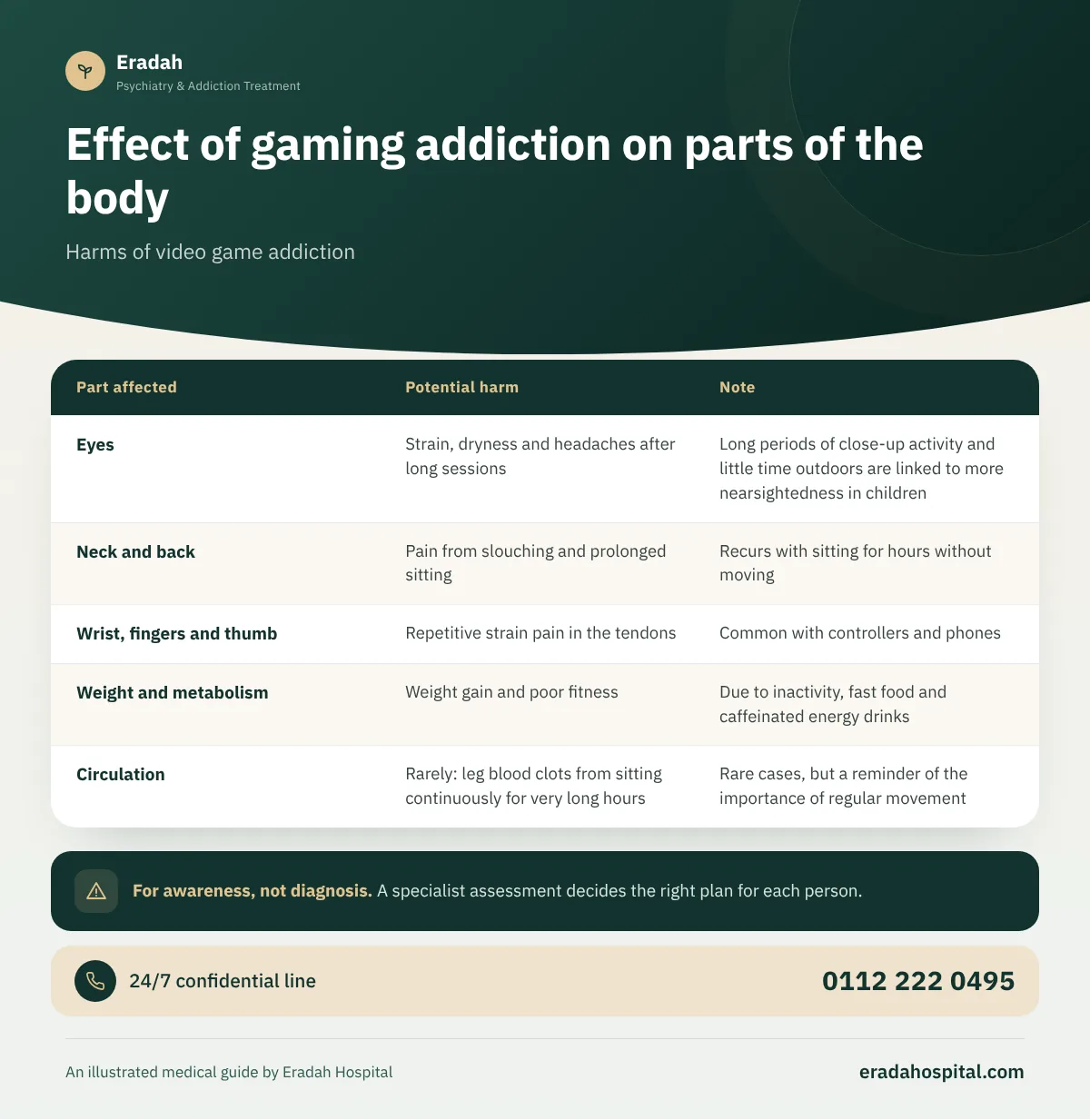
Parents may also notice neglect of eating and hygiene and reliance on stimulants to stay up late. These harms often improve quickly once balance returns and the person goes back to regular movement and sleep.
How does gaming addiction affect mental health?
Gaming addiction is strongly linked to anxiety, depression and attention problems, and the relationship runs in both directions: psychological distress pushes a person toward gaming, while compulsive gaming increases isolation, sleep loss and feelings of failure, which deepens the distress. Many patients notice that the game is no longer as enjoyable as it used to be, yet they cannot stop.
Emptiness and sadness outside the game, and loss of pleasure in other activities.
Tension when away from the game, and anxiety about piled-up school or work.
Outbursts of anger over a loss or a ban, made worse by lack of sleep.
A sense of failure whenever the person compares real life with their achievements in the game.
In severe cases, despair can reach thoughts of death, especially in teenagers after a sudden ban, a big loss, or an accumulation of school failure. These thoughts are a sign of pain that needs help, not a “threat” or “drama,” and they must be taken seriously right away: talk with him calmly and seek help through 123 or the mental health support line 16328.
What is the impact on school and work?
In students, the impact shows up as falling grades, absences, sleeping in class, putting off studying until the night before exams, and sometimes failing or dropping out. In adults, it shows up as repeated lateness, poor concentration in meetings, mistakes at work, and it can end in losing a job.
The UK’s NHS gaming disorders service notes that some of its patients played for hours approaching a full day, and that the consequences included avoiding school or work, social withdrawal, breakdown of family relationships and sometimes even violence.
How does it affect the family and relationships?
- Daily conflict over time and the device turns the home into a tug-of-war and wears parents out.
- Verbal or physical violence in some teenagers when the device is taken away, a sign of how severe the problem is.
- Isolation from siblings and relatives and absence from meals and family occasions.
- Marital conflict in adults over lost time, spending and emotional neglect.
- Effects on younger siblings, who copy the behavior or feel neglected because the family is preoccupied with the problem.
Does gaming addiction cause financial problems?
Yes, especially with games built around in-game spending. Small repeated purchases add up without the player noticing, and random loot boxes encourage paying again and again in the hope of a rare item. Children may use their parents’ cards without their knowledge, and adults may borrow money or sell their belongings.
What is the impact on the development of children and teenagers?
Childhood and adolescence are the years for building skills that are not learned in front of a screen: free play and movement, resolving disagreements face to face, tolerating boredom, and managing time. When a game replaces these experiences for years, social skills and the ability to concentrate on long, unenjoyable tasks such as studying may develop late.
This does not mean that all gaming harms development, since some games build planning and cooperation. The risk lies in displacement: what did the child not do because they were playing?
Do violent games make a person aggressive?
This is one of the most debated questions. In 2020 the American Psychological Association affirmed that there is not enough scientific evidence that violent games cause violent behavior in real life, though there is a small but consistent association with an increase in mild aggression such as shouting and shoving.
As for the irritability and violence some families see when a device is taken away, they mostly stem from the addiction itself, lack of sleep and frustration, not the content of the game. Even so, choosing games suited to a child’s age remains important for educational and psychological reasons.
Can the harms of gaming be avoided?
Yes, and most improve quickly when the pattern is broken early. Protecting sleep, gradually cutting down playing time, returning to movement and activities, and treating co-occurring anxiety, depression or ADHD all restore balance within weeks to months. The longer it goes without intervention, the harder it is to put right. Learn the steps in treatment of gaming addiction.
Suicidal thoughts, violence or severe collapse? Get help now
- Talk about wanting to die or about life being meaningless, especially after being stopped from playing or losing an account or a “level”
- Violent outbursts in which they hurt themselves or others or smash things when the device is taken away
- Going without eating or sleeping for many hours in a row in front of the game, with severe exhaustion or dizziness
- Complete withdrawal from family and school or work for weeks, with obvious despair
- Hidden debts or large spending inside games followed by panic or threats of self-harm
Stay calm and do not get into a fight or physical confrontation over the device; stay close to the person, ask calmly how they are feeling, and listen without blame. If there is a risk to their life or others’ lives, call the ambulance on 123 or go to the nearest emergency room, or call the mental health support line 16328 (24 hours), and remove anything they could harm themselves with.
Ambulance 123 Mental health support line 16328