Why do some people become addicted to games and others do not?
Millions of people play every day, and only a small proportion lose control. That is because addiction does not come from the game alone or from the person alone, but from the interaction of three circles: a game designed to hold attention, a person with a need or vulnerability that makes the game an ideal refuge, and an environment that does not provide enough limits or alternatives.
Understanding these circles changes how a family sees the problem. Instead of asking “Why is my son so weak?”, the question becomes “What does my son find in the game that he does not find in his life? And what is it about the game that makes it hard for anyone to stop?”
How are modern games designed to keep you playing?
Many games, especially free online ones, rely on carefully designed mechanisms to increase playing time and bring players back every day. We describe them here so that players and their families understand why stopping can feel so hard, not to say that every game is bad:
You never know when the rare loot will drop, so the brain stays in a state of anticipation. This unpredictable pattern is stronger at fixing a behavior than a fixed reward.
There is no “final level”; new seasons and constant updates leave the game with no finish line.
Gifts grow with each consecutive day and are lost if you miss one, so playing turns into an obligation.
Offers and missions that expire within hours create a fear of missing out.
The team is waiting for you, and leaving in the middle of a match exposes you to blame or penalties.
Levels, badges and numbers that keep rising give a sense of achievement that may be missing in real life.
These mechanisms do not cause addiction in everyone, but they raise the game’s “pull” to the point where someone with a psychological vulnerability or weak impulse control finds it truly difficult to stop. That is why we encourage families to pay attention to the type of game and how it is designed, not only the number of hours.
What do loot boxes have to do with gambling and addiction?
Loot boxes are items in some games that the player pays for with real money or in-game currency, and then receives random content that may be rare and valuable or ordinary. This paid randomness makes them similar in psychological structure to gambling, even if the player does not win any money.
Some countries have treated paid loot boxes as a form of gambling and restricted them. What matters most for families is that a teenager who spends compulsively on these boxes may be more likely to develop problems with gambling and betting later, and that turning on spending limits on devices is a simple preventive step.
Which psychological factors increase vulnerability?
| The situation | Why do they raise the risk? |
|---|---|
| Attention-deficit/hyperactivity disorder | A need for fast, constant stimulation, and difficulty with impulse control and time management; the game offers “easy” focus that studying does not |
| Depression | Playing temporarily eases the feeling of emptiness and gives a quick sense of achievement, but isolation then deepens the depression |
| Social anxiety | Communicating through the game is easier and safer than face-to-face contact, so the person avoids the real world |
| Low self-esteem | Success inside the game makes up for feelings of failure at school or work |
| Loneliness and bullying | The game community offers the belonging and acceptance missing at school or in the neighborhood |
The relationship here usually runs in both directions: anxiety or depression push a person toward excessive gaming, and excessive gaming deepens them. That is why a good assessment always looks at what lies “beneath” the gaming, because treating the co-occurring condition is a core part of the solution.
Why are teenagers more vulnerable than others?
In adolescence, the brain’s reward and thrill-seeking circuitry matures early, while the frontal lobe, which is responsible for inhibition, planning and weighing consequences, keeps maturing until roughly the mid-twenties. This natural gap makes teenagers more drawn to quick rewards and less able to say “enough” in the middle of an exciting match.
In addition, belonging to a group of friends is a strong need at this age, and many groups now meet inside games. So for a teenager, leaving the game can feel like leaving the “crew,” which explains why the reaction is sometimes so intense.
How do family and environment contribute to gaming addiction?
- A device in the bedroom without clear rules makes late-night gaming easy and out of sight.
- Family conflict, divorce or the absence of a parent pushes a child to escape into a world where they feel in control.
- Using the device as a “babysitter” from an early age builds a habit of relying on a screen to fill any gap.
- Lack of alternatives: few safe places for play, sport and activities, especially in crowded cities.
- Role models: parents who are absorbed in their own screens find it hard to persuade their children to stop.
- Inconsistent rules: strict bans followed by total leniency teach a child that nagging works.
What everyday triggers set off the urge to play?
A trigger is different from a cause: the cause makes a person vulnerable, while the trigger sets off a gaming binge at a particular moment. Identifying personal triggers is one of the first things a therapist works on:
- Boredom and unstructured free time, especially during vacations.
- Stress before exams or after a hard day at work.
- An argument at home or an embarrassing moment at school.
- A notification about a new event or a message from the team.
- Loneliness in the evening or after the family has gone to sleep.
- Watching live streams or clips of the same game.
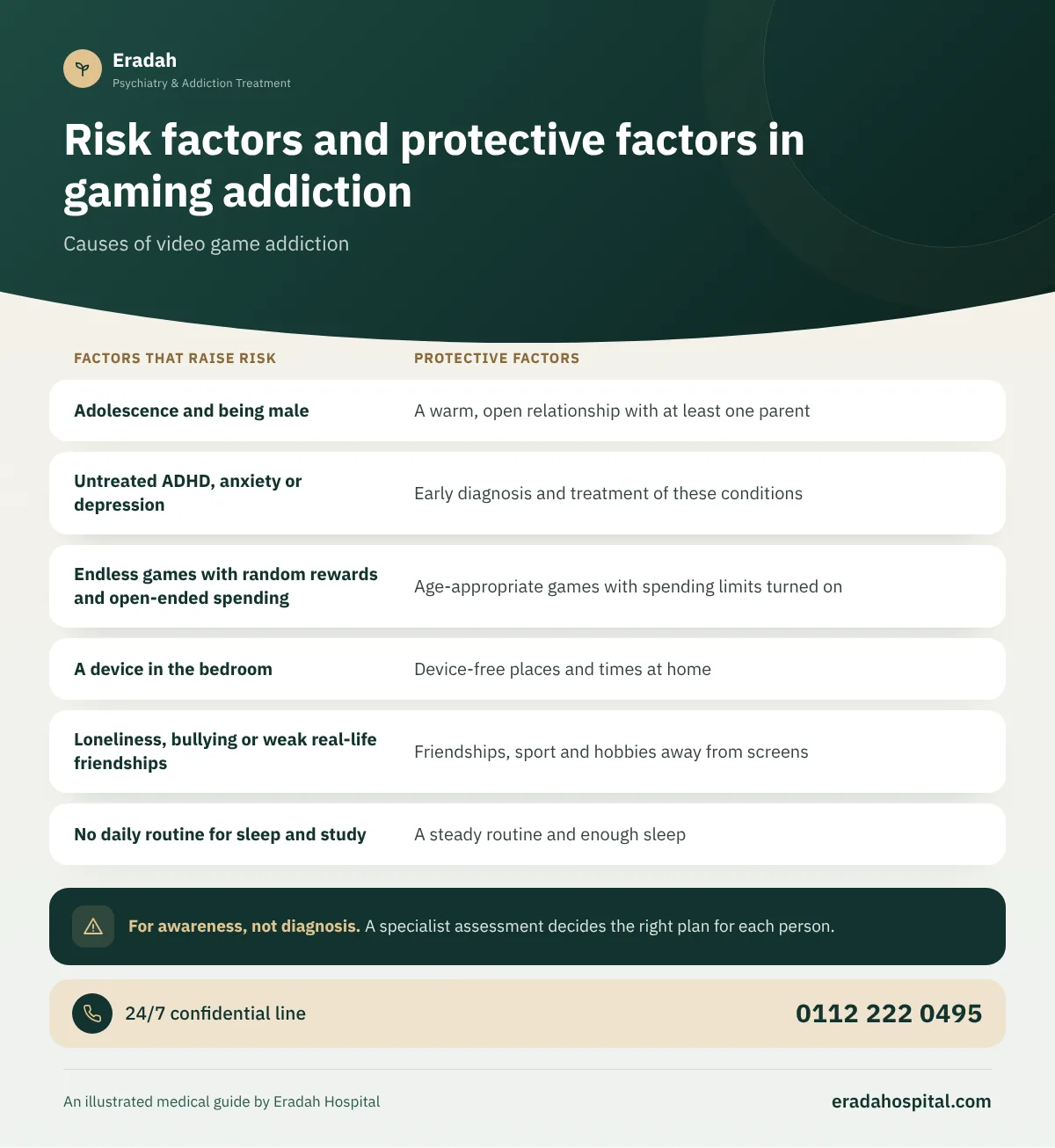
What are the risk and protective factors in gaming?
| Factors that raise risk | Protective factors |
|---|---|
| Adolescence and being male | A warm, open relationship with at least one parent |
| Untreated ADHD, anxiety or depression | Early diagnosis and treatment of these conditions |
| Endless games with random rewards and open-ended spending | Age-appropriate games with spending limits turned on |
| A device in the bedroom | Device-free places and times at home |
| Loneliness, bullying or weak real-life friendships | Friendships, sport and hobbies away from screens |
| No daily routine for sleep and study | A steady routine and enough sleep |
Are violent games or a “weak personality” the cause of addiction?
Addiction is linked less to how violent a game is than to how its rewards are designed; one person may become addicted to a quiet farming game while another never becomes addicted to a fighting game. A “weak personality” is a comfortable explanation but an incorrect one: behavioral addiction results from a biological, psychological and environmental interaction, and it can affect a top student or a successful employee.
A correct explanation of the causes leads to correct solutions: changing the environment, treating the co-occurring psychological condition, and building alternatives. This is what we explain in treatment of gaming addiction.