Why do some people develop hair-pulling disorder?
Many patients and their families ask, “Why me?” The honest answer is that science has not identified a single cause, but rather a combination of biological, psychological and environmental factors that come together in one person, turning a normal grooming behavior into a repeating loop that is hard to break.
It helps to see pulling as a behavior that serves a function: it calms stress, breaks boredom, or satisfies a particular physical sensation. When a behavior serves a function, the brain repeats and reinforces it until it runs automatically in many situations.
The role of genetics and the brain
Hair-pulling disorder is more common in some families than others, and family and twin studies point to a clear genetic contribution; it also shares part of its genetic predisposition with obsessive-compulsive disorder (OCD). This does not point to a “single gene” for pulling, but to a predisposition that makes it more likely without making it certain.
At the brain level, research points to differences in the circuits that link the frontal cortex with the basal ganglia, which are responsible for forming habits and for controlling and stopping repetitive movements. The role of neurotransmitters such as glutamate and dopamine is also being studied, and these findings are still at the research stage.
Why does it often begin around puberty?
The UK’s National Health Service notes that pulling usually begins between the ages of 10 and 13, and suggests that hormonal changes at puberty may contribute to its onset. In addition, this stage is full of academic and social pressure and physical change, fertile ground for developing physical habits that release tension.
Stress, boredom and difficult feelings
Most patients describe pulling increasing in particular emotional states, giving a feeling of release, absorption or even pleasure:
Pulling relieves stress temporarily, so the brain learns to turn to it under every pressure.
In free time or during long periods in front of screens, the hands look for something to do.
Some patients notice more pulling during periods of sadness or loneliness.
Tiredness weakens the ability to notice the behavior and stop it, especially at night.
The irony is that the relief pulling brings is short, and it is often followed by shame and distress at seeing the effect, and this distress itself may drive another round of pulling.
Sensory factors: texture and sensation
Physical sensation plays a large role for many people: a person may search for a hair that is coarse, differently shaped or “out of place,” and feel an urgent need to pull it out so that things feel “right.” Some find the sensation of the hair coming out, or the feel of its root, satisfying in itself. Understanding this side matters because it determines which sensory substitutes will work in treatment.
Perfectionism and impatience
Some studies have linked body-focused repetitive behaviors to a perfectionist style of thinking: expecting everything to be done perfectly, difficulty relaxing, and irritation with waiting or with unfinished tasks. In these cases pulling may become a way to release frustration, or an attempt to make the hair “perfect” by removing what looks uneven.
The link with anxiety, depression and OCD
| The situation | Nature of the link |
|---|---|
| Anxiety disorders | Anxiety increases the urge to pull, and pulling gives temporary release |
| Depression | May come before pulling or result from the shame and isolation that accompany it |
| Obsessive-compulsive disorder (OCD) | They share the same spectrum and part of the genetic predisposition |
| Skin-picking disorder and nail biting | Behaviors from the same group, often occurring in the same person |
| ADHD (attention-deficit/hyperactivity disorder) | Automatic pulling may increase because of the need for stimulation and impulsivity |
The presence of these conditions does not mean they “cause” pulling, but they raise its likelihood and severity, and treating them is an important part of an integrated plan.
Data from the International OCD Foundation indicate that a considerable proportion of people with hair-pulling disorder also have OCD, and that relatives of people with these behaviors are more likely than others to have OCD. That is why the doctor usually asks about obsessive thoughts and other rituals, and about family history, to see the whole picture before deciding on a plan.
Everyday triggers: where and when does pulling happen?
The deep cause is different from the everyday trigger that sets off the behavior. Knowing your personal triggers is the first practical step in understanding the pattern:
| Type of trigger | Examples |
|---|---|
| Activities | Reading and studying, watching screens, phone calls, driving |
| Places | In bed before sleep, in the bathroom in front of the mirror, at the study or work desk |
| Postures | Resting the head on a hand, touching the hair while thinking |
| Feelings | Stress, boredom, frustration, sadness, waiting |
| Tools | A magnifying mirror, strong lighting and tweezers within reach |
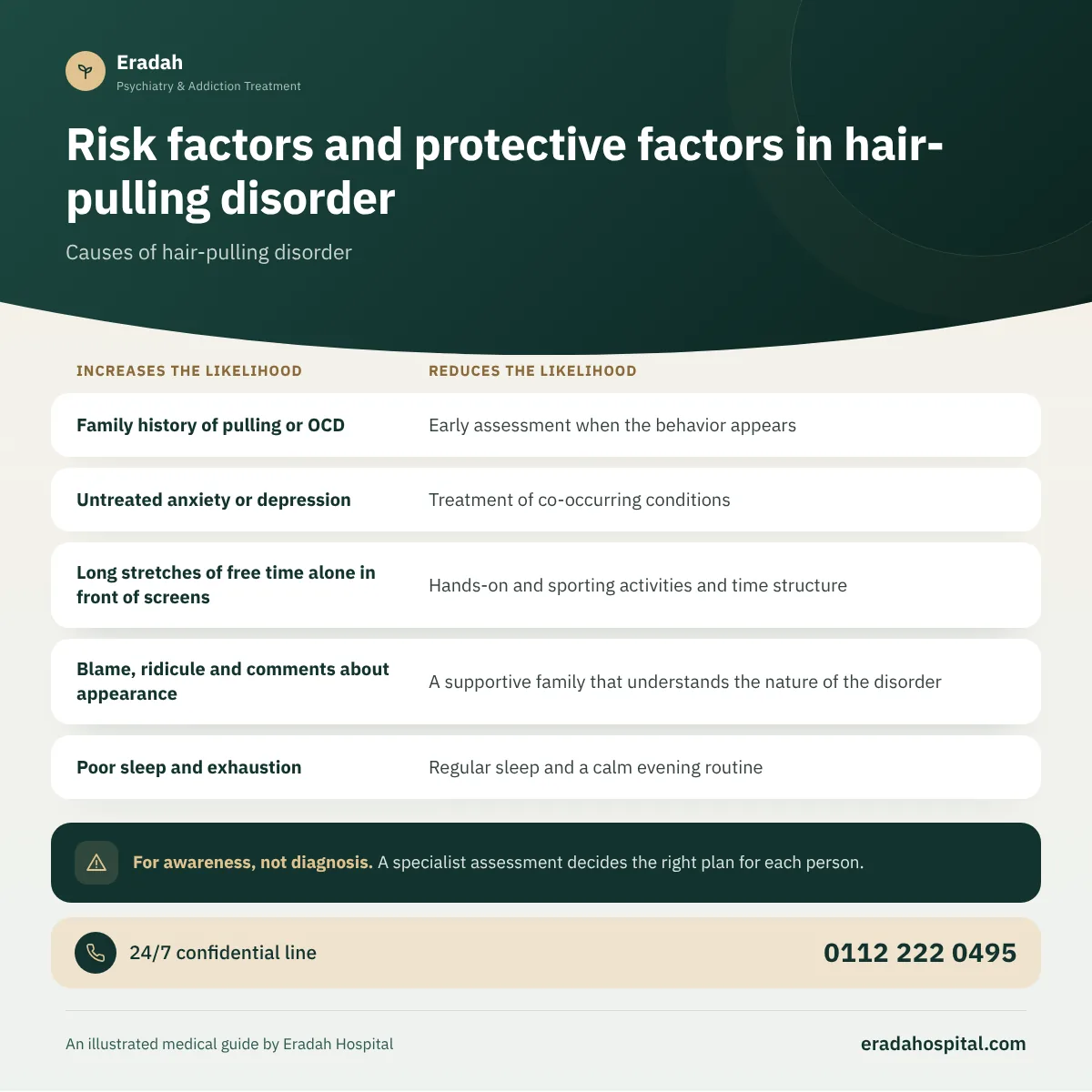
Risk and protective factors in hair pulling
| Increases the likelihood | Reduces the likelihood |
|---|---|
| Family history of pulling or OCD | Early assessment when the behavior appears |
| Untreated anxiety or depression | Treatment of co-occurring conditions |
| Long stretches of free time alone in front of screens | Hands-on and sporting activities and time structure |
| Blame, ridicule and comments about appearance | A supportive family that understands the nature of the disorder |
| Poor sleep and exhaustion | Regular sleep and a calm evening routine |
Common myths about the causes of pulling
- “It is necessarily caused by psychological trauma”: some patients have been through trauma, but many have not been through any obvious trauma.
- “It is caused by poor parenting”: the disorder appears in stable, loving families, and blaming parents helps no one.
- “It is caused by a vitamin deficiency”: there is no evidence for this, although the doctor may order tests to rule out other causes of hair loss.
- “They do it to get attention”: most patients put great effort into hiding it.
Understanding what drives pulling prepares the ground for treatment; you will find the proven steps and methods on the page about ways to overcome it.