What is trichotillomania?
Trichotillomania, known in Arabic as "hawas natf al-sha'r" and medically as Trichotillomania, is a disorder in which a person feels a strong, recurring urge to pull out their hair, followed by a sense of relief or satisfaction, and then often regret and shame when they see how it affects their appearance.
Hair may be pulled from the scalp, which is the most common site, or from the eyebrows or eyelashes, and sometimes from other parts of the body. With repetition, bald or thinned patches appear, and the person may try to hide them with particular hairstyles, head coverings or makeup, living with constant worry that someone will notice.
The word "hawas" (literally "mania") in the Arabic name may suggest madness, but this is not the case. A person with this disorder is an ordinary person in every other area of life, struggling with a behavior that is hard to stop, and needs understanding and treatment, not ridicule or blame.
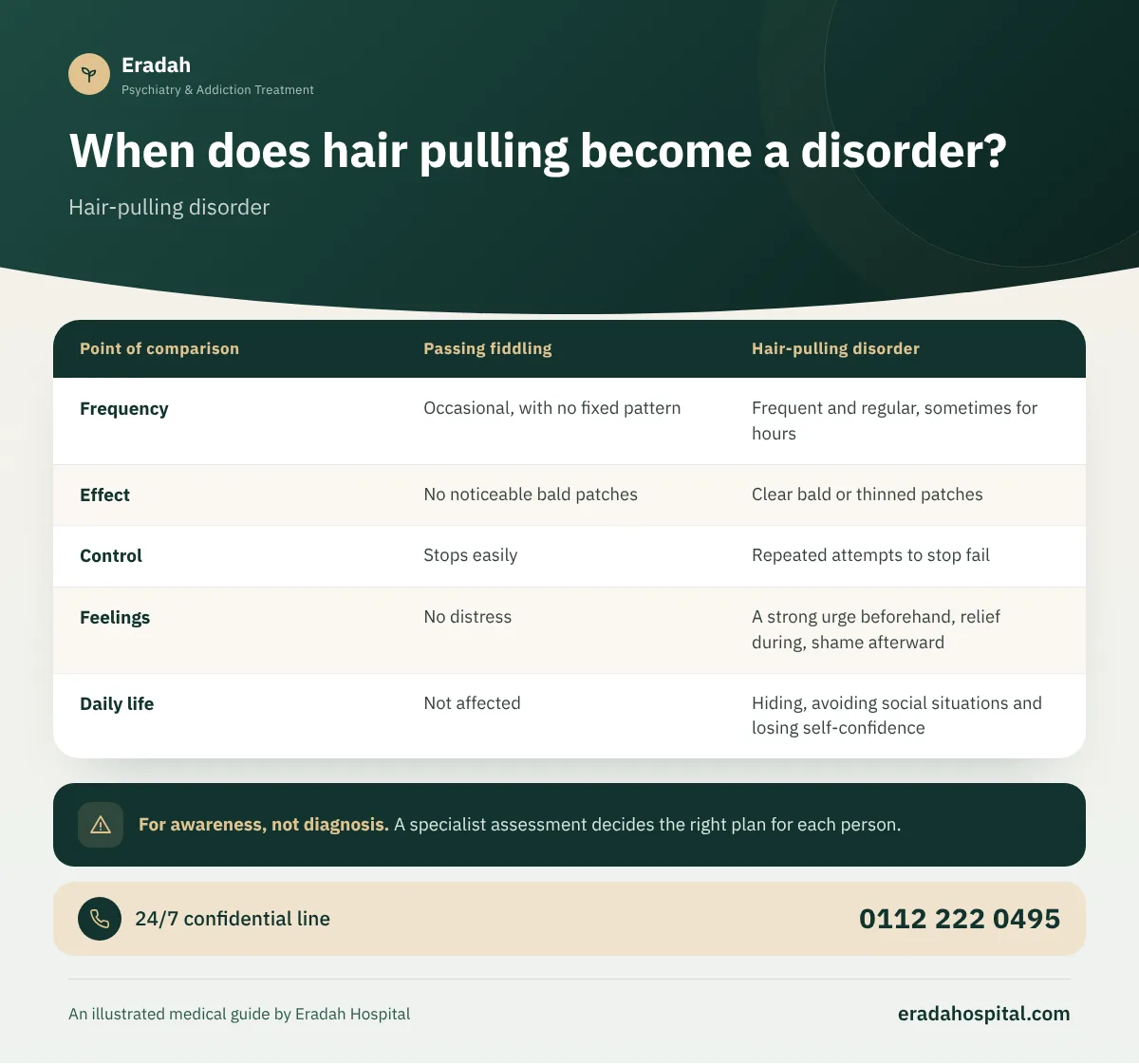
When does hair pulling become a disorder?
Many people fiddle with their hair or occasionally pull out a gray strand, and that is not a disorder. The behavior becomes a disorder when three things come together: repeated pulling that leads to noticeable hair loss, repeated unsuccessful attempts to stop, and clear distress or disruption in daily life, once skin and other medical causes of hair loss have been ruled out.
| Point of comparison | Passing fiddling | Hair-pulling disorder |
|---|---|---|
| Frequency | Occasional, with no fixed pattern | Frequent and regular, sometimes for hours |
| Effect | No noticeable bald patches | Clear bald or thinned patches |
| Control | Stops easily | Repeated attempts to stop fail |
| Feelings | No distress | A strong urge beforehand, relief during, shame afterward |
| Daily life | Not affected | Hiding, avoiding social situations and losing self-confidence |
How do doctors classify it, and why is it linked to OCD?
In the international classification ICD-11, trichotillomania has the code 6B25.0 within the group of "body-focused repetitive behavior disorders," which also includes skin-picking disorder and falls under obsessive-compulsive and related disorders. The American manual DSM-5 places it in the same category under the name "trichotillomania (hair-pulling disorder)."
It is linked to obsessive-compulsive disorder (OCD) through some shared brain and genetic mechanisms, and the two occur together in a considerable share of patients, but they are different: in OCD the behavior usually serves to relieve a distressing thought, whereas hair pulling responds to an urge or a sensation and sometimes brings real satisfaction. That is why treatment differs in its details.
How common is trichotillomania?
Because many people hide the problem out of shame, the true numbers are likely higher than studies record. There are no documented Egyptian statistics, but psychiatrists and dermatologists see these cases regularly.
What does trichotillomania look like?
Doctors describe two main patterns of pulling, and they often occur together in the same person:
Happens without awareness while reading, studying, watching screens or before sleep, and the person notices only after seeing the pulled hair.
Happens with awareness, in response to a strong urge or tension, or to a feeling that a particular hair is the "wrong" texture or shape.
The scalp first, then the eyebrows and eyelashes, and it can involve other areas of the body.
The person may examine the pulled hair, play with it or chew it, and pulling may continue for minutes or hours.
What complications can trichotillomania cause?
- Hair loss: noticeable bald patches, which may become permanent in some areas after years of repeated pulling if the follicles are damaged.
- Skin problems: irritation, redness and infections of the scalp, and scarring with long-term pulling.
- Swallowing hair: some patients chew or swallow hair, which can form a hairball in the stomach or intestines, causing pain, vomiting and obstruction, and requiring surgery.
- Recurring pain in the fingers, neck or shoulder from repeated postures while pulling.
- Psychological and social impact: shame, lower self-esteem, and avoiding swimming, shaving, social occasions or close relationships.
Trichotillomania in children
Pulling can appear in very young children, and it is often temporary and fades with growth, especially if parents handle it calmly without too much focus. When it starts at school age or near puberty, it tends to persist and deserves early assessment, because early intervention is linked to better outcomes. Above all, the child needs to know they are not "bad" and that many others go through the same thing.
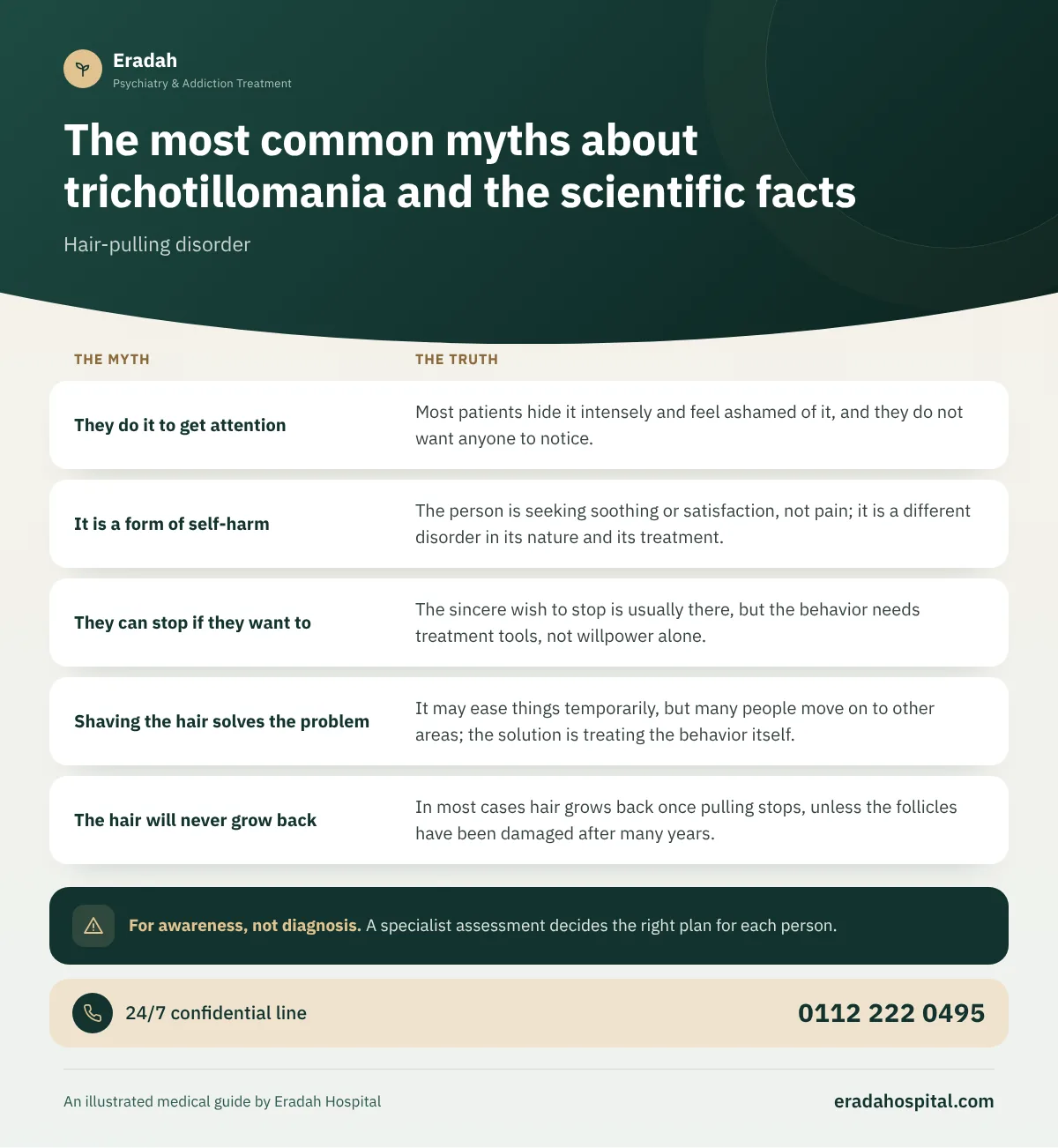
Myths and facts about trichotillomania
| The myth | The truth |
|---|---|
| They do it to get attention | Most patients hide it intensely and feel ashamed of it, and they do not want anyone to notice. |
| It is a form of self-harm | The person is seeking soothing or satisfaction, not pain; it is a different disorder in its nature and its treatment. |
| They can stop if they want to | The sincere wish to stop is usually there, but the behavior needs treatment tools, not willpower alone. |
| Shaving the hair solves the problem | It may ease things temporarily, but many people move on to other areas; the solution is treating the behavior itself. |
| The hair will never grow back | In most cases hair grows back once pulling stops, unless the follicles have been damaged after many years. |
How can the family support someone who pulls their hair?
The family's reaction makes a big difference. Repeated comments about appearance, constant monitoring and phrases like "leave your hair alone!" increase tension and shame, and tension increases pulling. It is more helpful for the family to understand that the behavior is not a choice, to encourage treatment, to praise effort, and to help conceal bald patches without making them a constant topic of conversation.
When do you need a specialist assessment?
- Noticeable bald patches have appeared in your hair, eyebrows or eyelashes.
- You have tried to stop more than once without success.
- Pulling makes you feel ashamed or makes you avoid social situations.
- It comes with anxiety, sadness or other repetitive behaviors such as skin picking or nail biting.
- There is chewing or swallowing of hair, and here a medical examination is needed even without symptoms.
The path may begin with a dermatologist to rule out other causes of hair loss, followed by a doctor or psychotherapist to treat the behavior itself.
Trichotillomania guide: everything you need to know
We have gathered everything about trichotillomania in 2 pages, each answering one question in detail. Choose what you are looking for:
Causes of hair-pulling disorder
How genetics, the brain and hormones interact with stress, boredom, sensory factors and perfectionism to produce pulling, why it often starts near puberty, and its everyday triggers.
Treatment of trichotillomania
Habit reversal training, comprehensive behavioral therapy and acceptance and commitment therapy, practical tools, the role of medication, helping children, and hair regrowth.
Swallowing hair with abdominal pain? Seek urgent medical care
- Persistent or severe abdominal pain in a person who swallows or chews hair
- Repeated vomiting, or feeling full quickly, loss of appetite and unexplained weight loss
- Abdominal swelling or a lump that can be felt in the upper abdomen
- Severe constipation or being unable to pass stool, with pain
- Severe despair or thoughts of self-harm because of shame about appearance
Swallowing hair can form a mass in the stomach or intestines that needs medical intervention, so do not wait and do not try home remedies: go to the nearest emergency room or call an ambulance (123), and tell the doctor plainly that the person swallows hair. If there is severe despair or thoughts of self-harm, stay with them and call the mental health support line 16328.
Ambulance 123 Mental health support line 16328