Can hair-pulling disorder be treated?
Yes. Although hair-pulling disorder may go through periods of improvement and relapse, behavioral therapy gives most patients far better control over the behavior, reduces pulling, lets the hair grow back, and eases the shame and isolation that come with it.
The realistic goal of treatment is to regain control and reduce pulling to a minimum or stop it, with skills ready for periods of stress. Therapists know that progress does not run in a straight line, which is why the plan is built on patience and follow-up, not quick promises.
The starting point: self-monitoring and understanding the pattern
Before any treatment, the therapist usually asks the patient to record every time they pull or feel the urge: the time, the place, the activity, the feeling, the area pulled from, and roughly how many hairs. This log alone reduces pulling in some people because it raises awareness, and it shows that most pulling is concentrated in specific situations that can be dealt with.
Habit reversal training: the main technique in treatment
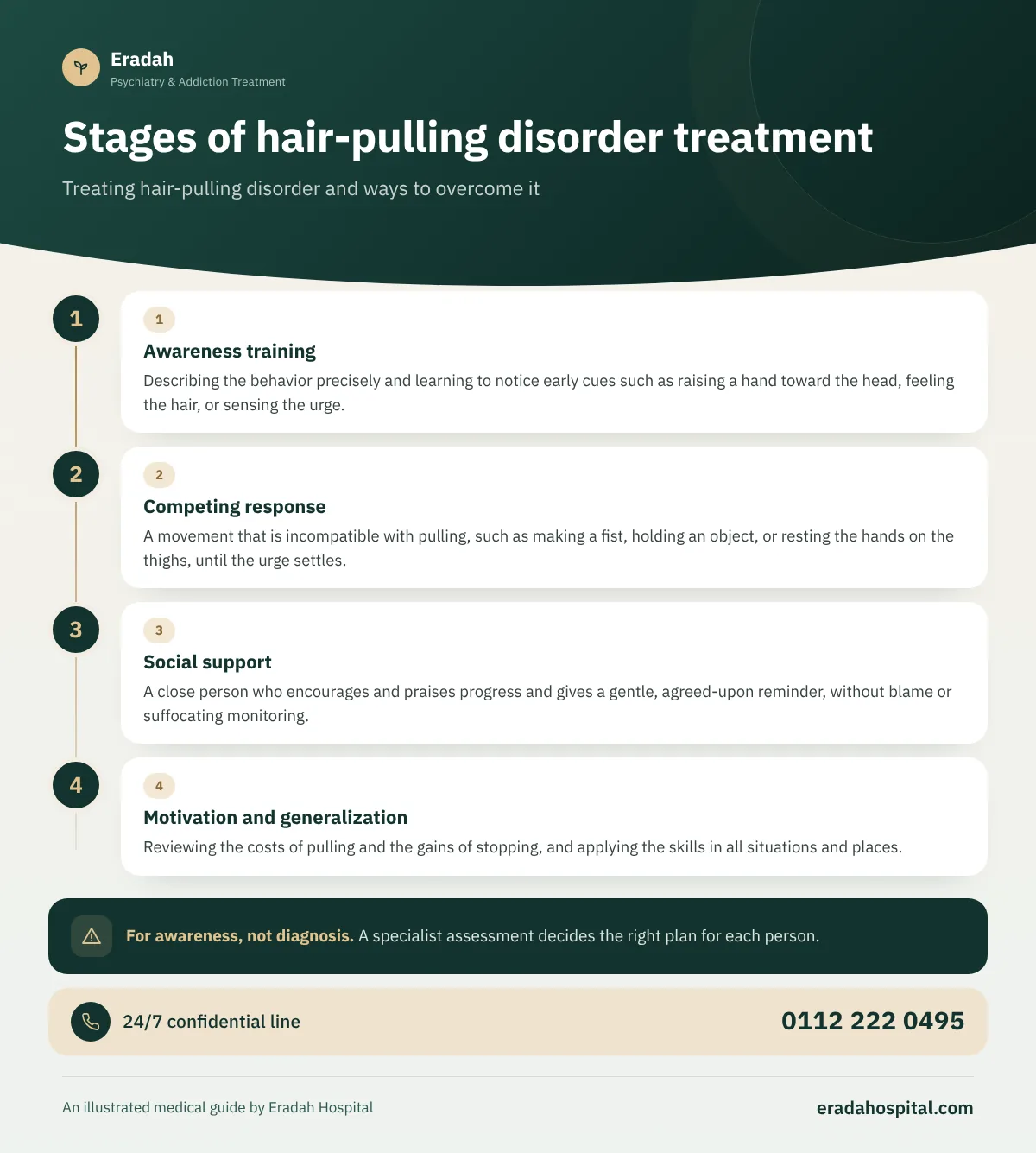
The UK’s National Health Service describes habit reversal training as the main type of cognitive behavioral therapy used for hair-pulling disorder, a low-risk treatment whose effectiveness has been shown in studies. It consists of:
- 1Awareness training
Describing the behavior precisely and learning to notice early cues such as raising a hand toward the head, feeling the hair, or sensing the urge.
- 2Competing response
A movement that is incompatible with pulling, such as making a fist, holding an object, or resting the hands on the thighs, until the urge settles.
- 3Social support
A close person who encourages and praises progress and gives a gentle, agreed-upon reminder, without blame or suffocating monitoring.
- 4Motivation and generalization
Reviewing the costs of pulling and the gains of stopping, and applying the skills in all situations and places.
Comprehensive behavioral therapy (ComB)
Comprehensive behavioral therapy approaches pulling from five angles: sensory (what sensation is the person looking for?), cognitive (what thoughts come before or justify pulling?), affective (what feelings are tied to it?), motor (what postures make it easier?), and place (where does it happen?). The therapist then chooses suitable tools for each angle with the patient, so treatment is tailored to their own pattern.
Acceptance and commitment therapy and emotion regulation
Acceptance and commitment therapy adds an important skill: noticing the urge without obeying it. Instead of fighting the urge or fearing it, the person learns to see it as a wave that rises and then falls, and chooses how to act according to what matters to them. Studies have shown that combining this therapy with habit reversal training improves outcomes in some patients, especially those whose pulling is tied to strong emotions.
Emotion regulation skills such as slow breathing, muscle relaxation and naming the feeling are also useful, because they offer alternatives to the soothing that pulling used to provide.
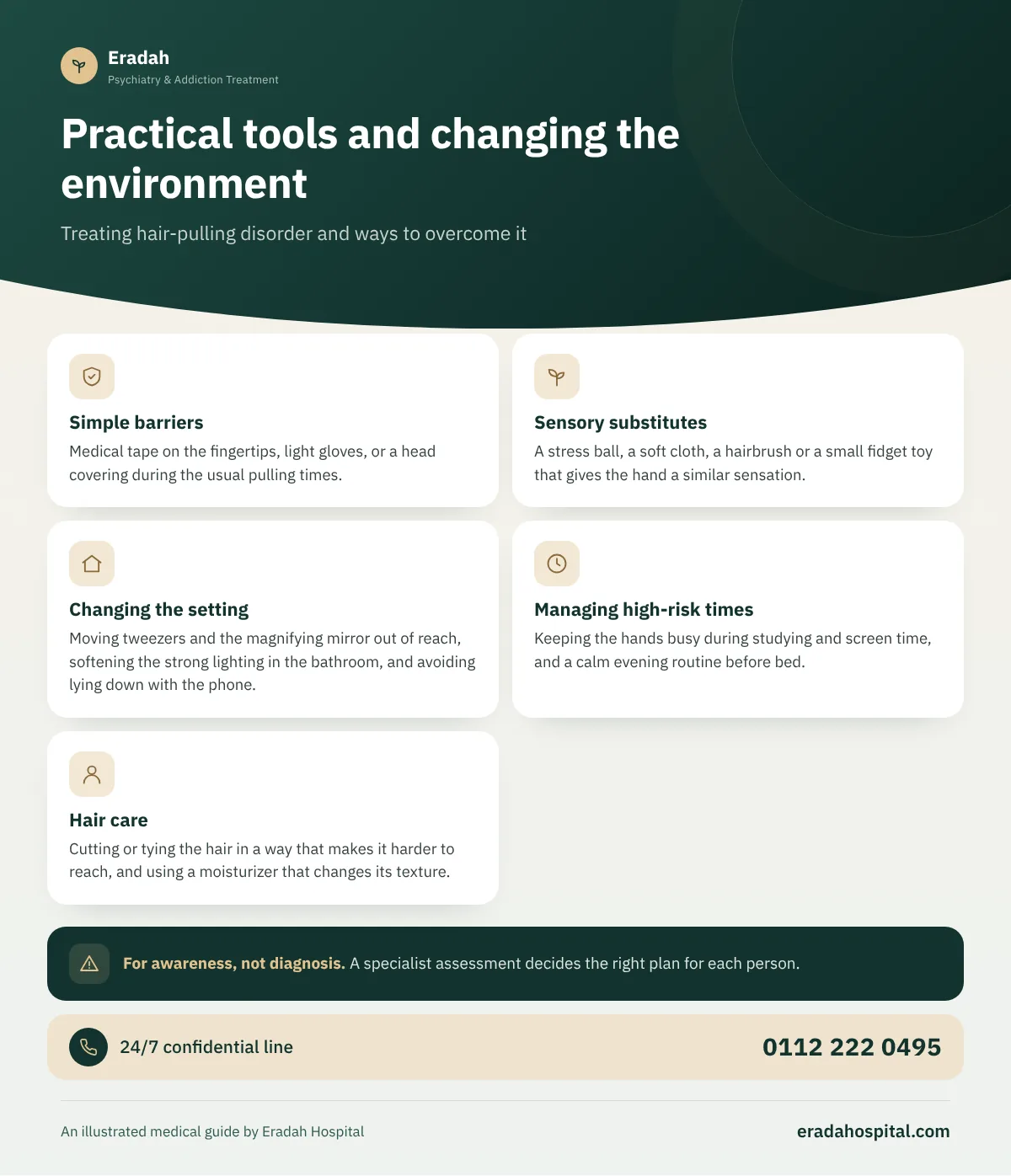
Practical tools and changing the environment
Medical tape on the fingertips, light gloves, or a head covering during the usual pulling times.
A stress ball, a soft cloth, a hairbrush or a small fidget toy that gives the hand a similar sensation.
Moving tweezers and the magnifying mirror out of reach, softening the strong lighting in the bathroom, and avoiding lying down with the phone.
Keeping the hands busy during studying and screen time, and a calm evening routine before bed.
Cutting or tying the hair in a way that makes it harder to reach, and using a moisturizer that changes its texture.
Are there medications to treat hair-pulling disorder?
No medication is approved specifically for hair-pulling disorder, and behavioral therapy has a stronger effect than medication in studies. Several medications have been studied with mixed results, including N-acetylcysteine (NAC), which showed benefit in a study of adults but not children, some antidepressants such as serotonin reuptake inhibitors and clomipramine, glutamate modulators such as memantine, and a few other drugs in small studies.
That is why the psychiatrist usually turns to medication as an adjunct, or when anxiety, depression or OCD is also present, after a full assessment and a weighing of benefits and risks. No medication or supplement should be taken for this purpose, or stopped, without medical supervision, especially in children and teenagers.
Treating children and teenagers
With very young children, calm handling by the parents is often enough: reducing excessive attention to the behavior, keeping the hands busy, and simple barriers such as gloves at bedtime. At school age and in adolescence, habit reversal training is used in an age-appropriate form, with parents involved in encouragement and reward, and coordination with the school when needed to protect the child from bullying.
- Make the child a partner in the plan, not an object of monitoring.
- Praise effort and small progress, and do not comment on appearance in front of others.
- Help the child cover the bare patches in comfortable ways if they wish; this eases shame and improves their involvement in treatment.
- Watch for any chewing or swallowing of hair and tell the doctor.
Does hair grow back? And how do you deal with bare patches?
In most cases hair grows back after pulling stops, but it takes months, and it may at first grow in with a slightly different texture. After many years of pulling from the same spot, some follicles may be damaged, and a dermatologist can assess this and suggest what suits. While the hair is growing, it is fine to use cosmetic methods to conceal bare patches, such as certain hairstyles, head coverings or eyebrow products, because they ease shame and support persistence.
Dealing with relapse and periods of pressure
Relapse is common in hair-pulling disorder, especially during exams, periods of pressure or major changes. What matters is that it does not turn into self-blame, which raises stress and then pulling. Review your log to see what has changed, switch the competing response and simple barriers back on, and get in touch with your therapist. Many people find it helpful to join support groups run by specialists, where they discover that they are not alone.
When do you need a specialist for hair pulling?
- Noticeable bare patches have appeared, or your own attempts to stop have failed.
- Pulling affects your studies, work or relationships, or makes you avoid people.
- It comes with anxiety, severe sadness or other repetitive behaviors.
- There is chewing or swallowing of hair, which also needs a medical examination.
- You have thoughts of despair or self-harm; this is urgent, so get help now: 16328 or 123.
Choosing a hospital for hair-pulling disorder treatment
Hair-pulling disorder usually needs neither detox nor a hospital bed; what you are really looking for is a therapist who knows habit reversal training and applies it precisely, not a luxurious building. Confusion is common here: some places treat pulling as a bad habit that advice can fix, and some jump straight to medication, and either way precious time is lost while the bare patches on the scalp, eyebrows or eyelashes widen.
- Who will run the sessions? Are they trained specifically in habit reversal and comprehensive behavioral therapy?
- Does the work begin with a log recording the times and places of pulling and the stress or boredom that comes before it?
- Is the patient asked about chewing or swallowing hair, and referred for an internal medical examination if so?
- Can it be coordinated with a dermatologist to follow hair regrowth?
- If the patient is a child, are the parents trained to encourage rather than blame and monitor?
At Eradah, the plan is led by psychologists in individual sessions, under the medical direction of Dr. Mahmoud El-Sawy, Consultant Psychiatrist and Addiction Specialist, and children and teenagers are seen for assessment, treatment and follow-up with their families present. Most of the work takes place through outpatient clinics and the day program, because home, school and work are the real training ground. To understand what drives the behavior before your first session, read about the causes of hair-pulling disorder.
Hair-pulling disorder treatment at Eradah
At Eradah Psychiatry & Addiction Treatment, hair-pulling disorder treatment begins with a psychological assessment that identifies the pulling pattern, its triggers and any co-occurring anxiety, depression or OCD, with coordination with a dermatologist when needed. We then set up a behavioral plan based on habit reversal training, comprehensive behavioral therapy and acceptance and commitment therapy, involve the family in a supportive way for children and teenagers, and add medication follow-up only when there is a clear justification.