What are the key signs of social media addiction?
Researchers use scales such as the Social Media Disorder Scale adopted by the World Health Organization's survey of adolescents, and the Bergen Social Media Addiction Scale. These scales revolve around a set of core signs that resemble the signs of addiction in general.
| The sign | What it looks like in daily life |
|---|---|
| Preoccupation | Thinking about platforms even when not using them, and waiting for the moment to pick up the phone |
| Tolerance | Needing gradually more time to feel the same satisfaction |
| Withdrawal-type symptoms | Tension, distress or irritability when the internet is down or the phone is withheld |
| Failed cutting down | Repeated attempts to cut back or delete the app, followed by a quick return |
| Displacement of activities | Losing interest in hobbies, sports and get-togethers in favor of scrolling |
| Continuing despite problems | Continuing to use despite arguments, falling grades and lack of sleep |
| Hiding and lying | Downplaying the real time spent in front of family or a partner, and scrolling in secret |
| Escape | Turning to scrolling to get rid of sadness, anxiety or boredom |
| Conflict | Repeated arguments with family or a partner because of use |
In the World Health Organization's survey of adolescents, use was classified as “problematic” when many of these signs were present together, not just one or two. That makes sense: we all get absorbed in our phones at times, but it is the combination of most of these signs over an extended period that calls for attention.
What behavioral signs can you easily notice?
- Opening apps as soon as waking up and right before sleep, and sometimes in the middle of the night.
- Checking the phone every few minutes for no reason or notification, even while talking with others.
- Scrolling on for hours and feeling empty or regretful about the lost time afterward.
- Putting off studying, work, prayer or meals for “just one more minute.”
- Constantly filming and posting every moment, and caring more about views and likes than enjoying the moment.
- Using the phone in inappropriate or dangerous situations, such as while driving or crossing the road.
- Withdrawing from family gatherings, or being there in body only with eyes on the screen.
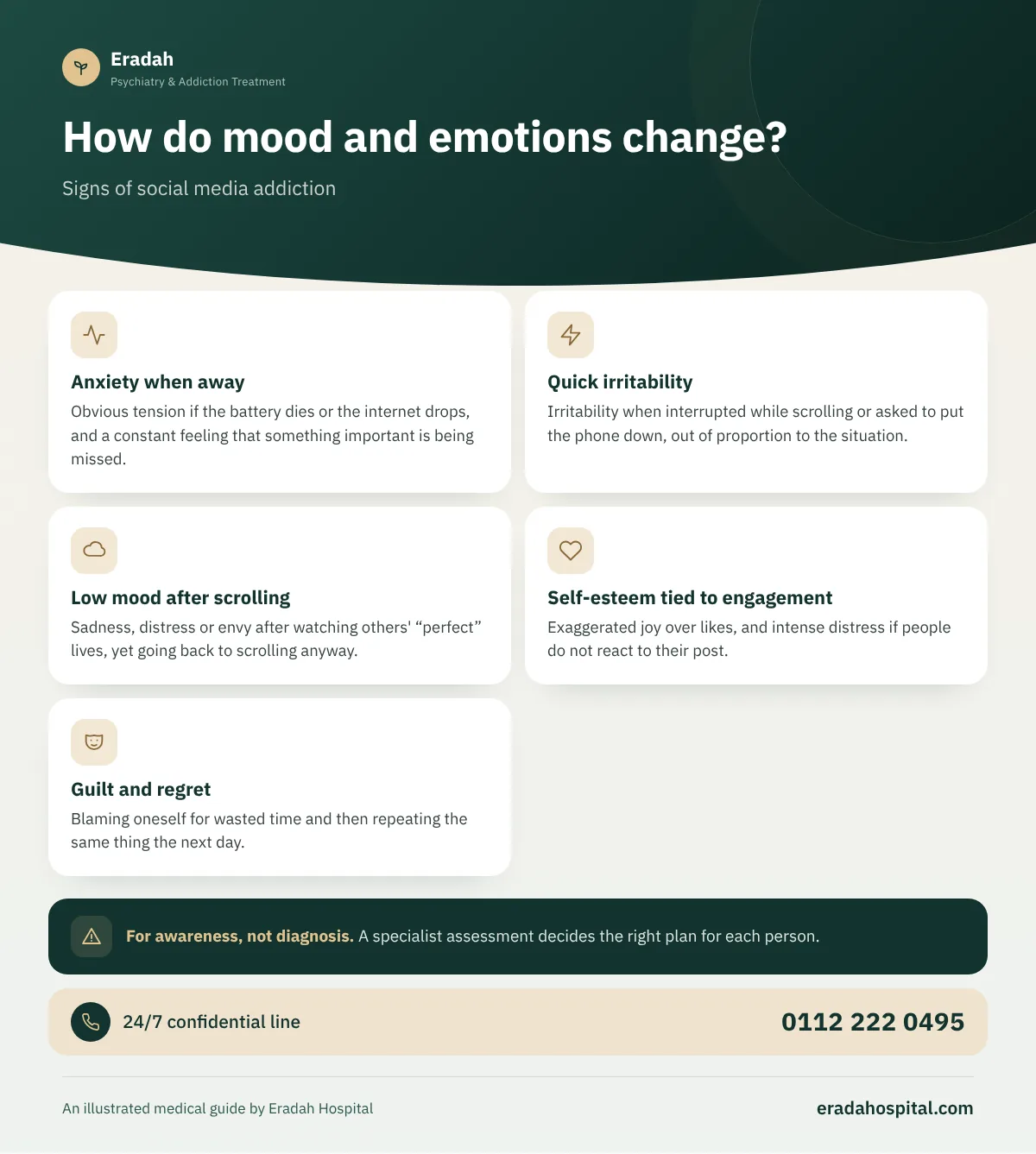
How do mood and emotions change?
Obvious tension if the battery dies or the internet drops, and a constant feeling that something important is being missed.
Irritability when interrupted while scrolling or asked to put the phone down, out of proportion to the situation.
Sadness, distress or envy after watching others' “perfect” lives, yet going back to scrolling anyway.
Exaggerated joy over likes, and intense distress if people do not react to their post.
Blaming oneself for wasted time and then repeating the same thing the next day.
Are there physical signs of social media addiction?
Digital behavior leaves its mark on the body too, and these visible signs help families notice the problem even if the person denies it:
- Dark circles, morning exhaustion and difficulty waking up because of late nights on the phone.
- Sleeping during the day or in class, or falling asleep with the phone in hand.
- Repeated complaints of dry or strained eyes, or headaches.
- Neck and shoulder pain from long hours hunched over the screen.
- Less movement and physical activity than before.
- Eating in front of the screen without paying attention to what is eaten.
These physical signs are not proof on their own, as they may have other causes, but they are worth asking about when they come with the behavioral signs.
How do the signs appear in children and teenagers?
A teenager does not usually say “I'm addicted”; the problem shows up in daily life. Signs worth a parent's attention include:
- Tantrums or intense crying when the phone is taken or limited, beyond ordinary refusal.
- A sudden drop in grades and concentration, or repeated lateness to school in the morning.
- Staying up late in secret under the covers with the phone.
- Excessive preoccupation with looks, photos and filters, and negative comments about their body or appearance.
- A sudden change of mood after using the phone, or hiding the screen when someone approaches.
- Giving up sports and real-life friends and settling for the virtual world.
And what are the signs in adults?
In adults the problem may seem “socially acceptable” because it is so widespread that no one notices it. Its signs include lower productivity at work from constantly switching between apps, neglecting conversation with a partner and children, staying up every night watching short clips, following news and arguments in a way that raises stress, and feeling that the day ended without real accomplishment.
Many spouses complain that the other partner is “present but absent,” sitting with the family with eyes on the screen. This may be the first thing that leads a person to admit there is a problem.
Self-assessment questions about your relationship with social media
- Over the past year, have you tried to cut back on social media and failed more than once?
- Do you feel distressed or irritable when you cannot get on?
- Do you often use it to escape negative feelings or thinking about your problems?
- Have you neglected your sleep, study, work or hobbies because of it?
- Have you lied to your family or partner about the time you spend on it?
- Has it caused repeated arguments with people you love?
- Do you often feel worse after scrolling than you did before?
If you find yourself answering yes to several of these questions, start with the practical steps on the page about treating social media addiction, and if they come with persistent sadness or severe anxiety, consult a specialist.
How can a family start the conversation with a son or partner?
An angry confrontation or suddenly taking away the phone often backfires: stubbornness, hiding and lying. A calm conversation at a suitable time, away from a moment of conflict, is better:
- Start with an observation, not an accusation: “I noticed you've been going to bed very late and can't concentrate, and I'm worried about you.”
- Ask about their experience: what do they like about platforms? What bothers them? Are they being harassed?
- Acknowledge your own part too if you overuse your phone; this makes the conversation fair.
- Agree together on one small, doable step instead of a long list of prohibitions.
- If signs of severe sadness, isolation or talk of death appear, the priority is to seek specialist help immediately.
Bullying, online blackmail or suicidal thoughts? Get help now
- Talk of wanting to die, of life being meaningless, or of being a "burden" on the family
- A sudden collapse after a message, post or online scandal, or intense fear of private photos or information being published
- Complete withdrawal from family and friends and suddenly deleting accounts, with clear sadness or hopelessness
- Self-harm or talk of it, or saying goodbye to people and giving away personal belongings
- Sleeplessness for several days in a row with agitation or severe hopelessness
Do not leave the person alone; ask calmly what they are going through and listen without blame or violently confiscating the phone. In cases of blackmail, do not pay and do not delete the messages; keep the evidence and report it to the competent authorities. If thoughts of self-harm appear, call an ambulance on 123 or take them to the nearest emergency room, or call the mental health support line 16328 (24 hours).
Ambulance 123 Mental health support line 16328