Why is it so hard to leave social media?
There is no single cause of social media addiction. The picture closest to reality is three overlapping circles: a platform designed to capture attention, a brain that naturally seeks reward and social acceptance, and psychological and social circumstances that make escaping into the screen easier than facing reality.
That is why two people can use the same platform for roughly the same amount of time, and one stays in control while the other falls into a compulsive cycle. The difference comes from the combination of factors explained on this page, and “willpower” is only one of them.
How does platform design draw us in?
Platforms rely on an attention-based business model: the longer you stay, the more ads you see. So interfaces are carefully designed to reduce natural moments of pause. Here are the main mechanisms, explained for understanding and awareness:
There is no “end of the page” to invite you to stop, so content continues without limit and the brain loses its signal of having had enough.
Every interaction is a small social reward, and because it arrives unpredictably it becomes stronger at locking in the behavior.
They constantly interrupt you and pull you back to the app, and their color and sound are designed to grab your attention instantly.
The next clip starts on its own before you decide, so continuing becomes the default.
They learn exactly what holds your attention and serve you more of it, so the content feels tailor-made for you.
Such as stories that disappear within a day or daily interaction streaks, which create a sense that you must log in right now.
What is the role of the brain and dopamine?
The dopamine system is more active when anticipating a reward than when receiving it, which is why the “suspense” before opening a notification is so tempting. With repetition, the brain links certain cues, such as boredom, the sound of a notification or simply seeing the phone, to opening the app, and the behavior becomes an almost automatic habit.
The US Surgeon General's advisory noted that early adolescence, roughly ages 10 to 19, is a sensitive period of brain development: sensitivity to social reward and the desire for peer approval increase, while the regions that control impulses have not yet matured. This combination explains why teenagers find it harder to stop.
What are the psychological causes of compulsive scrolling?
Much compulsive scrolling is less a search for pleasure than an escape from an uncomfortable feeling. The app offers quick numbing of boredom, anxiety or sadness, and then the feeling returns stronger after it is closed. The most important psychological factors include:
| Factor | How it drives compulsive scrolling |
|---|---|
| Depression | Looking for any source of pleasure or distraction, with difficulty doing activities that take energy |
| Anxiety | Constantly checking the phone to relieve tension, and fear of missing news or messages |
| Social anxiety | Communicating from behind a screen is easier than face-to-face contact, so real-life connection gradually declines |
| Attention-deficit/hyperactivity disorder | Attraction to fast, novel stimuli and difficulty stopping an enjoyable activity |
| Loneliness | Trying to make up for lost relationships with virtual interaction that does not meet the need |
| Low self-esteem | Seeking appreciation through likes, comments and followers |
| Boredom and empty time | Filling every empty moment with the phone, so the person loses the ability to tolerate boredom |
The relationship often runs in both directions: anxiety and depression push people toward excessive use, and excessive use increases anxiety and depression, creating a vicious circle that needs to be broken from both sides.
What is the role of comparison and fear of missing out?
The fear of missing out, known in English as FOMO, is an anxious feeling that others are having enjoyable experiences or know important news while you are absent. This feeling drives constant checking and makes staying away from the phone a source of tension.
Social comparison is a natural human tendency, but platforms amplify it: we compare our real lives, with everything in them, against selected and edited snapshots of other people's lives. With each comparison the feeling of inadequacy grows, so the person returns to scrolling for reassurance or distraction, and then compares again.
How do family and environment contribute?
- Parents as role models: children learn from how their parents behave with their phones more than from their advice.
- Lack of rules: no screen-free times or places, especially the bedroom and the dining table.
- Free time and few alternatives: limited opportunities for sports, activities and safe get-togethers make the phone the only entertainment.
- Family conflict: a tense home pushes children to withdraw into their virtual world.
- Peer pressure: the fear of being the only one who is not in the friends' group or is not keeping up with what they share.
- An early, unsupervised phone: having accounts at a young age, before self-regulation skills have developed.
What triggers a scrolling binge?
It helps to distinguish between the factors that make a person vulnerable to the problem and the triggers that set off a long scrolling session at a particular moment. Among the most common triggers are boredom during commutes or waiting, stress before a difficult task such as studying, loneliness at night, insomnia, the sound of a notification, and even just having the phone in view. Knowing your personal triggers is the first step toward changing them.
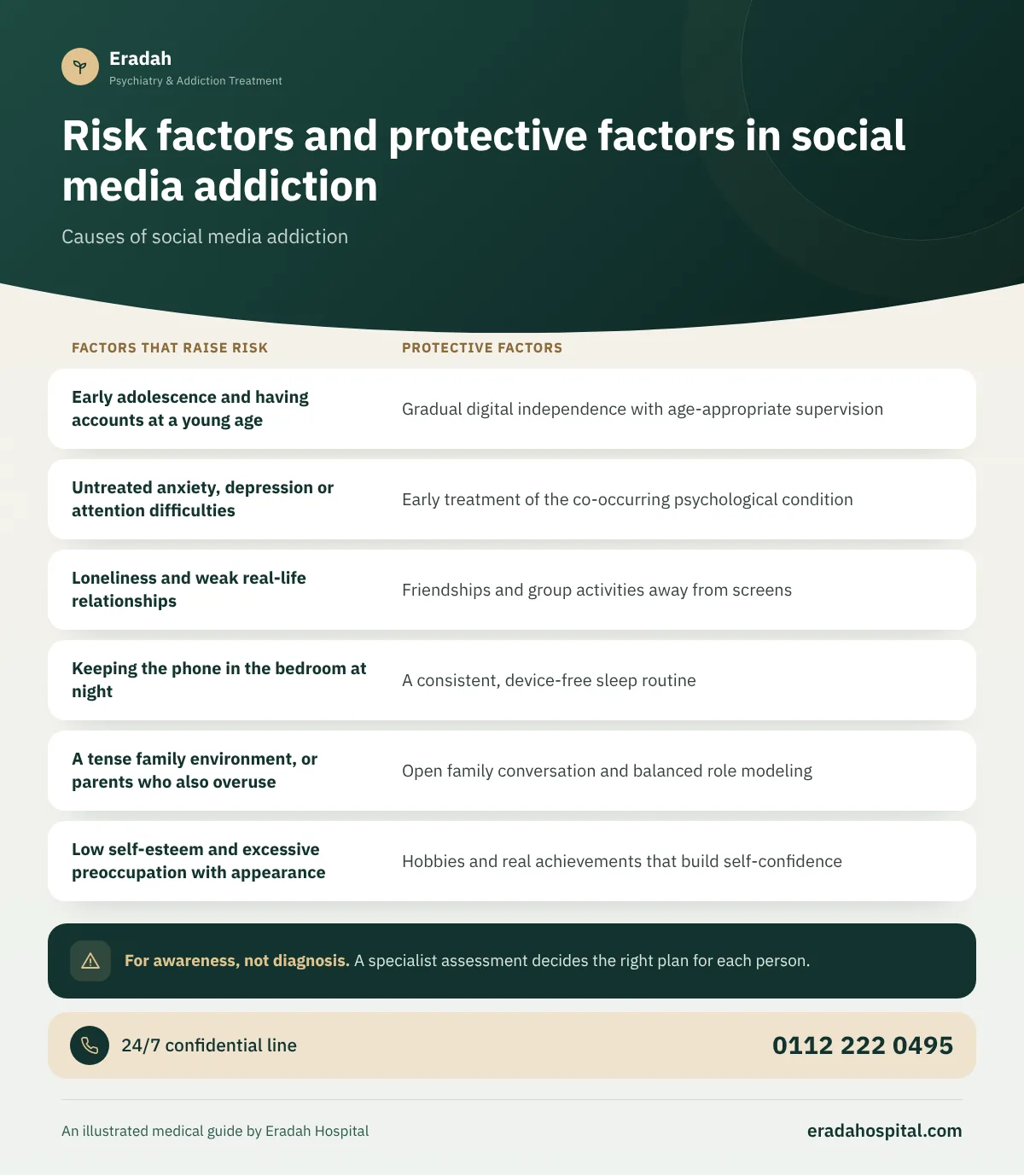
What are the risk and protective factors in social media use?
| Factors that raise risk | Protective factors |
|---|---|
| Early adolescence and having accounts at a young age | Gradual digital independence with age-appropriate supervision |
| Untreated anxiety, depression or attention difficulties | Early treatment of the co-occurring psychological condition |
| Loneliness and weak real-life relationships | Friendships and group activities away from screens |
| Keeping the phone in the bedroom at night | A consistent, device-free sleep routine |
| A tense family environment, or parents who also overuse | Open family conversation and balanced role modeling |
| Low self-esteem and excessive preoccupation with appearance | Hobbies and real achievements that build self-confidence |
Myths about the causes of social media addiction
- “It's poor parenting”: Overuse affects children of very attentive families too, because the design itself is powerful and its appeal is universal.
- “It's only the phone”: The phone is a tool; the deeper cause is often feelings or circumstances the person is trying to escape.
- “If you know it's a waste of time, you won't get hooked”: Knowledge alone is not enough; most people who struggle know the harm well and wish they could change.
We understand the causes in order to choose the right solution, not to look for someone to blame. The practical and therapeutic steps are on the page about treating social media addiction.