What is work addiction?
The only addiction whose sufferer gets a promotion because of it. The manager praises it, the family is sometimes proud of it, and the person quietly loses sleep, health and family. Because it does not look like a "problem", many people discover it late.
Researchers describe work addiction as a pattern similar to behavioral addiction in general: constant preoccupation with work, a need to work more and more, using it to soothe feelings, tension when prevented, and failed attempts to cut down, despite clear harm. In a study of a representative sample of employees in Norway, the criteria for work addiction applied to about 8% of them.
The difference between hard work and work addiction
| The hard worker | The person addicted to work |
|---|---|
| Works a lot because they love their work | Works because they cannot stop |
| Enjoys vacation and rests during it | Gets tense on vacation and keeps checking on work |
| Knows when enough is enough | No achievement is ever enough |
| Balances work and life | Work eats up sleep, family and health |
| Accepts mistakes | Perfectionism and intense fear of failure |
Signs of work addiction
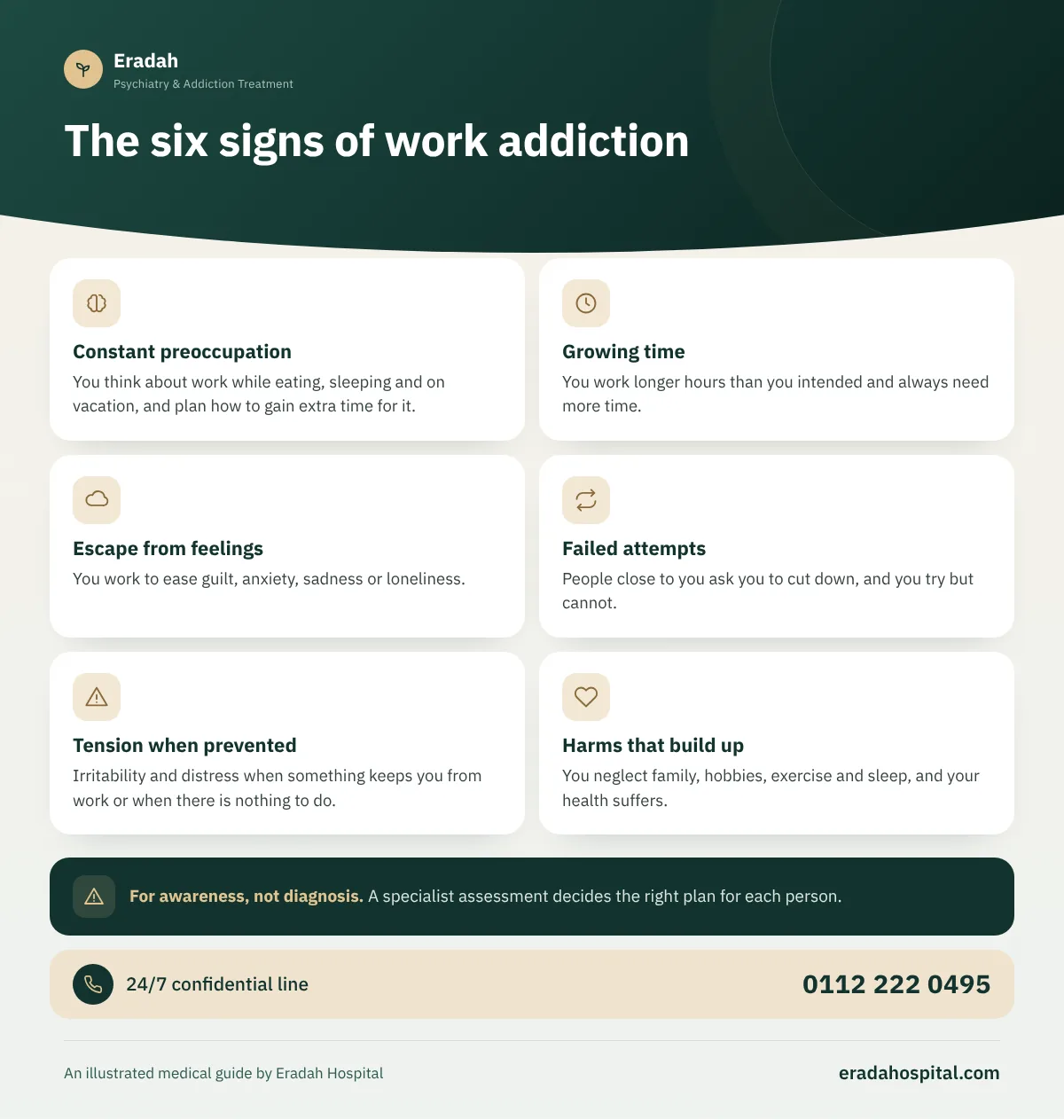
You think about work while eating, sleeping and on vacation, and plan how to gain extra time for it.
You work longer hours than you intended and always need more time.
You work to ease guilt, anxiety, sadness or loneliness.
People close to you ask you to cut down, and you try but cannot.
Irritability and distress when something keeps you from work or when there is nothing to do.
You neglect family, hobbies, exercise and sleep, and your health suffers.
Causes of work addiction
- Perfectionism and tying self-worth to achievement alone.
- Anxiety: work gives a sense of control and keeps the mind off fears.
- Escape: from marital problems, loneliness or sadness.
- An upbringing in which love was conditional on excelling.
- A work culture that rewards constant presence and replying at all hours.
- Financial pressures that turn over time into a fixed pattern.
A large study found that people addicted to work are more likely to have symptoms of attention-deficit/hyperactivity disorder, obsessive-compulsive disorder, anxiety and depression, which means work addiction can sometimes be a way of coping with an undiscovered disorder.
Harms of work addiction
- Chronic exhaustion that leads to burnout.
- Insomnia and lack of sleep, with the poor concentration that follows.
- High blood pressure and heart and stomach symptoms linked to stress.
- Marital problems and absence from the children's lives.
- Social isolation and loss of hobbies and friends.
- Relying on stimulants by day and sedatives or alcohol by night.
Treatment of work addiction
- Admitting the problem: ask your family honestly what they think about your working hours.
- Clear time limits: a set time to finish work, and a real day of rest each week.
- Disconnecting devices: turn off email and work group notifications after a set time.
- Scheduling rest the way you schedule meetings: exercise, family and a hobby.
- Delegating tasks and accepting that "good enough" is sometimes enough.
- Cognitive behavioral therapy: to adjust perfectionist thoughts and views of self-worth, and to treat anxiety, depression or hyperactivity if present.
Breakdown or suicidal thoughts because of work pressure? Get help now
- Chest pain or tightness, or severe palpitations with exhaustion and lack of sleep
- Talk of death or of life being meaningless after a failure or loss at work
- Repeated panic attacks or a sudden breakdown and inability to do the simplest tasks
- Excessive use of stimulants, sedatives or alcohol to keep going or to sleep
For chest pain or fainting, call an ambulance on 123 immediately. If hopelessness or talk of death appears, do not leave the person alone; ask them calmly and frankly about their thoughts and listen without blame, because asking does not plant the idea; it opens the door to help. Call the mental health support line 16328, available around the clock, or take them to the nearest emergency room, and keep away from them medications and anything they could use to harm themselves.
Ambulance 123 Mental health support line 16328