What are behavioral addictions?
A cigarette with morning coffee, a small bet on a match, or a shopping trip after a tiring day. These are ordinary acts that many people do without any problem. But in some people the act turns into an urgent need, is repeated more than planned, and continues even though they know full well they are losing their health, their money or their family's trust.
We have grouped five behaviors in this family that are linked by one pattern: a strong craving, then an act that brings temporary relief or excitement, then regret or loss, then a new craving to soothe the regret itself. This loop is what makes stopping hard even with a sincere intention.
An important difference within the family is that smoking is an addiction to a chemical substance, nicotine, mixed with daily habits and rituals, while gambling and compulsive shopping are purely behavioral, with no substance entering the body. The same goes for masturbation, which is not a disease in itself but can become a compulsive pattern, while food addiction revolves around food itself and is often tied to emotional eating. Even so, all of these patterns tap into the brain's reward system in a similar way.
What mechanisms do smoking, gambling and compulsive shopping share?
Nicotine reaches the brain within seconds, a bet gives instant excitement, and shopping gives an instant sense of feeling better.
After the act come guilt or loss, and the person returns to the same behavior to calm it.
Places, times, people and feelings linked to the behavior, which set off the craving automatically.
Many people use the behavior to soothe anxiety, sadness or boredom, not for pleasure alone.
Cigarettes are available everywhere, and betting and shops have moved onto the phone, day and night.
Gambling adds a special element, chasing losses: the belief that the next bet will make up for what was lost, a way of thinking that pushes a person to carry on and borrow. Nicotine adds physical and psychological withdrawal symptoms such as irritability, difficulty concentrating and intense cravings, which is why the first hours and days of quitting are the hardest.
Types of behavioral addictions
Each behavior in this family has a full guide and separate pages on its signs, causes, harms and treatment. Here is a short card for each:
Smoking and nicotine addiction
Nicotine dependenceAlso known as: Cigarettes, vaping
Nicotine is among the substances most likely to cause dependence, and quitting is possible with a plan that combines psychological support and medical alternatives.
- Medical recognition
- Official diagnosis: nicotine use disorder in ICD-11 and DSM-5-TR
- How common
- About 1.2 billion tobacco users worldwide
- Most affected group
- Teenagers, with onset often before age 20
- Addiction potential
Very high
When should you seek help? Any time you decide to quit; medical support multiplies the chances of success, and immediately if you have chest pain.
Gambling and betting addiction
Gambling disorderAlso known as: Online betting
A recognized disorder involving chasing losses, lying and debt, which has spread with betting apps.
- Medical recognition
- Official diagnosis in ICD-11 and DSM-5-TR (gambling disorder)
- How common
- About 1.2% of adults worldwide
- Most affected group
- Young males, and rising with betting on mobile phones
- Addiction potential
Very high
When should you seek help? When chasing losses, borrowing or lying to the family, and immediately if there are any thoughts about death.
Compulsive shopping
Compulsive buyingAlso known as: Shopping addiction
Repeated buying driven by stress rather than need, followed by guilt and financial and family problems.
- Medical recognition
- Not a separate diagnosis; included under other impulse control disorders in ICD-11
- How common
- Not precisely known, and estimated to affect a small proportion of adults
- Most affected group
- Young people and adults, often together with anxiety or depression
- Addiction potential
Moderate
When should you seek help? If you repeatedly spend to escape stress and then regret it, or if debts you hide from your family have piled up.
Masturbation
Compulsive masturbationAlso known as: Compulsive self-stimulation
A common behavior that is not a disease in itself, but can become compulsive, hard to control, and cause distress and disruption to life.
- Medical recognition
- Not a disease in itself; a severe compulsive pattern may fall under compulsive sexual behavior disorder in ICD-11
- How common
- A very common behavior, while the compulsive pattern affects a small proportion
- Most affected group
- Teenagers and young people, and those with anxiety or loneliness
- Addiction potential
Moderate
When should you seek help? If your attempts to control it have failed and it disrupts your sleep, studies or relationships, or you are overwhelmed by guilt or despair.
Food addiction
Food addiction / emotional eatingAlso known as: Emotional eating
Eating out of stress or boredom rather than hunger, with intense cravings and loss of control followed by guilt.
- Medical recognition
- Not an official diagnosis; a research concept measured with the Yale Food Addiction Scale
- How common
- About 14% of adults in a pooled analysis using a research scale (not a diagnosis)
- Most affected group
- Teenagers and adults, and people who eat to soothe stress or sadness
- Addiction potential
Moderate
When should you seek help? If you repeatedly lose control over eating and feel intense guilt afterward, and immediately if there is deliberate vomiting or thoughts of self-harm.
Love addiction
Love addictionAlso known as: Pathological attachment
Compulsive attachment to a person or to relationships that continues despite harm, with withdrawal-like pain when apart.
- Medical recognition
- Not recognized as a diagnosis
- How common
- Not precisely known
- Most affected group
- People with an anxious attachment style
- Addiction potential
Moderate
When should you seek help? If the relationship is abusive, or a breakup brings thoughts of self-harm or turning to substances.
Work addiction
Work addictionAlso known as: Workaholic
Compulsive preoccupation with work and inability to stop despite harm; an addiction that society rewards, so it is noticed late.
- Medical recognition
- Not an official diagnosis in ICD-11 or DSM
- How common
- About 8% of employees in a Norwegian study
- Most affected group
- Younger people, managers and people with anxiety
- Addiction potential
Moderate
When should you seek help? If work has become a compulsion you cannot stop, and exhaustion, insomnia or reliance on stimulants and sedatives has appeared.
Sex addiction
Compulsive sexual behaviour disorderAlso known as: Compulsive sexual behavior disorder
A persistent loss of control over repeated sexual urges and behaviors that continues despite distress and harm.
- Medical recognition
- Recognized in ICD-11
- How common
- About 10% of men in a US survey
- Most affected group
- Slightly more men than women
- Addiction potential
Moderate
When should you seek help? If attempts to stop have failed and are accompanied by depression, blackmail, substance use or thoughts of self-harm.
How do the types of behavioral addiction differ?
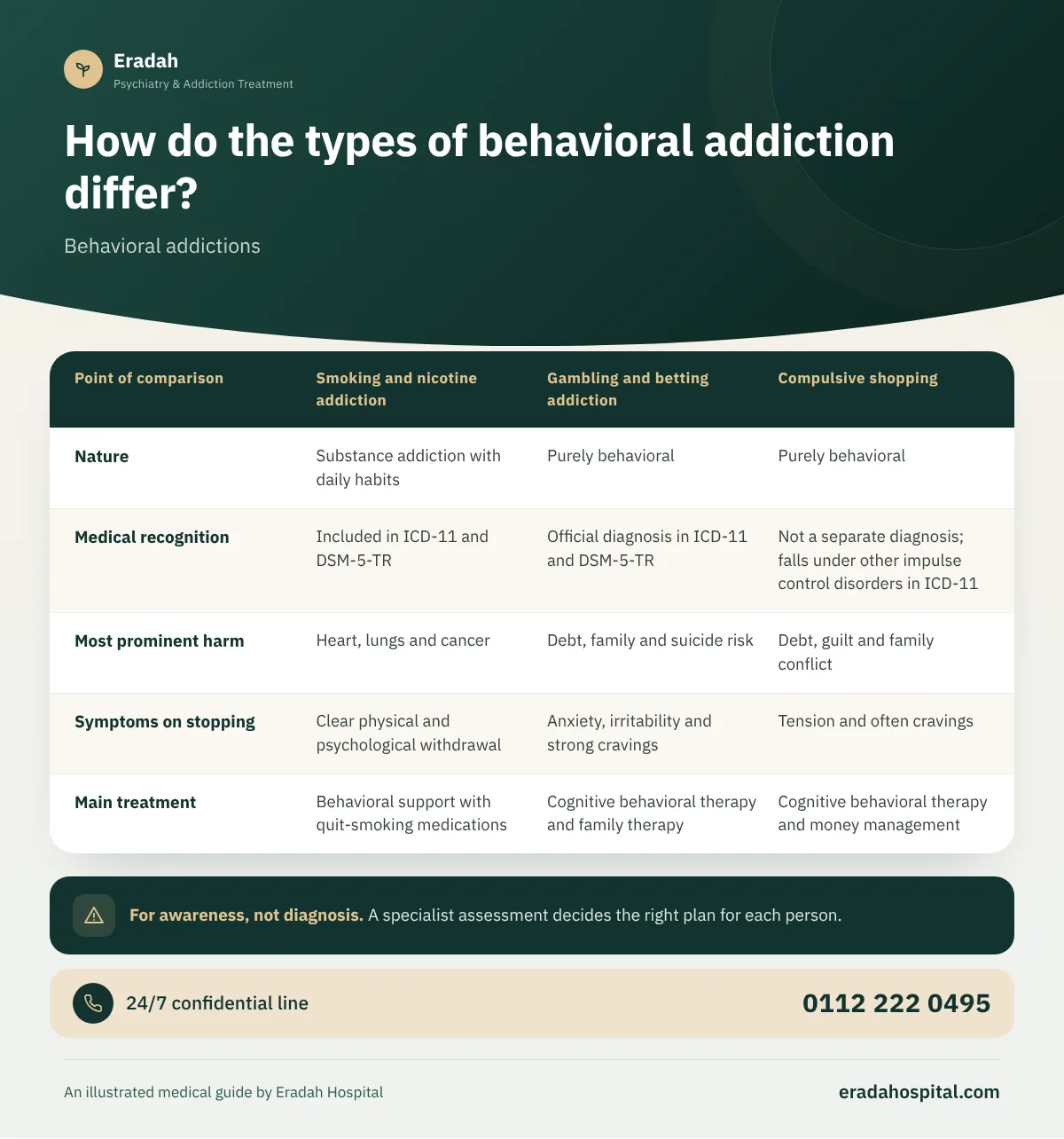
Despite the shared loop, each behavior differs in its nature, its medical recognition, its most prominent harm and how it is treated:
| Point of comparison | Smoking and nicotine addiction | Gambling and betting addiction | Compulsive shopping |
|---|---|---|---|
| Nature | Substance addiction with daily habits | Purely behavioral | Purely behavioral |
| Medical recognition | Included in ICD-11 and DSM-5-TR | Official diagnosis in ICD-11 and DSM-5-TR | Not a separate diagnosis; falls under other impulse control disorders in ICD-11 |
| Most prominent harm | Heart, lungs and cancer | Debt, family and suicide risk | Debt, guilt and family conflict |
| Symptoms on stopping | Clear physical and psychological withdrawal | Anxiety, irritability and strong cravings | Tension and often cravings |
| Main treatment | Behavioral support with quit-smoking medications | Cognitive behavioral therapy and family therapy | Cognitive behavioral therapy and money management |
You will find the details of each behavior in its full guide: smoking and nicotine addiction, gambling and betting addiction, compulsive shopping, masturbation, and food addiction.
Are shisha and vaping milder than cigarettes?
This is one of the most common questions in Egypt, where a shisha session has become part of social life and e-cigarettes have spread among young people as the “safe alternative.” The truth is that the World Health Organization states that all forms of tobacco are harmful, and there is no safe level of exposure to it, and that e-cigarettes are harmful to health and not safe.
Shisha is not smoking “filtered through water” as some people think; water does not remove the harmful substances, a single session usually lasts far longer than a cigarette, a large amount of smoke is inhaled, and those sitting around it are exposed too. Vapes often contain the same nicotine and can cause addiction, and according to the WHO nicotine is highly addictive and especially harmful to children, adolescents and young adults. Details are in the harms of smoking.
Behavioral addictions in numbers
World Health Organization figures show that these behaviors are public health issues affecting millions of families, and are bigger than minor personal problems:
The WHO also notes that about 11.9% of men and 5.5% of women worldwide experience some degree of gambling harm, and that the expansion of mobile betting in low- and middle-income countries increases these risks. For compulsive shopping there are no unified international figures from an official source. Source: World Health Organization tobacco and gambling fact sheets.
What harms do behavioral addictions share?
- Financial strain and debt, especially with gambling and compulsive shopping, which can reach borrowing or selling belongings.
- Lying and hiding that destroy trust in the family and lead to marital conflict.
- Anxiety, depression, insomnia and a constant feeling of guilt.
- Serious physical harms with smoking, including the heart, lungs, blood vessels and many types of cancer.
- Children affected by secondhand smoke, by family tension, and by household money being diverted from needs.
- A higher risk of suicide with gambling disorder, which makes seeking help early essential.
Details are on the pages about the harms of gambling and betting addiction and the harms of compulsive shopping. Any discussion of the legal status of betting is general awareness information and not legal advice.
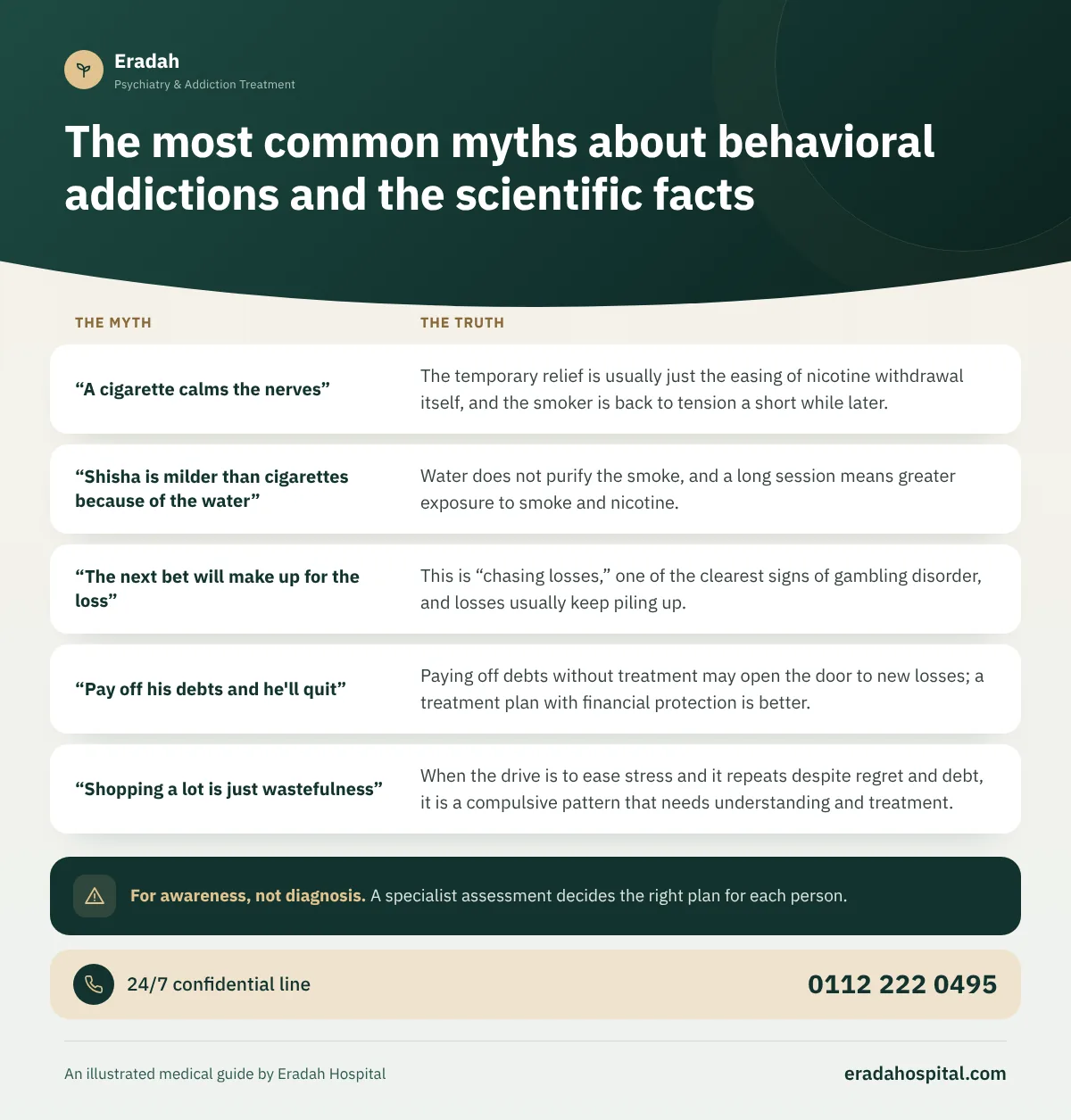
Common myths about behavioral addictions
| The myth | The truth |
|---|---|
| “A cigarette calms the nerves” | The temporary relief is usually just the easing of nicotine withdrawal itself, and the smoker is back to tension a short while later. |
| “Shisha is milder than cigarettes because of the water” | Water does not purify the smoke, and a long session means greater exposure to smoke and nicotine. |
| “The next bet will make up for the loss” | This is “chasing losses,” one of the clearest signs of gambling disorder, and losses usually keep piling up. |
| “Pay off his debts and he'll quit” | Paying off debts without treatment may open the door to new losses; a treatment plan with financial protection is better. |
| “Shopping a lot is just wastefulness” | When the drive is to ease stress and it repeats despite regret and debt, it is a compulsive pattern that needs understanding and treatment. |
When do you need specialist help?
Ask for a specialist assessment if you notice any of the following in yourself or someone close to you. This list is for awareness and is not a diagnosis.
- Repeated attempts to quit smoking that end in a return within days.
- Betting larger amounts to get the same excitement, or going back to win back losses.
- Borrowing, hiding debts or lying to the family about money or time.
- Shopping to escape sadness or stress, then feeling guilty and hiding purchases.
- Losing control over eating out of stress or sadness, or a repeated compulsive behavior followed by overwhelming guilt.
- Anxiety, depression or insomnia accompanying the behavior.
- Any thoughts of death because of debts or losses, in which case help must be sought immediately.
How are these behaviors treated?
Treatment is possible and effective, and varies slightly from one behavior to another. For smoking, the most successful plans combine behavioral support with medications such as nicotine replacement, varenicline and bupropion, which are used only after consulting a doctor. For gambling and compulsive shopping, the foundation is cognitive behavioral therapy, which addresses thoughts such as chasing losses, along with family therapy, a plan to protect money, and treatment of any accompanying depression or anxiety. Compulsive masturbation and food addiction rely on cognitive behavioral therapy, habit-change skills and managing emotions and sleep, plus mindful eating in the case of food.
You will find the practical steps in treating smoking and nicotine addiction, treating gambling and betting addiction, treating compulsive shopping, treating masturbation and treating food addiction.
How can a family help someone with a behavioral addiction?
- Talk calmly about the effect of the behavior on the family, without accusation or scandal.
- With gambling and compulsive shopping, quietly protect the family's money and accounts, and do not pay off debts without a treatment plan.
- Support attempts to quit smoking by keeping the home and car smoke-free.
- Expect relapse and treat it as part of recovery, not a final failure.
- Encourage a specialist assessment, and offer to go along to the first appointment.
- Take any talk of death with complete seriousness, and get help immediately.
A debt crisis and suicidal thoughts, or sudden chest pain? Get help now
- Talking about death, or about being a burden on the family after losses or debts
- Severe despair after debts or a large hidden loss come to light
- Suddenly saying goodbye to family or giving away important belongings
- Threats to harm himself or others when confronted about debts
- Sudden chest pain or pressure spreading to the arm or jaw, with shortness of breath or sweating
- Sudden weakness or numbness on one side of the body, difficulty speaking or a drooping face
In a psychological crisis: stay with the person and do not leave them alone, listen without blaming them for the loss, remove any dangerous objects from their reach, and call the ambulance (123) or the mental health support line 16328. With chest pain or signs of a stroke: call the ambulance (123) immediately and do not wait for the symptoms to pass.
Ambulance 123 Mental health support line 16328