“I read the page three times and don't remember anything, and at work I forget the simplest things.” We all have days when the mind wanders, but when poor concentration becomes the rule rather than the exception, worry begins: is it exhaustion? An illness? Something in the brain? The truth is that the causes of poor concentration are many, and most can be treated once they are identified.
What does poor concentration mean?
Poor concentration is difficulty directing your attention to one task and staying with it, showing up as mind-wandering, forgetfulness, slow comprehension and needing to reread. The Cleveland Clinic describes what people call brain fog as a cluster of symptoms that includes difficulty concentrating, confusion, forgetfulness, losing the thread of thoughts, mental fatigue and slowed thinking. It describes a symptom, not a diagnosis of a disease.
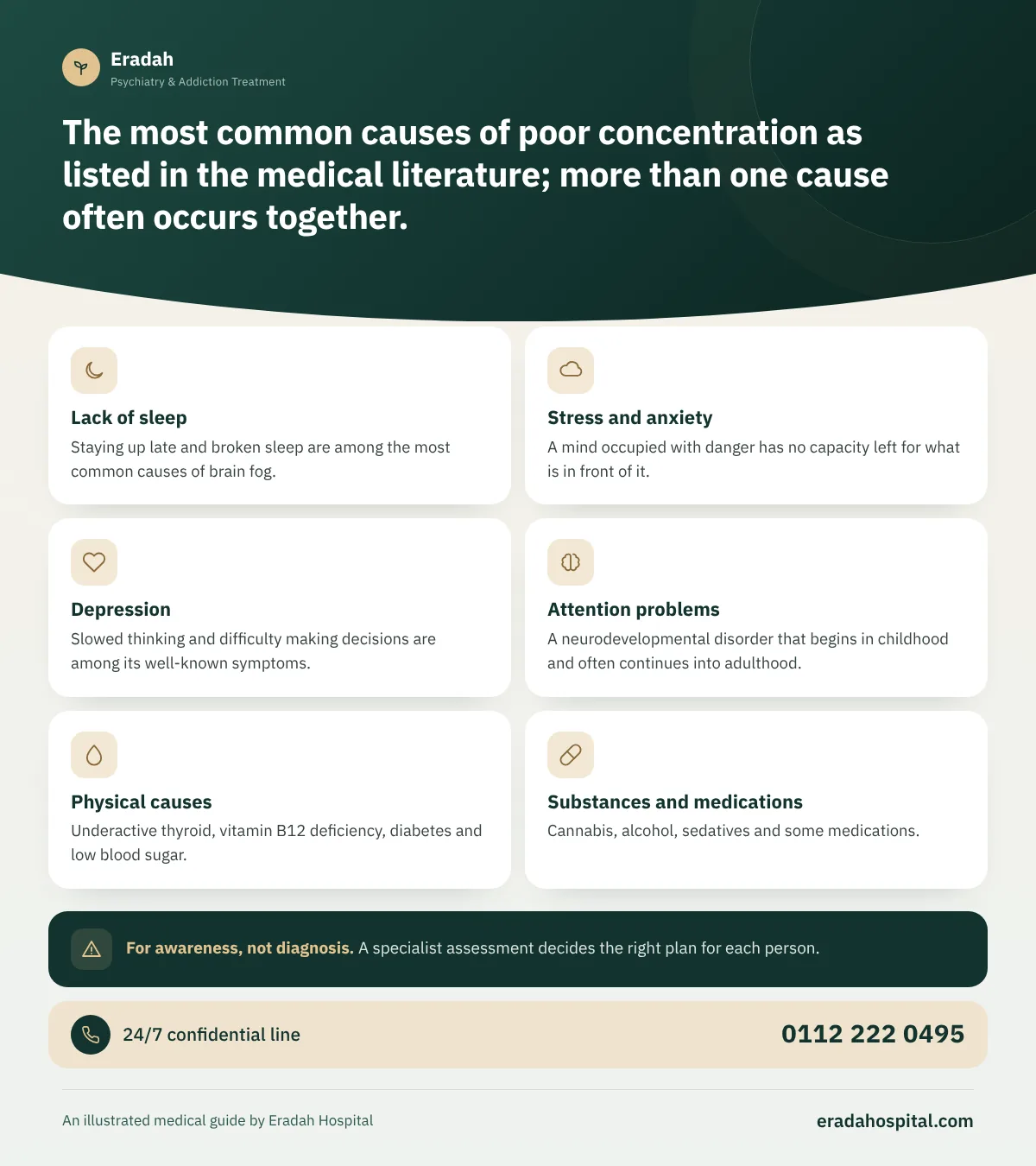
The most common causes of poor concentration
Staying up late and broken sleep are among the most common causes of brain fog.
A mind occupied with danger has no capacity left for what is in front of it.
Slowed thinking and difficulty making decisions are among its well-known symptoms.
A neurodevelopmental disorder that begins in childhood and often continues into adulthood.
Underactive thyroid, vitamin B12 deficiency, diabetes and low blood sugar.
Cannabis, alcohol, sedatives and some medications.
The Cleveland Clinic also lists among the causes of brain fog: poor nutrition, hormonal changes such as pregnancy and menopause, some autoimmune diseases, COVID-19 infection, chemotherapy, and long hospital stays.
Psychological causes of poor concentration
When the mind is busy with fear or sadness, there is not enough left for the task in front of it. In generalized anxiety, thoughts jump from one worry to another; in depression, thinking becomes slow and decisions hard; in burnout, the mind switches off after months of pressure. Overthinking also drains mental energy in endless loops.
Does poor concentration mean ADHD?
Not always. According to the US National Institute of Mental Health (NIMH), the symptoms of attention deficit hyperactivity disorder begin in childhood and often continue into adolescence and adulthood, and are frequently accompanied by anxiety, depression or sleep problems, which makes diagnosis harder. But if poor concentration began recently in adulthood after a period when your focus was good, it more likely has another cause such as sleep, pressure or a physical problem. The page on attention deficit symptoms explains the signs in detail.
Physical causes of poor concentration that tests can reveal
- Underactive thyroid: the UK National Health Service (NHS) lists among its common symptoms difficulty concentrating or thinking clearly, along with severe tiredness, feeling cold, weight gain, constipation and low mood.
- Vitamin B12 or folate deficiency: according to the NHS, it can cause problems with memory, understanding and judgment, along with tiredness, headaches and palpitations.
- Diabetes and low blood sugar, as the Cleveland Clinic notes.
- Hormonal changes in pregnancy and menopause.
This is why a doctor may order simple blood tests before concluding that the cause is psychological.
Cannabis and sedatives: a cause many people overlook
The US National Institute on Drug Abuse (NIDA) says that frequent or heavy use of cannabis is linked to problems with mental functions such as learning, memory, attention and processing speed. People who use it daily often complain of forgetfulness and poor concentration without connecting them to it. Sedatives, sleeping pills and pregabalin used without supervision can also slow thinking and attention, and alcohol impairs memory.
How can you improve concentration?
- Get your sleep in order before any other fix.
- Move every day; the Cleveland Clinic suggests about 30 minutes of physical activity.
- Write down important information and do not rely on memory alone.
- Break work into short periods with breaks in between.
- Keep your phone and notifications away while working or studying.
- Eat balanced meals and do not depend on stimulants.
- Stay away from cannabis, alcohol and sedatives without a prescription.
When should you see a doctor about poor concentration?
See a doctor if poor concentration is sudden, is getting worse, comes with severe forgetfulness, confusion or an unusual headache, comes with physical symptoms such as fatigue and weight change, or affects your work and studies even after you improve your sleep and habits. If anxiety, depression or substance use is behind it, a psychiatric assessment will set the way forward, and you can start with an assessment in Eradah's outpatient clinics; the first consultation is free and confidential.