What is acetylcholine?
Every movement you make right now, from moving your eyes along this line to breathing, begins with a signal carried by acetylcholine from nerve to muscle. And inside the brain, the same neurotransmitter helps you pay attention to what you read and remember it later.
Acetylcholine is one of the neurotransmitters, and it was the first to be discovered, in the 1920s, when the scientist Otto Loewi proved that nerves communicate through chemical substances. It is made from choline, which we get from food such as eggs, liver and fish, and after it has done its job it is quickly broken down by an enzyme called acetylcholinesterase, so that the signal does not continue longer than needed.
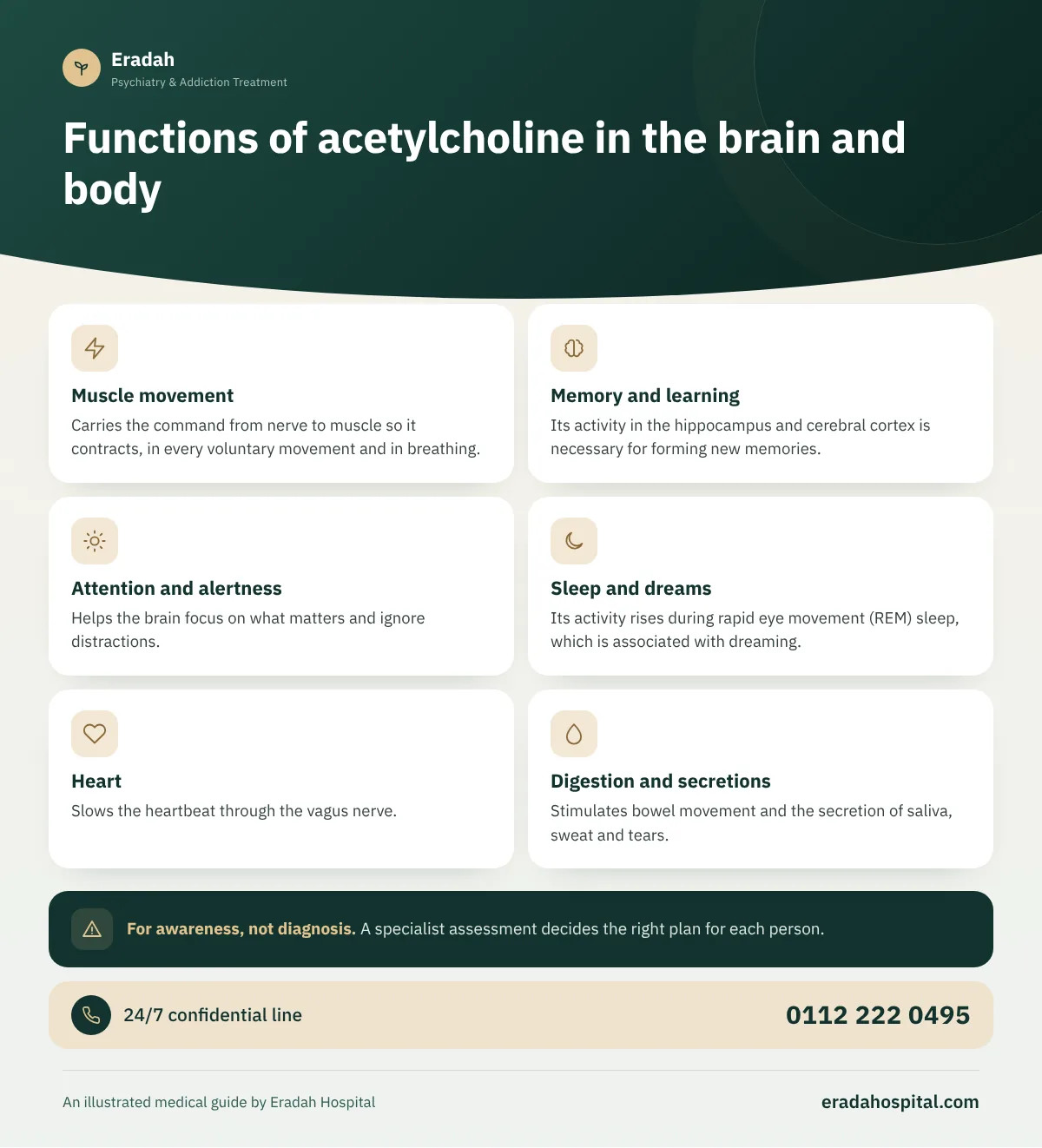
Functions of acetylcholine
Carries the command from nerve to muscle so it contracts, in every voluntary movement and in breathing.
Its activity in the hippocampus and cerebral cortex is necessary for forming new memories.
Helps the brain focus on what matters and ignore distractions.
Its activity rises during rapid eye movement (REM) sleep, which is associated with dreaming.
Slows the heartbeat through the vagus nerve.
Stimulates bowel movement and the secretion of saliva, sweat and tears.
Two types of receptors
| Receptor | Where it is found | What affects it |
|---|---|---|
| Nicotinic | Muscles, and parts of the brain including the reward circuits | Nicotine activates it, and some anesthetic drugs relax it |
| Muscarinic | The heart, intestines, glands and the brain | Anticholinergic drugs such as Parkinol block it |
Acetylcholine and nicotine
Nicotine resembles acetylcholine closely enough to activate its nicotinic receptors, including receptors located on dopamine cells in the reward circuits. That is why a cigarette gives a quick feeling of focus and relief, and dopamine rises. With regular smoking the brain adapts by increasing the number of these receptors and reducing their sensitivity, so the smoker needs nicotine to feel normal, and withdrawal symptoms appear when they stop. This is a core part of smoking addiction, and one of the quit-smoking medications, varenicline, acts on these same receptors.
Acetylcholine deficiency
There is no simple blood test that measures acetylcholine in the brain, and its "deficiency" is not diagnosed as a stand-alone disease. But reduced function shows up in specific conditions:
- Alzheimer's disease: cells that make acetylcholine die early, which is why medications such as donepezil work by slowing its breakdown to improve memory temporarily.
- Myasthenia gravis: the immune system attacks acetylcholine receptors in the muscles, causing weakness that worsens with exertion.
- Anticholinergic medications: cause forgetfulness and confusion, especially in older adults, and some allergy and bladder medications have this effect.
When acetylcholine is blocked: anticholinergics
Some medications block muscarinic acetylcholine receptors, including Parkinol, which is used to reduce the movement side effects of antipsychotics. At high doses, as in misuse, a distinctive picture of poisoning appears: severe dryness of the mouth and skin, dilated pupils, a fast heartbeat, urinary retention, high temperature, and confusion and hallucinations. Something similar happens with the datura plant.
Excess acetylcholine
A dangerous excess of acetylcholine activity occurs in poisoning by certain insecticides that stop the enzyme responsible for breaking it down, so it builds up everywhere. Symptoms appear that are the opposite of anticholinergics: excessive saliva, sweat and tears, narrowed pupils, diarrhea and vomiting, a slow heartbeat, muscle twitching and then weakness, and difficulty breathing. This is an emergency that needs an ambulance immediately.
How can you support acetylcholine naturally?
- Eat sources of choline: eggs, liver, fish and legumes.
- Get enough sleep, especially for consolidating memories.
- Do regular physical activity, which improves brain health.
- Challenge your mind with learning and reading.
- Review anticholinergic medications with your doctor, especially in older adults.
- Quit smoking to restore the balance of receptors.
Poisoning by pesticides or anticholinergics? Call the ambulance (123) immediately
- Difficulty breathing or heavy secretions from the mouth and nose after exposure to an insecticide
- Severely narrowed pupils with heavy sweating and tears, vomiting and diarrhea
- Muscle twitching followed by severe weakness, or a clearly slow heartbeat
- After excess Parkinol or anticholinergics: hot, dry skin, high temperature, a racing heart, confusion and hallucinations
- Seizures or loss of consciousness
Call the ambulance on 123 immediately. If the person was exposed to a pesticide, move them away from the place of exposure, remove their contaminated clothing and wash their skin with soap and water while protecting your own hands, and do not try to make them vomit. If they are unconscious but breathing, place them on their side and stay with them, and take the pesticide or medication container with you so the paramedics know what they were exposed to.
Ambulance 123 Mental health support line 16328