“Will this medicine turn me into a zombie?” Many patients and families ask this before starting antipsychotics, because of an outdated image of these drugs. The truth is that antipsychotics have spared millions of people from devastating episodes of psychosis, and that their side effects are real but can be monitored and reduced. This guide explains the types, who they are prescribed for, and what you should watch for.
What are antipsychotics?
Antipsychotics are a group of psychiatric medications used to treat psychosis, meaning a loss of contact with reality that shows up as hallucinations, delusions, or disorganized speech and behavior. They do not “sedate” the mind, as is commonly believed; they recalibrate excessive signals in specific circuits of the brain. Agitation usually settles within days, while hallucinations and delusions take weeks to recede.
How do antipsychotics work?
Psychosis is linked to overactivity of dopamine in certain brain pathways. Almost all antipsychotics block dopamine D2 receptors, while many second-generation drugs also block serotonin 5-HT2A receptors, which is thought to reduce movement-related side effects. Aripiprazole works differently: it is a partial dopamine agonist rather than a full blocker. Each drug also differs in its effect on histamine and acetylcholine, which explains why drowsiness and weight gain vary from one drug to another.
Types of antipsychotics: first and second generation
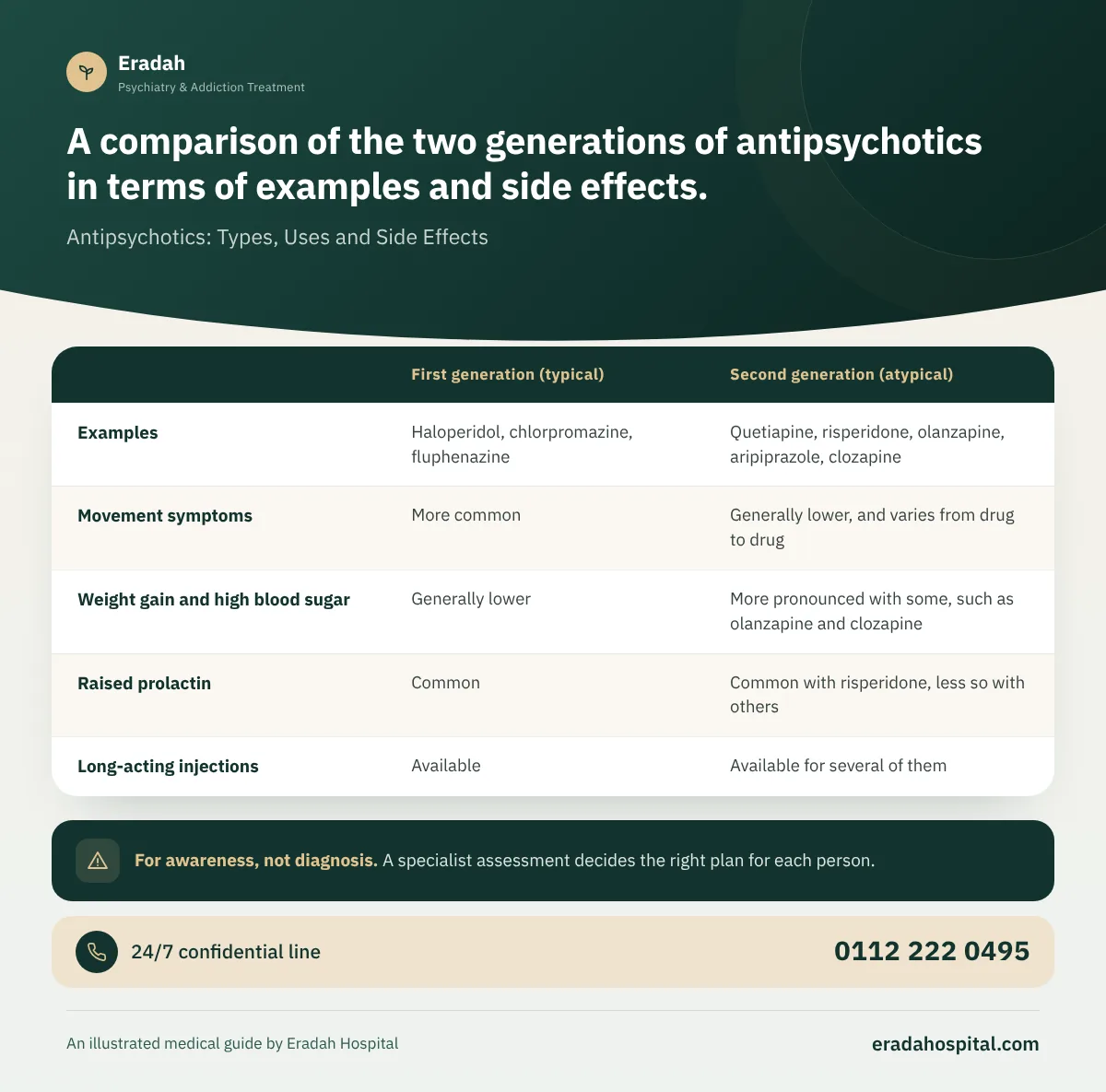
| First generation (typical) | Second generation (atypical) | |
|---|---|---|
| Examples | Haloperidol, chlorpromazine, fluphenazine | Quetiapine, risperidone, olanzapine, aripiprazole, clozapine |
| Movement symptoms | More common | Generally lower, and varies from drug to drug |
| Weight gain and high blood sugar | Generally lower | More pronounced with some, such as olanzapine and clozapine |
| Raised prolactin | Common | Common with risperidone, less so with others |
| Long-acting injections | Available | Available for several of them |
There is no single “best” drug for everyone. A network meta-analysis published in The Lancet in 2019 compared 32 antipsychotics and found that differences in effectiveness exist but are mostly gradual, while differences in side effects are far clearer. That is why the doctor chooses a drug based on symptoms, medical history, weight, heart health and the patient's preference. Clozapine remains a special option for treatment-resistant schizophrenia and requires regular blood tests.
Uses of antipsychotics
- Schizophrenia and other psychotic disorders, for acute treatment and relapse prevention.
- Manic episodes in bipolar disorder, with some used for prevention and for bipolar depression.
- Psychotic depression and treatment-resistant depression, together with an antidepressant.
- Drug-induced psychosis such as shabu and hashish psychosis, for a period set by the doctor.
- Severe agitation in emergency settings, and delirium in selected cases for a short period.
Side effects of antipsychotics
Stiffness and tremor, unbearable restlessness, and sudden spasms in the neck or eyes.
Increased appetite and weight, and raised blood sugar and fats.
Breast enlargement, sexual dysfunction, and menstrual irregularity in women.
Heaviness and slowness, especially with the more sedating drugs at the start.
Dizziness on standing, and QT prolongation with some drugs.
Neuroleptic malignant syndrome, tardive dyskinesia, and low blood cell counts.
How are antipsychotics monitored safely?
- Measure weight, waist circumference and blood pressure before starting and regularly afterward.
- Check blood sugar and fats periodically.
- Get an ECG if there is heart disease or with drugs that prolong the QT interval.
- Check for involuntary movements at every visit.
- Have regular blood counts with clozapine.
- Ask frankly about sexual and hormonal effects, as they are a common reason people stop their medication secretly.
Movement symptoms are managed by lowering the dose, changing the drug, or adding a medicine such as Parkinol for a limited time and by prescription only. The leaflets for these drugs also warn of an increased risk of death in older adults with dementia, so they are used in this group only with great caution.
Are antipsychotics addictive?
No. Antipsychotics do not cause euphoria or compulsive craving, and they do not require dose increases to get the same effect. The documented exception is misuse of quetiapine by some people with a history of substance use, as in the Seroquel guide. However, stopping suddenly can cause nausea, insomnia, sweating and a return of psychosis, and the most common cause of relapse is stopping the medication. Never start or stop an antipsychotic without a doctor.
Integrated treatment and when to seek help
Medication alone is only half the road. Recovery also needs psychotherapy, rehabilitation and family support, and staying away from substances that trigger psychosis, such as hashish and stimulants. At Eradah Hospital, the plan begins with a comprehensive assessment, followed by treatment in residential care for acute episodes or in outpatient clinics, with a dual diagnosis program for people who have both psychosis and addiction.