What is Parkinol?
Parkinol is the brand name in use in Egypt for trihexyphenidyl tablets, an anticholinergic medicine prescribed by neurologists and psychiatrists to treat tremor and stiffness. But it is also one of the medicines that is repeatedly misused in large amounts in search of euphoria or hallucinations, to the point that it has a street name: “cockroach pills.”
Trihexyphenidyl is also known worldwide as “Artane,” and in some British sources as “Benzhexol.” The official US label describes its therapeutic properties as similar to atropine, but with side effects at the prescribed dose that are less frequent and less severe.
On our site we place it among the hallucinogens because the purpose of its misuse is usually to alter consciousness and perception, even though it is originally a medicine for movement disorders, and its mechanism is completely different from traditional hallucinogens such as LSD.
What are the medical uses of Parkinol?
According to the official drug label and the MedlinePlus medical encyclopedia, trihexyphenidyl is used in two main situations, and only the doctor decides whether it is needed and for how long:
An add-on treatment to ease tremor and stiffness in the different forms of Parkinson’s disease, sometimes together with the drug levodopa.
Controlling the stiffness, tremor and spasms caused by some psychiatric medicines such as phenothiazines and butyrophenones.
One patient may need it for years, while another may do without it over time or after their main treatment is adjusted.
Because many people with schizophrenia take Parkinol along with antipsychotics, talking about its misuse does not mean frightening people about the medicine itself when it is prescribed and followed up.
How does Parkinol affect the brain and body?
Parkinol blocks receptors called “muscarinic” receptors on which acetylcholine acts. In the brain’s movement centers, acetylcholine and dopamine work in a delicate balance; if the effect of dopamine falls because of Parkinson’s disease or medicines that block it, acetylcholine gains the upper hand and tremor and stiffness appear, and Parkinol comes in to restore part of this balance.
A systematic review published in 2022 in the journal Biomedicines indicates that anticholinergics also act as an indirect stimulant of dopamine in the reward and mood circuits, which may partly explain their potential for misuse. With large amounts the blockade extends through the whole body:
- In the brain: euphoria or energy in some people at first, then confusion, disorientation and hallucinations that can reach delirium.
- In the eye: dilated pupils, blurred vision and difficulty seeing up close.
- In the heart: a faster heart rate.
- In the skin and glands: a dry mouth and dry skin and less sweating, which hinders the body’s cooling.
- In the gut and bladder: constipation and difficulty urinating that can reach urinary retention.
Names and forms of Parkinol
Parkinol is available in Egypt as tablets, while the same active ingredient is available outside Egypt under other names, and MedlinePlus notes that it comes as tablets and a syrup. On the street it is known by names such as “cockroach pills” and “cockroach tablets.” There is no documented source for the origin of the name; the common explanation links it to the visual hallucinations that can accompany anticholinergic poisoning, including seeing insects or small things moving.
Why is Parkinol misused?
The available studies identify several motives, most of them tied to the person’s psychological state more than to the medicine itself:
- Seeking euphoria or a “high,” the reason most often given when people were asked directly in an Australian study of psychiatric patients.
- Calming anxiety, or seeking energy or sleep; in the largest described group of patients with addiction to it, on the French island of Réunion, easing anxiety was the most common motive.
- Trying to get rid of the dullness and loss of pleasure that can accompany some antipsychotics, according to the 2022 review.
- Easy access from an old prescription or from another patient’s medicines, and the belief that it is safe because it is a “medicine.”
- Going along with friends and a sense of futility, which were among the reasons that appeared in the Australian study when people were asked indirectly.
Parkinol rarely comes alone; the systematic review notes that the cases described often involved benzodiazepines, alcohol and hashish along with it, and sometimes opioids or stimulants. Every added substance raises the risk and complicates treatment.
Parkinol compared with similar substances
| Parkinol | Mydriatic eye drops | LSD | |
|---|---|---|---|
| How it acts | Blocks acetylcholine receptors | Block acetylcholine receptors | Acts on serotonin receptors |
| Medical use | Tremor and the movement effects of antipsychotics | Dilating the pupil for eye examination | No approved use |
| Common misuse | Swallowing large numbers of tablets | Injecting the contents of the drops, often with opioids | Recreational use in tiny amounts |
| Main risk | Delirium, high temperature and a racing heart | Delirium, and harm from injecting and to the liver and kidneys | Panic attacks and accidents |
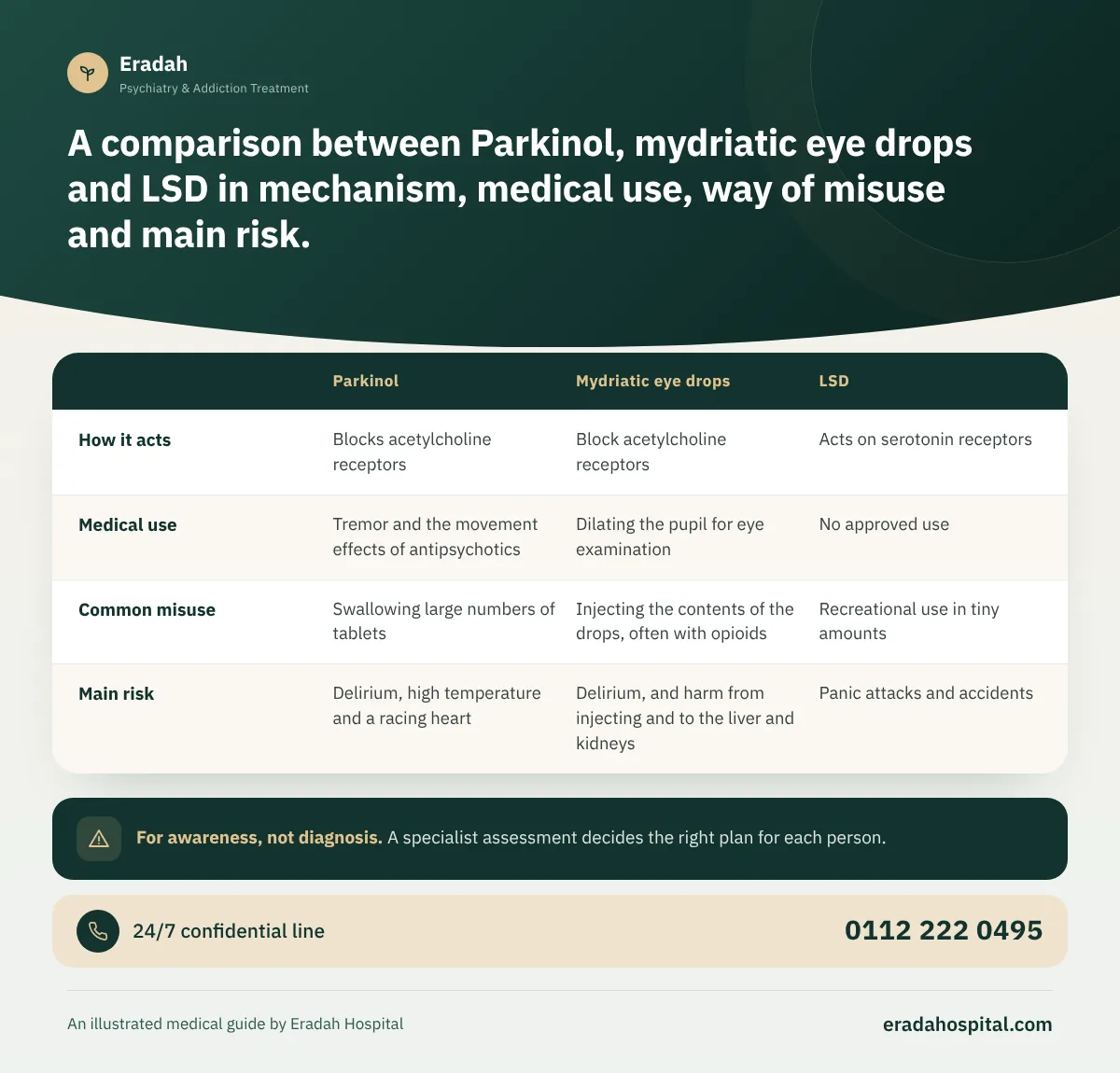
Parkinol and mydriatic eye drops are alike in mechanism because both are anticholinergics, which is why the picture of poisoning with them is similar: dryness, heat, flushing and dilated pupils with confusion and hallucinations. The mental state they cause is closer to medical “delirium” than to the “trip” sought by people who use traditional hallucinogens.
The legal status of Parkinol in Egypt
Parkinol is a medicine dispensed by prescription, and its proper place is a treatment plan followed by a doctor. Obtaining it, circulating it or selling it for use outside that framework is an offense that may expose a person to legal action. If use has already occurred, the Fund for Drug Control and Treatment of Addiction offers free, confidential consultation and treatment through hotline 16023.
This is general educational information and not legal advice.
Parkinol in numbers
Sources: the official trihexyphenidyl label on DailyMed, the study by Buhrich and colleagues (2000), and the study by Torrents and colleagues (2018).
Parkinol guide: everything you need to know
We have gathered everything about Parkinol into 4 pages, each answering one question in detail. Choose what you are looking for:
Harms of Parkinol to the body and mind
What are the harms of Parkinol (“cockroach pills”)? Delirium and hallucinations during poisoning, a high temperature and racing heart, glaucoma and urinary retention, its effect on memory, and the danger of mixing it with other substances.
Parkinol use symptoms and signs of addiction
How do you know if someone is misusing Parkinol? The physical signs of anticholinergic poisoning, the behavioral and psychological signs, the difference between someone who takes it by prescription and someone who misuses it, and how to respond.
Parkinol withdrawal symptoms and how long they last
When do Parkinol withdrawal symptoms start and how long do they last? Anxiety, insomnia, sweating and cravings, the risk of tremor returning for those who take it as treatment, and why stopping should be gradual under medical supervision.
Parkinol addiction treatment: stages and duration
How is Parkinol addiction treated? An assessment that begins by asking who prescribed the medicine, safe withdrawal under supervision, a review of the antipsychotic, psychological and behavioral therapy and follow-up to prevent relapse, and how long each stage lasts.
Found Parkinol with your son? Start here
- First make sure: is it prescribed for him or for someone at home? If it is prescribed, talk to the treating doctor before any decision.
- Watch for signs of excess: dilated pupils, flushed and dry skin, incoherent speech, and disorientation that is not like his usual state.
- Do not argue with someone in delirium; focus on his safety, and keep him away from heat, the street and high places.
- Calmly ask about other substances, since Parkinol is rarely used alone.
- Ask for a psychiatric assessment, since many people who misuse it have a psychiatric disorder that needs treatment.
- Save the ambulance number, 123, and learn the overdose signs.
Parkinol harms, symptoms, withdrawal and treatment in brief
Harms: these range from acute poisoning with delirium, fever and a racing heart, to harm to the eyes and memory with repeated use, and a greater risk when it is mixed with other substances. Details are in harms of Parkinol.
Symptoms: a distinctive picture of dryness, heat, flushing and dilated pupils with confusion, and behavioral signs that should alert the family. Details are in symptoms of Parkinol misuse.
Withdrawal: anxiety, insomnia, sweating and cravings on sudden stopping, and the return of movement symptoms for those who take it as treatment. Details are in symptoms of Parkinol withdrawal.
Treatment: an assessment that begins by asking who prescribed the medicine and why, then safe withdrawal, a review of psychiatric treatment and behavioral rehabilitation. Details are in treatment of Parkinol addiction.
Danger signs after using Parkinol: call an ambulance (123) immediately
- Delirium or severe agitation with hallucinations, or not knowing where he is or who people are
- A high temperature with hot, dry skin that does not sweat
- A very fast or irregular pulse, or chest pain
- Seizures, loss of consciousness or difficulty breathing
- Complete urinary retention with severe pain in the lower abdomen
Call an ambulance on 123 immediately, and if the person is unconscious but breathing, place them on their side so they do not choke on vomit. Stay with them in a cool, quiet place away from the street and high places, do not give them any medicine, drink or other substance, keep the empty strips, and tell the paramedics everything they took.
Call the ambulance 123