What are neurotransmitters?
Nerve cells in the brain do not touch each other directly; a very tiny gap separates them. For a message to cross this gap it needs a chemical “messenger”: small molecules released by the first cell and picked up by the second. These molecules are neurotransmitters, the language the brain uses to talk to itself and to the body.
Cleveland Clinic’s health library describes neurotransmitters as chemical messengers used by the nervous system to carry messages between nerve cells, and from nerve cells to muscles and glands. With them a person breathes, their heart beats, they move, learn, and feel fear, reassurance or desire. Scientists know of at least a hundred neurotransmitters and believe others exist that have not yet been discovered.
The difference between a neurotransmitter and a hormone is explained in detail on the main brain chemistry page. In short: a neurotransmitter is a very fast, short-range message between two neighboring cells, while a hormone travels in the blood. Some substances, such as norepinephrine and endorphins, play both roles, which is why we have placed them here, since their neural role is the more important one for mood and addiction.
How does a neurotransmitter carry a message between two cells?
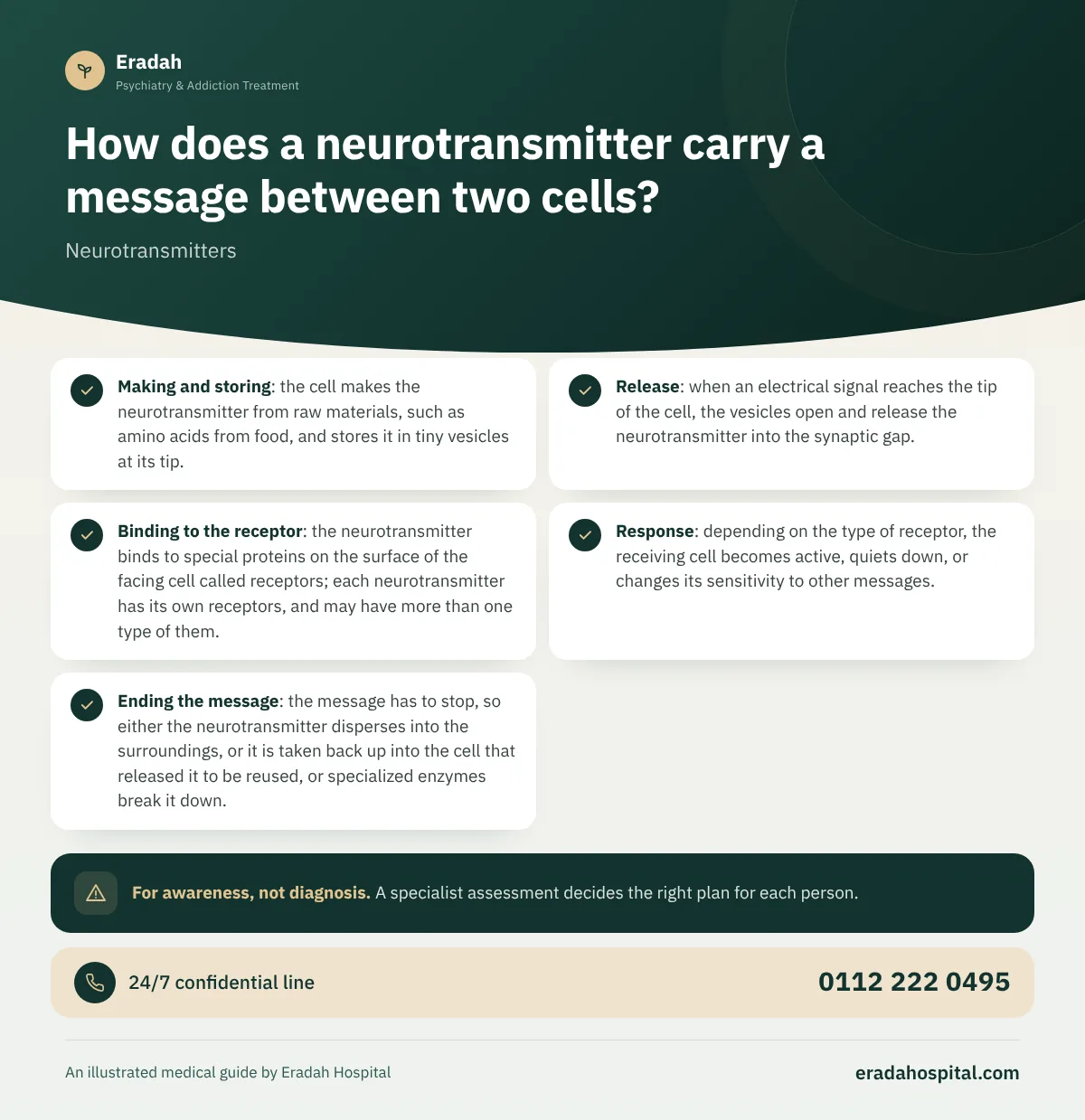
A nerve message goes through successive steps that all happen in a small fraction of a second, and understanding them is the key to understanding how psychiatric medications and drugs work, because each of them interferes in one or more of these steps:
- Making and storing: the cell makes the neurotransmitter from raw materials, such as amino acids from food, and stores it in tiny vesicles at its tip.
- Release: when an electrical signal reaches the tip of the cell, the vesicles open and release the neurotransmitter into the synaptic gap.
- Binding to the receptor: the neurotransmitter binds to special proteins on the surface of the facing cell called receptors; each neurotransmitter has its own receptors, and may have more than one type of them.
- Response: depending on the type of receptor, the receiving cell becomes active, quiets down, or changes its sensitivity to other messages.
- Ending the message: the message has to stop, so either the neurotransmitter disperses into the surroundings, or it is taken back up into the cell that released it to be reused, or specialized enzymes break it down.
The last step in particular matters a great deal to readers of this guide. Many antidepressants work by slowing reuptake, cocaine blocks dopamine reuptake far more powerfully, and an older group of drugs works by inhibiting the enzymes that break down neurotransmitters. The mechanism is roughly the same, but the difference in intensity, speed, medical supervision and outcome is enormous.
How are neurotransmitters classified?
Scientists classify neurotransmitters in two complementary ways: by their effect on the receiving cell, and by their chemical structure. The first is more useful for understanding mood and addiction:
Push the receiving cell to fire its signal. The most important is glutamate, the main excitatory neurotransmitter in the brain and the basis of learning and memory.
Stop the cell from firing or make it less likely to, protecting the brain from overexcitation. The most important is GABA, together with glycine in the spinal cord.
Do not act on a single cell only but regulate the activity of whole networks and influence the effect of other neurotransmitters, such as dopamine, serotonin and norepinephrine.
By chemical structure, medical references list several groups, most notably: amino acids such as glutamate, GABA and glycine; monoamines such as dopamine, serotonin, norepinephrine and histamine; peptides, which are short chains of amino acids, such as endorphins; in addition to acetylcholine, which is usually listed in a separate category.
This classification is approximate and useful for understanding, but it is not strict. The same neurotransmitter may be excitatory in one place and inhibitory in another, depending on the type of receptor it binds to. Dopamine, for example, has two large families of receptors with different effects, which is why it is hard to describe any neurotransmitter in a single phrase such as “the happiness chemical” or “the calming chemical.”
Types of neurotransmitters in the Eradah guide
From dozens of neurotransmitters we chose six that are most closely tied to mood, motivation, stress, pain and addiction, each with a full guide and separate pages. Here is a short card for each neurotransmitter:
Dopamine
DopamineAlso known as: the happiness hormone
The messenger of reward and motivation; drugs release it in huge amounts, so the brain learns to seek them before anything else.
- Type
- A neurotransmitter that also acts as a hormone
- Where it is released
- Nerve cells in the midbrain, and a small amount in the adrenal gland
- Key function
- Motivation, reward learning and movement
- Role in addiction
Central
When to seek help? Slow or trembling movement, prolonged loss of motivation, or hallucinations and severe suspicion after stimulant use.
Serotonin
SerotoninRegulates mood, sleep and appetite. Most of it is made in the gut, and its disruption is linked to depression and anxiety.
- Type
- A neurotransmitter, with hormone-like roles in the gut and blood
- Where it is released
- About 90% in the gut, and the rest in the brainstem
- Key function
- Regulating mood, sleep, appetite and digestion
- Role in addiction
Strong
When to seek help? Sadness or anxiety lasting weeks, and immediately if you develop fever, stiffness and confusion after combining medications.
GABA
GABAAlso known as: GABA
The brain's main calming neurotransmitter. Alcohol and sedatives act on it, which is why withdrawal from them is dangerous.
- Type
- An inhibitory neurotransmitter
- Where it is released
- Inhibitory nerve cells throughout the brain and spinal cord
- Key function
- Calming nerve activity and preventing overexcitation
- Role in addiction
Central
When to seek help? Before stopping alcohol or sedatives after long-term use, and immediately if you have severe tremor or seizures.
Glutamate
GlutamateThe brain's main excitatory neurotransmitter, with a role in learning and memory and in cementing cravings for a substance.
- Type
- An excitatory neurotransmitter
- Where it is released
- Most nerve cells in the brain
- Key function
- Learning, memory and the flexibility of neural connections
- Role in addiction
Strong
When to seek help? Seizures or sudden confusion, or cravings for a substance that return despite stopping.
Norepinephrine
NorepinephrineAlso known as: noradrenaline
Regulates alertness, attention and the fight-or-flight response, and rises sharply during opioid withdrawal.
- Type
- A neurotransmitter and a hormone
- Where it is released
- The brainstem, the sympathetic nerves and the adrenal medulla
- Key function
- Alertness, attention and the fight-or-flight response
- Role in addiction
Strong
When to seek help? Palpitations, high blood pressure and repeated severe anxiety, and immediately if you have chest pain or signs of a heart attack.
Endorphins
EndorphinsThe body's natural painkillers; opioids imitate them with a strength far beyond what the body can produce naturally.
- Type
- Neuropeptides that act as both neurotransmitter and hormone
- Where it is released
- The pituitary gland and hypothalamus
- Key function
- Natural pain relief and a feeling of comfort
- Role in addiction
Central
When to seek help? If you depend on over-the-counter opioid painkillers, or chronic pain is pushing you to take more of your painkiller.
Acetylcholine
AcetylcholineAlso known as: ACh
The neurotransmitter of movement, memory and attention. Nicotine acts on its receptors, and anticholinergics such as Parkinol block it.
- Type
- A neurotransmitter in the brain and nerves
- Where it is released
- Nerve endings and the basal forebrain
- Key function
- Muscle movement, memory and attention
- Role in addiction
Strong
When to seek help? Difficulty breathing after exposure to a pesticide, or agitation, fever and hallucinations after Parkinol, or muscle weakness that worsens with exertion.
What is the difference between dopamine, serotonin, GABA and the other neurotransmitters?
The following table summarizes the main role of each neurotransmitter in this group and the addictive substances most closely tied to it. It is a summary for comparison only; the detailed information is on each neurotransmitter’s page:
| Neurotransmitter | Nature of its effect | Most prominent role | Substances that act on it strongly |
|---|---|---|---|
| Dopamine | Modulatory | Motivation, reward learning and movement | Stimulants, and almost all drugs indirectly |
| Serotonin | Modulatory | Mood, sleep, appetite and digestion | Ecstasy and hallucinogens |
| GABA | Inhibitory | Calming and preventing overexcitation | Alcohol, sedatives and pregabalin |
| Glutamate | Excitatory | Learning, memory and cementing habits | Alcohol and ketamine |
| Norepinephrine | Modulatory | Alertness, attention and the fight-or-flight response | Stimulants, and it surges in opioid withdrawal |
| Endorphins | Modulatory, pain-relieving | Pain relief and a feeling of comfort | All opioids |
The table shows that the six neurotransmitters work in pairs and networks: glutamate and GABA are the fuel and the brakes for most neural activity; dopamine directs motivation toward what the brain learns is rewarding; serotonin takes part in regulating mood and impulsivity; norepinephrine raises alertness and readiness; and endorphins ease pain and give a feeling of comfort after exertion.
What other neurotransmitters are worth knowing?
There are important neurotransmitters we have not dedicated separate guides to at this stage, but mentioning them completes the picture, especially since some are directly tied to substances common in Egypt:
- Acetylcholine: the first neurotransmitter discovered historically, it carries commands from nerves to muscles and takes part in attention and memory. Nicotine in cigarettes acts on one type of its receptors, and this is where its effect on the reward circuit begins.
- Histamine: known for its role in allergy, but in the brain it is a neurotransmitter of wakefulness, which is why some older allergy medications cause drowsiness.
- Glycine: an inhibitory neurotransmitter that works mainly in the spinal cord and brainstem, and it also joins glutamate in activating NMDA receptors.
- Endocannabinoids: molecules the body makes itself that bind to receptors on which the active ingredient in hashish also acts, while synthetic drugs such as Strox bind to the same receptors far more powerfully, and this is part of their danger.
This reminds us that what is written online about “the four happiness neurotransmitters” is a drastic oversimplification of a network of dozens of overlapping substances whose roles science is still discovering.
How do psychiatric medications act on neurotransmitters?
Most well-known psychiatric medications affect one or more neurotransmitters, and this has made neurotransmitters the focus of psychiatric pharmacology since the middle of the last century. This is only an overview of drug classes, without names or doses, because choosing a medication is an individual medical decision:
| Drug class | Main target neurotransmitter | Common use |
|---|---|---|
| Selective serotonin reuptake inhibitors (SSRIs) and similar drugs | Serotonin, and for some also norepinephrine | Depression, anxiety and obsessive-compulsive disorder |
| Benzodiazepines | Enhancing the effect of GABA | Acute anxiety and alcohol withdrawal under medical supervision, for short periods because of the risk of dependence |
| Antipsychotics | Dopamine receptors, and for some serotonin | Schizophrenia, psychosis and some cases of bipolar disorder |
| Stimulants used in ADHD | Dopamine and norepinephrine | ADHD (attention-deficit/hyperactivity disorder) |
| Medications for opioid addiction | Opioid endorphin receptors | Adjunct drug treatment under specialist supervision |
But one point must be clear: that a drug acts on a neurotransmitter does not mean the illness is caused by a “deficiency” of that neurotransmitter. A comprehensive review published by Moncrieff and colleagues in 2022 concluded that the evidence does not consistently support the idea that depression results from low serotonin, yet antidepressants remain useful for many patients, and scientists are still studying their full mechanism. That is why we discuss this controversy fairly on the serotonin deficiency symptoms page.
How do drugs change neurotransmitters?
The US National Institute on Drug Abuse explains that drugs interfere with the way nerve cells send, receive and process messages, in three main ways, to which we add a fourth way known in pharmacology:
| Way of interfering | What happens? | Examples |
|---|---|---|
| Imitating the natural neurotransmitter | The substance resembles the neurotransmitter in structure and activates its receptors, but in an abnormal way | Heroin on endorphin receptors, and hashish on cannabinoid receptors |
| Releasing huge amounts | Drives cells to empty their store of the neurotransmitter all at once | Shabu and ecstasy |
| Blocking reuptake | The neurotransmitter stays in the synaptic gap, so its message is amplified | Cocaine with dopamine |
| Modifying or blocking the receptor | Enhance the effect of an inhibitory neurotransmitter or block an excitatory one | Alcohol and Xanax with GABA, and ketamine with glutamate |
Substances differ in which neurotransmitters they hit first, but they converge in the end on the reward circuit: most of them raise dopamine in this circuit directly or indirectly, faster and stronger than any natural reward does. This circuit is explained in the reward system section.
Why do tolerance and withdrawal happen at the neurotransmitter level?
The brain is an organ that always seeks balance. When a substance floods a neural system with an excessive signal day after day, the brain responds with counter-adjustments: it reduces the number or sensitivity of receptors, or reduces what it makes of the natural neurotransmitter, or strengthens the opposing system. The result is that the person needs a larger amount to get the same effect, and this is tolerance.
When the substance is suddenly absent, these counter-adjustments remain alone with nothing to balance them, and withdrawal appears as a mirror image of the substance’s effect. A person used to a sedative that enhances GABA faces, on stopping suddenly, anxiety, insomnia and tremor, and seizures may occur, because the excitatory glutamate system is left without enough brakes. A person used to opioids faces a surge of norepinephrine that causes sweating, diarrhea, a fast pulse and tension.
- Alcohol and sedative withdrawal: an imbalance between GABA and glutamate, which can be dangerous and needs medical supervision. Details are in GABA and addiction.
- Opioid withdrawal: absence of natural pain relief and a surge of norepinephrine. Details are in endorphins and addiction.
- After stimulants: dulled pleasure and motivation, exhaustion and low mood. Details are in dopamine and addiction.
- Cravings and relapse: a strong memory cemented by glutamate links the substance to places and people. Details are in glutamate and addiction.
The reassuring side is that the same flexibility that let the brain adapt to the substance lets it adapt to its absence. With abstinence and treatment, receptors and neurotransmitter systems gradually move back toward balance, and the time varies from one substance to another and from person to person. This is why the first weeks need patience, support and a clear treatment plan, not judging oneself a failure.
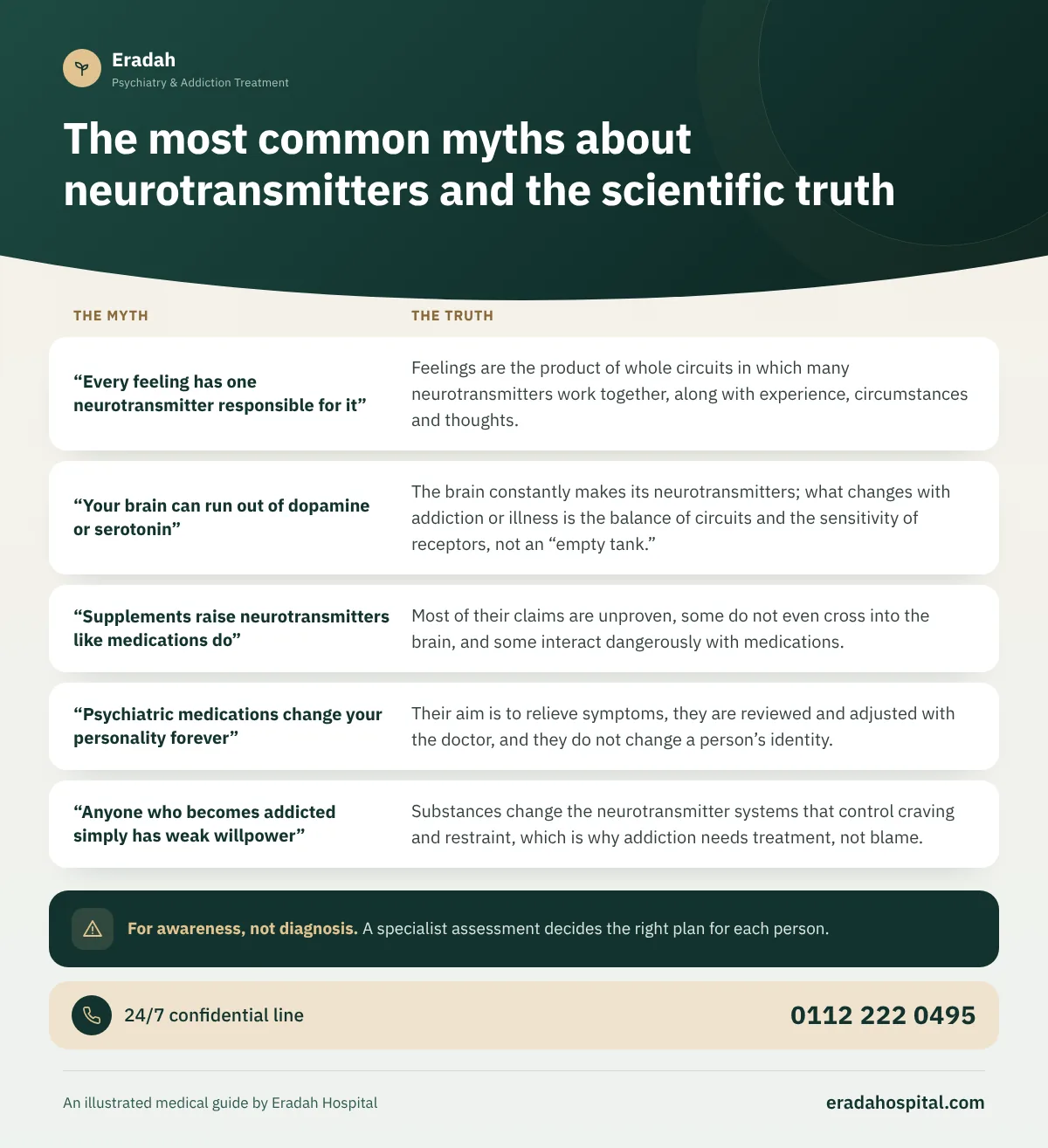
What are the common myths about neurotransmitters?
| The myth | The truth |
|---|---|
| “Every feeling has one neurotransmitter responsible for it” | Feelings are the product of whole circuits in which many neurotransmitters work together, along with experience, circumstances and thoughts. |
| “Your brain can run out of dopamine or serotonin” | The brain constantly makes its neurotransmitters; what changes with addiction or illness is the balance of circuits and the sensitivity of receptors, not an “empty tank.” |
| “Supplements raise neurotransmitters like medications do” | Most of their claims are unproven, some do not even cross into the brain, and some interact dangerously with medications. |
| “Psychiatric medications change your personality forever” | Their aim is to relieve symptoms, they are reviewed and adjusted with the doctor, and they do not change a person’s identity. |
| “Anyone who becomes addicted simply has weak willpower” | Substances change the neurotransmitter systems that control craving and restraint, which is why addiction needs treatment, not blame. |
When should you see a doctor about symptoms linked to neurotransmitters?
No one needs to know which neurotransmitter is “off” in order to ask for help, and there is no blood test in the clinic that measures neurotransmitters inside the brain. Seek a psychiatric medical assessment if you notice the following. This list is for awareness and is not a diagnosis.
- Loss of pleasure and motivation, or sadness or anxiety, lasting more than two weeks and affecting your daily life.
- Cravings for a substance, a sedative or a painkiller, or needing an increasing amount of it for the same effect.
- Distressing physical and psychological symptoms whenever you try to stop a substance or medication.
- Tremor, slowness or stiffness in movement that you cannot explain.
- Suspicion, hearing voices or strange thoughts, especially after using stimulants or hashish.
- Any thoughts about death or harming yourself; in this case, seek help immediately by calling 123 or the mental health support line 16328.
At Eradah, the doctor begins with a comprehensive assessment of symptoms, medical history, and the substances and medications used, then builds a plan combining medication when needed, psychotherapy and family support, with safe medical supervision of withdrawal when required, in complete confidentiality.
Serious symptoms after a medication or substance that affects neurotransmitters? Get help now
- High temperature, heavy sweating, muscle stiffness or twitching and confusion after combining medications or supplements that affect mood
- Seizures, severe tremor or hallucinations after suddenly stopping alcohol, sedatives or pregabalin
- Extreme drowsiness, slow breathing or difficulty waking the person after mixing sedatives with opioids or alcohol
- Chest pain, severe palpitations, or clear suspicion and agitation after using stimulants
- Talk of death or self-harm, or suddenly saying goodbye to family
Call an ambulance (123) or go to the nearest emergency room immediately, do not leave the person alone, and bring the medication packs with you or tell the medical team everything the person took. Do not try to treat seizures or high temperature at home, and do not give the person any extra medication to calm them. If the danger is thoughts of death, listen without blame and keep dangerous objects out of reach, and you can call the mental health support line 16328, available around the clock.
Ambulance 123 Mental health support line 16328