What is nicotine addiction?
Nicotine addiction, or nicotine dependence, is a condition in which the body and brain become so used to nicotine that the person finds it really hard to stop, even if they sincerely want to and know the harms well. Nicotine is the substance that makes a cigarette "craved", while tar, carbon monoxide and hundreds of other substances in the smoke are responsible for most of the diseases.
Many people think a smoker can stop "if they have willpower", but in reality most smokers try to quit more than once before they succeed. The explanation is that nicotine changes how the brain's reward circuits work and ties smoking to every detail of the day: coffee, tea, after meals, stress and sitting with friends. It has nothing to do with a weak character.
That is why Eradah treats smoking as a treatable addiction, not a moral flaw. Stopping is possible, and scientifically supported methods make it much easier than trying to stop alone without a plan.
When does the smoking habit become an addiction?
There is no single moment when a smoker turns from an "ordinary smoker" into an "addict"; it is a gradual spectrum. But there are clear differences between someone who smokes occasionally on social occasions and someone whose day is now run by nicotine:
| Point of comparison | Occasional use | Nicotine dependence |
|---|---|---|
| Control | Smokes on occasions and can go without for days with no distress | Finds it hard to go even a few hours without smoking |
| Start of the day | Does not think about a cigarette in the morning | First cigarette or "puff" within minutes of waking |
| When stopping | Does not feel much change | Irritability, anxiety, poor concentration and strong cravings |
| Attempts to quit | Has not needed them | Repeated attempts that end in going back |
| Despite harm | Stops if the doctor asks | Continues despite chest or heart disease or pregnancy |
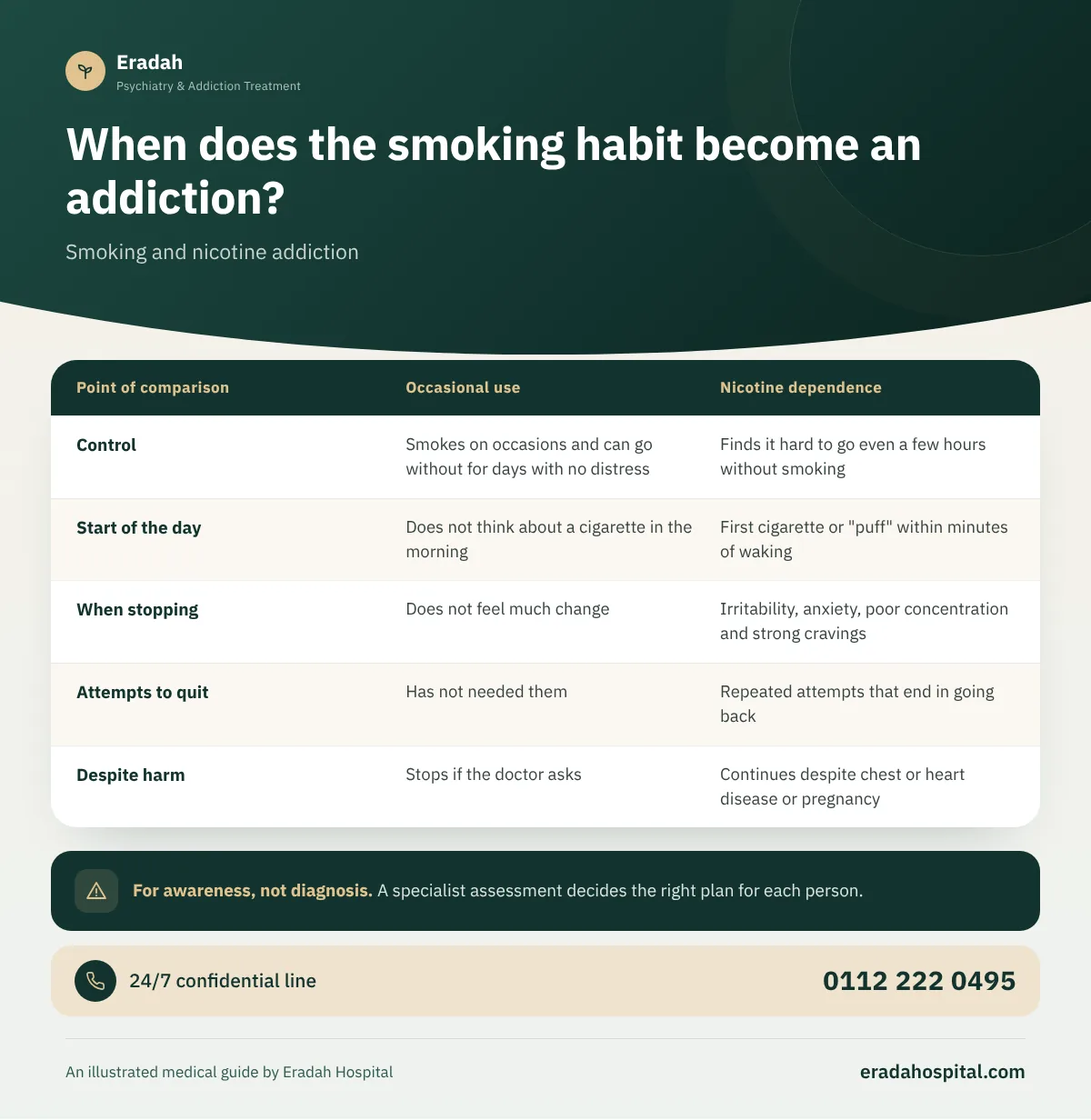
The problem is that the move from occasional use to dependence can happen quickly, especially in teenagers, whose brains keep developing until the mid-twenties. Many adult smokers started with a "trial" cigarette or a shisha session with friends.
Is nicotine addiction a recognized medical diagnosis?
Yes, clearly. The World Health Organization's International Classification of Diseases (ICD-11) places "nicotine dependence" among disorders due to substance use under category 6C4A, and the American Diagnostic and Statistical Manual (DSM-5) calls it "tobacco use disorder" and places it alongside alcohol and other substance use disorders.
This means a doctor assesses smoking by the same criteria used for any addiction: loss of control, cravings, tolerance, withdrawal symptoms, and continuing despite harm. Smoking differs from the other "behavioral addictions" in this section because it is an addiction to a chemical substance, not only to a behavior, although its behavioral side (the hand movement, the rituals, the situations) is very strong.
How many smokers are there worldwide and in Egypt?
Sources: the tobacco fact sheet and the 2025 tobacco trends report from the World Health Organization, and the Egyptian Cabinet's Media Center. Figures vary by survey method and age group.
Although the smoking rate in Egypt is falling, smoking remains far more common among men than women, shisha is widespread in cafes among young people of both sexes, and vaping is growing among school and university students.
What forms of smoking and nicotine are common today?
The best-known form and the most studied; the smoke carries nicotine along with tar, carbon monoxide and many cancer-causing substances.
Flavored tobacco heated with charcoal, with the smoke passing through water. Very common in Egypt, and many people think it is milder, which is not true.
Devices that heat a liquid that usually contains nicotine and flavorings, popular among teenagers in forms that look like pens or flash drives.
Devices that heat real tobacco without burning it and, according to the World Health Organization, release toxic emissions, many of which resemble cigarette smoke.
Such as chewing tobacco and nicotine pouches, all of which can cause dependence.
The common denominator of all these forms is nicotine. So switching from cigarettes to vapes or shisha only changes the delivery method and does not free you from addiction, unless it is part of a clear quit plan under a specialist's supervision.
Shisha in Egypt: why is it widely believed to be "milder"?
Shisha is part of Egyptian cafe culture, presented as a symbol of sitting together and good company, and it comes in fruit flavors and a pleasant smell that hide what it really is. That is why many people say: "I'm not a smoker, I only smoke shisha." But the medical reality is completely different:
| Common belief | The truth |
|---|---|
| Water purifies the smoke | Water does not filter the smoke, which stays loaded with high levels of toxic substances according to the US Centers for Disease Control. |
| A shisha coal is lighter than a pack of cigarettes | In a one-hour session, a person may inhale smoke equal to 100 to 200 times that of a single cigarette. |
| Fruit-flavored molasses tobacco is not tobacco | Molasses tobacco is flavored tobacco, and it contains nicotine that causes dependence just like cigarettes. |
| Charcoal is just a heat source | The charcoal itself releases carbon monoxide, metals and cancer-causing substances that are inhaled with the smoke. |
| Shisha does not cause addiction | Many people cannot get through a day without a "coal" and feel irritable and distressed when they go without. |
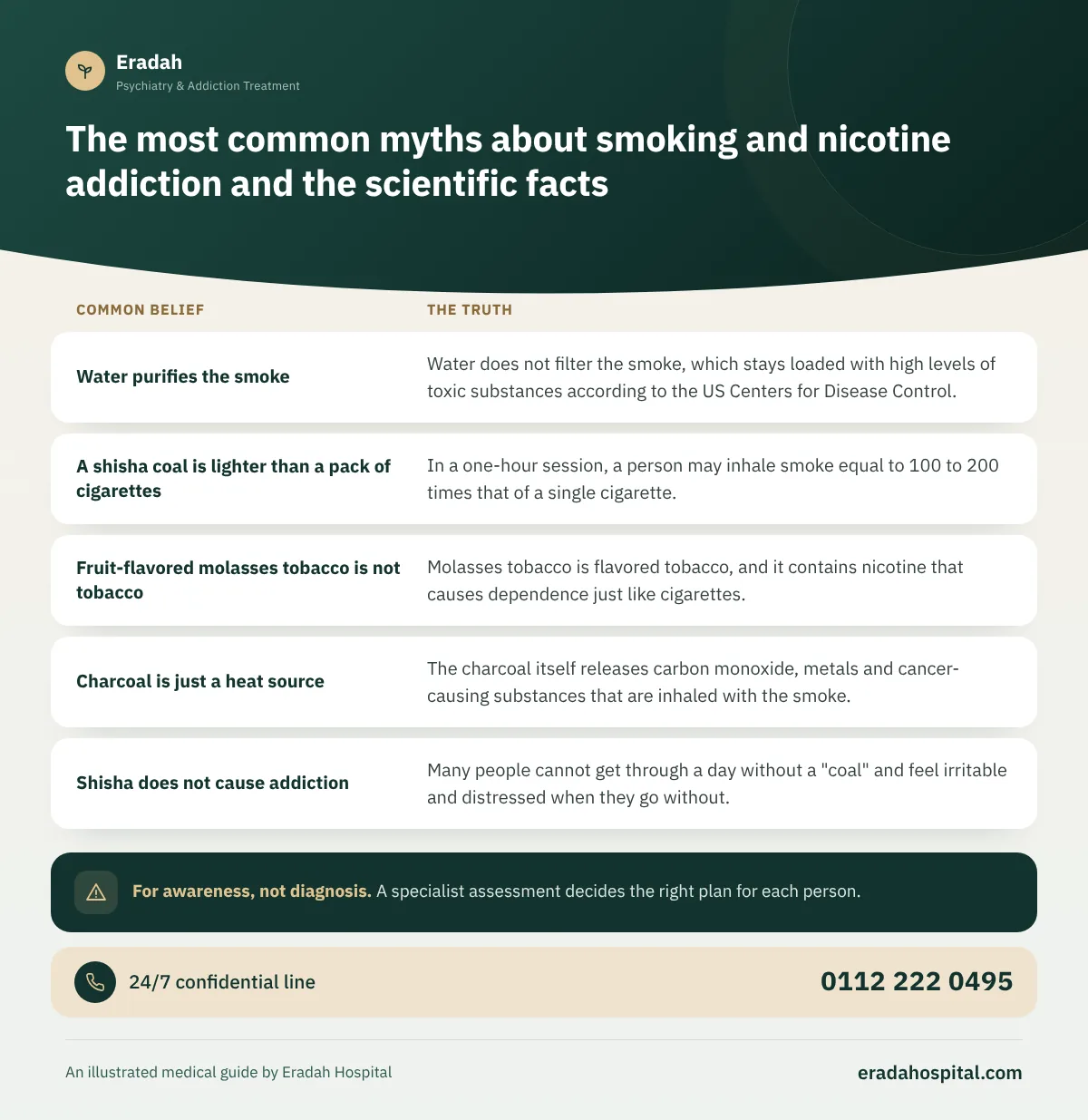
Details of what shisha does to the body are on the harms of smoking page, while quitting it needs particular attention to its social side, because the session itself is often stronger than the nicotine.
How does nicotine affect the brain, in brief?
When inhaled, nicotine reaches the brain within seconds, binds to specific receptors and triggers the release of dopamine in the reward circuit, so the smoker feels quick comfort and temporary focus. But this effect fades fast, and the brain asks for the next dose.
With repetition the brain adapts and needs nicotine to feel "normal". This is where the familiar loop forms: the cigarette does not calm stress so much as silence the discomfort of withdrawal caused by the previous cigarette. The details of this mechanism and why quitting is hard are on the causes of smoking page.
Myths and facts about smoking and nicotine
| The myth | The truth |
|---|---|
| A cigarette calms the nerves | The relief a smoker feels is mostly the end of withdrawal discomfort, and for many people anxiety levels fall after quitting, not before. |
| Vaping is just water vapor | It is an aerosol that usually carries nicotine and other substances, and the World Health Organization describes it as harmful and unsafe. |
| "Light" cigarettes are less harmful | Smokers unconsciously compensate with deeper and longer puffs, and there is no safe tobacco. |
| I smoked for many years, so there is no point in stopping | The benefits of quitting begin within minutes and continue for years, at any age. |
| Smoking is a personal choice that doesn't harm anyone else | Secondhand smoke kills more than 1.6 million people a year, including children. |
| I'll quit whenever I want | Most smokers need several attempts, and planning and support greatly increase the chances of success. |
How can the family help a smoker who wants to quit?
The family can be the biggest motivation to quit or the biggest obstacle. What really helps:
Constant reminders of the harms breed stubbornness. Saying "I'm beside you if you decide" helps more than "you're going to die from those cigarettes."
Keep the home and car smoke-free to protect children; this also reduces the situations that trigger the smoker.
A day without a cigarette is an achievement, and a week is a bigger one. A relapse is not the end of the attempt.
Irritability in the first days is a temporary withdrawal symptom, not a change in personality.
If a parent smokes, their attempt to quit is the strongest message to their children.
If you discover that your teenage son is smoking or vaping, calm conversation helps more than punishment, and you will find practical guidance on the signs of smoking page.
Smoking and nicotine addiction guide: everything you need to know
We have gathered everything about smoking and nicotine addiction into 8 pages, each answering one question in detail. Choose what you are looking for:
Signs of smoking and nicotine addiction
How to know you have become dependent on nicotine, signs that a teenager is smoking or vaping, with non-diagnostic self-assessment questions.
Causes of smoking and nicotine addiction
Why quitting is hard: the effect of nicotine on the brain, daily associations, stress, family and friends, and flavor marketing.
Harms of smoking and nicotine addiction
What cigarettes, shisha and vapes do to the heart, lungs, teeth, fertility, pregnancy and mental health, and the harms of secondhand smoke.
Treatment of smoking and nicotine addiction
A practical quit plan, dealing with withdrawal symptoms, nicotine replacements and helpful medications, and what happens to your body after you stop.
Tombak and naswar
What is tombak and how does it differ from naswar? A tobacco placed in the mouth, not smoked, yet rich in nicotine and cancer-causing substances. Its harms to the mouth and heart, warning signs, and ways to quit.
E-cigarettes (vapes): the truth without exaggeration or downplaying
E-cigarettes (vapes): how they work, what enters your lungs, their harms for teenagers and pregnant women, whether they really help people quit smoking, and how to quit vaping itself.
Harms of secondhand smoke: what those around you breathe
Harms of secondhand smoke: it kills more than 1.6 million people a year. Its effect on children, pregnant women, the heart and lungs, the truth about opening the window, smoke clinging to clothes, and how to protect your family.
How long nicotine stays in the body
How long does nicotine stay in the body? Nicotine's half-life is one to two hours and cotinine's is 15 to 20 hours. When it leaves the blood and urine, why it varies between people, and when withdrawal symptoms settle.
Chest pain or signs of a stroke or heart attack? Call an ambulance on 123 immediately
- Pain, pressure or heaviness in the middle of the chest that may spread to the arm, jaw or back, with cold sweat or shortness of breath
- Sudden drooping of the face, or weakness or numbness in an arm or leg, especially on one side of the body
- Sudden difficulty speaking or understanding, or blurred vision, sudden loss of vision or loss of balance
- Severe shortness of breath or blue lips in a smoker with chronic chest disease
- A child who swallowed e-cigarette liquid or a nicotine pack, then developed vomiting, dizziness or unusual drowsiness
Call an ambulance on 123 immediately and do not wait for the symptoms to pass; have the person sit or lie in a comfortable position, and do not give them food or drink. Note the time the symptoms began, because it matters greatly to doctors in treating strokes and heart attacks. If a child has swallowed nicotine liquid, take them to the nearest emergency room with the container, and do not try to make them vomit.
Ambulance 123 Mental health support line 16328