How is insomnia linked to addiction?
Insomnia is one of the most common complaints that lead people to sedative substances, and one of the hardest things they face when they try to quit. That is why we see it constantly in addiction clinics: sometimes as the reason substance use began, sometimes as an obstacle threatening recovery, and sometimes both.
A sleeping pill, sedative, or alcohol “just to sleep” gradually turns into dependence.
Substances damage the structure of sleep, and insomnia appears when their effect wears off.
Severe insomnia and disturbing dreams after stopping push the person back to the substance.
Insomnia that continues in the first months is linked to a higher risk of relapse.
How do sleeping pills and sedatives turn into addiction?
The story often starts with a short-term prescription, or a pill from a friend or from a pharmacy without a prescription. Benzodiazepine sleeping pills, such as Xanax, Rivotril, and Valium, as well as the “Z-drug” sleeping medicines, give quick sleep at first. But with continued nightly use:
- Tolerance: the medicine’s effect weakens, so the person needs a larger amount or a stronger medicine.
- Dependence: the body gets used to having the medicine, so it becomes hard to sleep at all without it.
- Rebound insomnia: when the medicine is stopped or delayed, insomnia comes back worse than before, and the person becomes convinced they “can only sleep with the medicine.”
- Misuse: taking the medicine during the day to calm anxiety, combining more than one medicine, or getting it from more than one doctor.
Other substances misused for sleep in Egypt include pregabalin and some opioid painkillers such as tramadol; both carry a risk of dependence, and the risk rises when they are mixed with sedatives.
Does alcohol help with sleep?
Many people use alcohol as a “sleeping pill,” which is one of the best-known harmful myths. It is true that it may speed up falling asleep, but it ruins the second half of the night: frequent waking, light sleep, disturbed dreams, sweating, and needing to urinate, and it may worsen snoring and sleep apnea. With repeated use the body gets used to the sedative effect and needs more, and sleeping without alcohol becomes harder.
| What it seems like | What actually happens |
|---|---|
| I fall asleep faster | Sleep early in the night comes at the cost of broken sleep later in the night |
| Deeper sleep | Dream sleep is reduced, then rebounds later with disturbing dreams |
| Relaxation | Rebound in tension and anxiety as the effect wears off during the night |
| A solution to insomnia | Tolerance and dependence, and worse insomnia when stopping |
Why does insomnia get worse after quitting drugs?
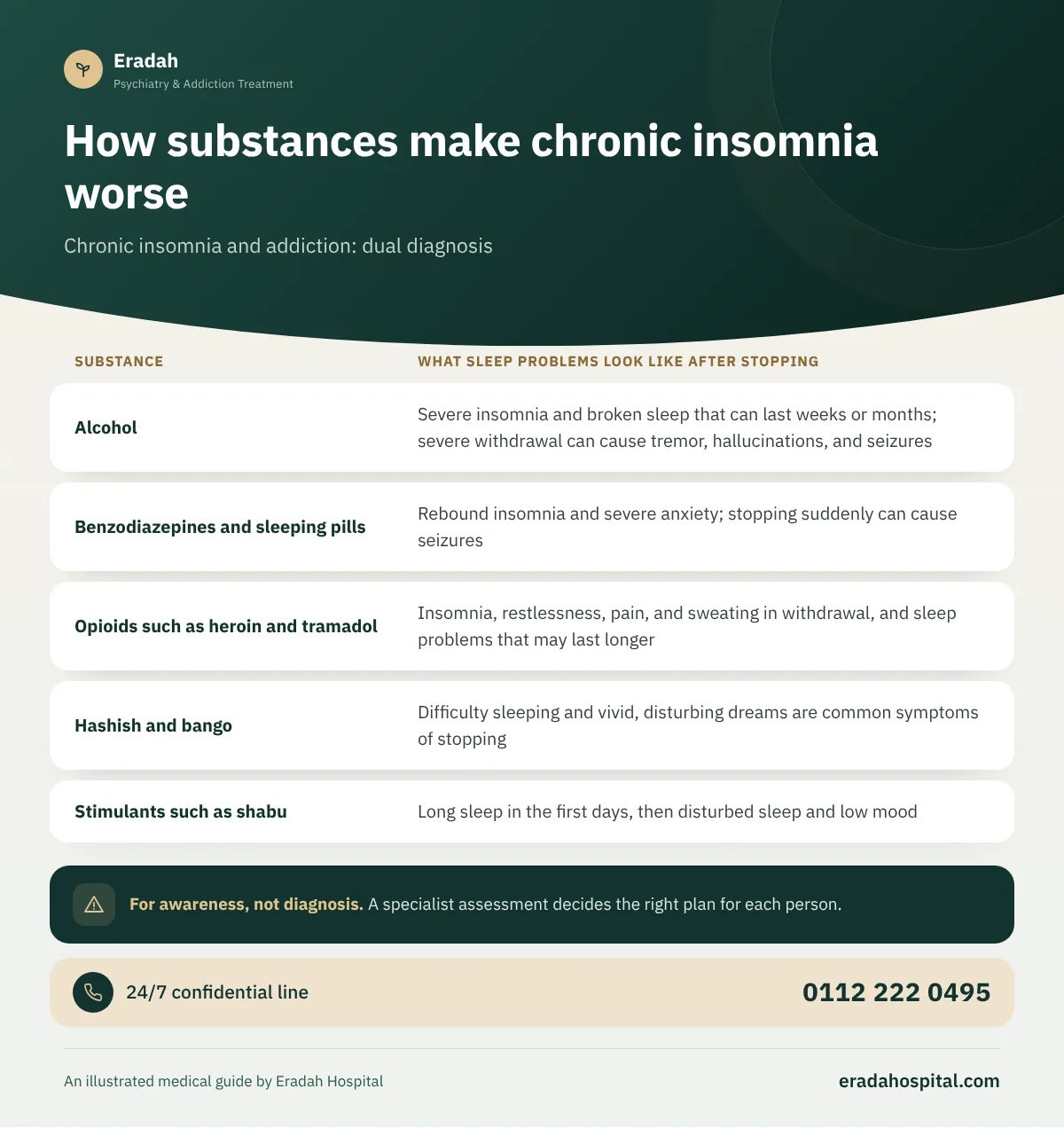
When the brain gets used to a substance that calms or stimulates it, it resets its sleep and wake systems around it. When the substance is stopped, this setting is thrown off for a while, and what is called withdrawal insomnia appears. Its form differs by substance:
| Substance | What sleep problems look like after stopping |
|---|---|
| Alcohol | Severe insomnia and broken sleep that can last weeks or months; severe withdrawal can cause tremor, hallucinations, and seizures |
| Benzodiazepines and sleeping pills | Rebound insomnia and severe anxiety; stopping suddenly can cause seizures |
| Opioids such as heroin and tramadol | Insomnia, restlessness, pain, and sweating in withdrawal, and sleep problems that may last longer |
| Hashish and bango | Difficulty sleeping and vivid, disturbing dreams are common symptoms of stopping |
| Stimulants such as shabu | Long sleep in the first days, then disturbed sleep and low mood |
Why does insomnia threaten recovery from addiction?
In the first months of recovery, long sleepless nights can be the hardest moments: exhaustion, boredom, heavy thoughts, and a memory telling you the substance used to “solve the problem.” This is why ongoing sleep problems after stopping are linked to a higher risk of relapse, and many people in recovery feel that insomnia was one of the strongest things pushing them back. So treating sleep is at the core of a recovery program, because it is part of relapse prevention.
What signs should cause concern?
- Cannot sleep without a pill or a drink every night for weeks or months.
- The amount has increased or a stronger medicine is needed for the same effect.
- Gets sleeping pills from more than one doctor or without a prescription.
- Also takes the sedative during the day to calm anxiety.
- Combines sleeping pills with alcohol or opioid painkillers.
- Develops severe anxiety or tremor if late for the next dose.
- Forgets things done at night after taking the sleeping pill.
How are insomnia and addiction treated together?
- A comprehensive assessment of the substance, how long it has been used and how much, the insomnia, and any co-occurring mood problems, anxiety, and trauma.
- Safe withdrawal under medical supervision, gradual in the case of sedatives, and with close monitoring in the case of alcohol because of the risk of seizures.
- Treating insomnia without substances that cause dependence: CBT for insomnia, adapted to the stage of recovery and started early.
- Medication with caution: if the patient needs a sleep medicine, the doctor chooses one that does not carry a risk of misuse, and avoids sedatives that cause dependence.
- Treating co-occurring conditions: the depression, anxiety, and trauma that fed both the insomnia and the substance use.
- A relapse prevention plan that includes nights of insomnia as a high-risk situation with a ready plan.
What should you expect from your sleep in recovery?
To be honest, sleep may be disturbed in the first weeks after stopping, and it improves gradually with time and treatment. Knowing this in advance helps you avoid reading hard nights as “the body can only sleep with the substance.” With fixed schedules, avoiding caffeine in the evening, and applying behavioral therapy skills, sleep returns to an acceptable rhythm in most people in recovery.
How can the family help?
- Do not keep extra sleeping pills or sedatives at home, and return old medicines to the pharmacy for safe disposal.
- Never share your medicines, even “for one night.”
- Understand that insomnia in recovery is real and temporary, and encourage patience with it instead of a return to the substance.
- Help with a fixed routine for sleeping and waking and daytime activity.
- If you notice signs of dependence on a sleeping pill, talk calmly and suggest a specialist assessment.
Insomnia and addiction treatment at Eradah
At Eradah we work every day with patients whose addiction began with a sleeping pill or a drink “to sleep,” and with people in recovery who are threatened by withdrawal insomnia. We provide safe withdrawal from sedatives and alcohol under round-the-clock medical supervision, and an insomnia program using cognitive behavioral therapy without medicines that cause dependence, along with treatment of any co-occurring psychiatric disorder. Learn more about dual diagnosis. All of this in complete confidentiality.
Insomnia with suicidal thoughts or severe hopelessness? Get help now
- Talking about wanting to die, or saying that eternal sleep would be better than this exhaustion
- Severe hopelessness and a feeling that the suffering will never end, with sleep collapsing for days in a row
- Taking increasing amounts of sleeping pills or mixing them with alcohol or sedatives
- Severe confusion, seizures or hallucinations after suddenly stopping a sedative or alcohol
- Irresistible sleepiness that puts the person or others at risk, such as falling asleep while driving
Stay with the person and listen calmly and without judgment, ask them directly about their thoughts, and do not leave them alone. Call an ambulance (123) or go to the nearest emergency room, or call the mental health support line 16328, and keep sleeping pills, sedatives and anything that could hurt them out of their reach.
Ambulance 123 Mental health support line 16328