What is tapentadol?
Tapentadol is a painkiller from the opioid family, made entirely in laboratories and not extracted from the poppy plant. It was first approved in the United States in 2008, and then spread to many countries for relieving severe pain that ordinary painkillers cannot manage.
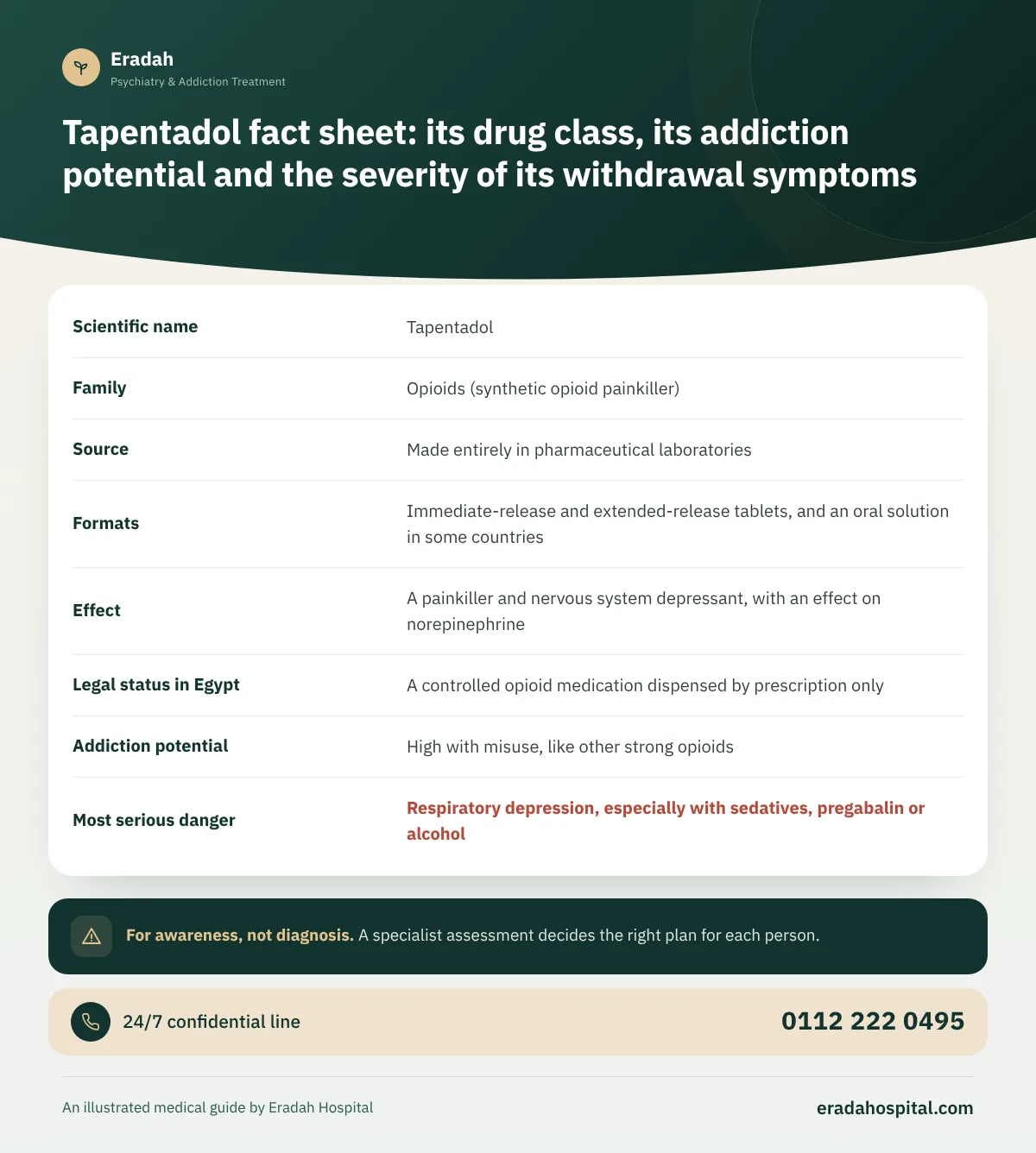
In the United States, tapentadol is classified as a Schedule II controlled substance, the same category that includes morphine and oxycodone, which reflects the strength of its opioid effect and its high potential for misuse. Its official prescribing information opens with a prominent warning about the risk of addiction, overdose and respiratory depression.
Many people confuse it with tramadol because of the similar name and the dual mode of action, and they think it is a “mild” painkiller that can be taken without worry. In fact its effect on opioid receptors is stronger and more direct, which is why it must be treated with more caution, not less.
It is important to distinguish between a patient who takes tapentadol by prescription and for a set period to relieve real pain, and someone who takes it without a prescription, in larger amounts, or to chase euphoria. The medication is the same, but the risk differs greatly depending on the pattern of use and medical follow-up.
Forms of tapentadol
Licensed tapentadol comes in more than one dosage form, and the form available differs from one country to another:
Usually used to relieve acute pain for a short period, such as pain after surgery and injuries.
They release the drug slowly over the day for people with severe chronic pain, and breaking or chewing them is dangerous because it releases the whole amount at once.
Available only in some countries, and dispensed under the same controls.
Tablets of unknown origin and strength that are smuggled in some markets, and the most dangerous of what circulates under the name tapentadol.
How does tapentadol affect the brain?
Tapentadol acts through two mechanisms at the same time, and both contribute to pain relief according to the drug’s official prescribing information:
| The mechanism | What it does | What follows from it |
|---|---|---|
| Activating opioid receptors | Binds to them directly, without needing conversion in the liver | Pain relief accompanied by euphoria, drowsiness and respiratory depression, as well as addiction |
| Blocking norepinephrine reuptake | Raises the level of this neurotransmitter in the pain pathways of the spinal cord and brain | Extra pain relief, especially for nerve pain, with an effect on heart rate and blood pressure |
Unlike tramadol, which needs an enzyme in the liver to turn into its active substance, tapentadol acts on its own, and no active metabolites result from it. This makes its effect more consistent from person to person, but it also reaches opioid receptors more strongly.
With repeated use, the brain adapts to tapentadol as it does to any other opioid: the same amount has less effect, the person needs more, and distressing symptoms appear when it is stopped. This is the biological beginning of dependence, which can turn into addiction with misuse.
Some people think tapentadol is a diluted version of tramadol. In fact it is an opioid that acts directly on opioid receptors, and it deserves the same caution we apply to morphine.
The medical use of tapentadol
Tapentadol has a real place in medicine. It is prescribed for severe acute pain and, in some countries, for diabetic nerve pain and severe chronic pain that requires a daily opioid painkiller. The doctor decides the form, dose and duration according to the condition, liver function and the other medications the patient takes.
- Take it only with a doctor’s prescription, and only for the duration the doctor sets.
- Tell your doctor if you have epilepsy, liver or lung disease, or sleep apnea.
- Tell them about all your medications, especially antidepressants, sedatives, pregabalin and gabapentin.
- Do not combine it with alcohol or any sedative without your doctor’s knowledge.
- Store it locked away from children; accidental swallowing can be fatal for them.
- Do not stop it suddenly or change your prescribed dose except on your doctor’s direction.
Is tapentadol widespread in Egypt?
There are as yet no reliable published figures on the extent of tapentadol misuse in Egypt. But its name appeared among the substances covered by decisions updating Egypt’s drug schedules in recent years, which reflects the regulators’ attention to it.
Globally, the International Narcotics Control Board has noted that traffickers in some African countries shifted from tramadol to tapentadol after controls on the former were tightened, a pattern specialists fear may repeat in any market where tramadol is restricted. For this reason we believe that raising families’ awareness of it early is a necessity, not a luxury.
Tapentadol compared with tramadol and other opioids
Tapentadol is often compared with other painkillers, and these are the most important differences in simplified form:
| Substance | How they work | Medical use | Main risk |
|---|---|---|---|
| Tapentadol | Direct opioid with an effect on norepinephrine | Severe acute and chronic pain | Respiratory depression and addiction |
| Tramadol | Needs conversion in the liver, with a strong effect on serotonin | Moderate to severe pain | Seizures and serotonin syndrome |
| Morphine | Natural direct opioid | Severe pain in hospitals | Respiratory depression |
| Pregabalin | Not an opioid; acts on calcium channels | Nerve pain and epilepsy | Multiplies respiratory depression when mixed with opioids |
Mixing any opioid with pregabalin or sedatives is one of the most dangerous known patterns of use in Egypt, because it multiplies the depression of breathing and consciousness even if each substance alone seems “tolerable.”
Tapentadol and the law in Egypt
In Egypt, tapentadol is a controlled opioid medication dispensed only by prescription, and possessing or circulating it without a medical basis falls under Law No. 182 of 1960 on drug control and its amendments. Egypt’s drug schedules have seen successive amendments, so the latest Ministry of Health decisions should always be consulted.
The Fund for Drug Control and Treatment of Addiction offers free, confidential treatment through hotline 16023, alongside specialized centers, and seeking treatment does not expose the patient to legal liability.
This is general awareness information and is not legal advice.
Tapentadol guide: everything you need to know
We have gathered everything about tapentadol into 6 pages, each answering one question in detail. Choose what you are looking for:
Harms of tapentadol
From respiratory depression and addiction to its effects on hormones, the liver and mood, the danger of mixing it with sedatives and antidepressants, and its harms in pregnancy.
Causes of tapentadol addiction
Why does a prescribed painkiller turn into addiction? The strength of its opioid effect, chronic pain, moving over from tramadol, and psychological and environmental factors.
Symptoms of tapentadol addiction
The physical, behavioral and psychological signs a family may notice, the diagnostic criteria, and when use becomes addiction.
Tapentadol withdrawal symptoms
Opioid withdrawal symptoms that begin within hours of the last dose and peak in the first days, and why medical supervision is needed.
Treatment of tapentadol addiction
From assessment and safe withdrawal to supporting medications, psychological therapy, an alternative pain plan and relapse prevention.
How long tapentadol stays in the body
How long it stays in urine, blood, saliva and hair, and why it does not show up on the traditional opioid test.
Do you think a family member is misusing tapentadol?
The family may not even know the name of the medication, and the person may justify it by pain or exhaustion. These steps help you start in the right way:
- Do not dismiss it on the grounds that it is “a medicine from the pharmacy”; dependence on opioids is a real illness.
- Talk to them at a calm time, and tell them you are worried about them, without accusation or threats.
- If the medication was prescribed for genuine pain, suggest that you both see the treating doctor.
- Do not cut off the medication suddenly at home, especially if they take it with sedatives or pregabalin.
- Learn the overdose signs listed below and the ambulance number, 123.
- Seek specialized consultation for family members, even if the person refuses treatment at first.
Signs of tapentadol overdose: call an ambulance (123) immediately
- Very slow, shallow or stopped breathing, or unusual snoring during sleep
- Pupils that are extremely small, like pinpoints
- Extreme drowsiness and difficulty waking, or loss of consciousness and no response to being called
- Blue lips and nails, cold skin and a slow pulse
- Seizures, or agitation with fever, heavy sweating and shaking if it was mixed with drugs that raise serotonin
Call an ambulance on 123 immediately, place the person on their side (recovery position) so they do not choke, give them nothing by mouth, stay with them until help arrives, and keep the medication box. Emergency doctors use naloxone to reverse the respiratory depression caused by opioids.
Call the ambulance 123