What are benzodiazepines?
“I’m only taking a pill for my nerves, it’s not drugs.” We hear this sentence often in the clinic, and what is usually meant is a benzodiazepine tablet. The truth is that these medicines are not “drugs” when used by prescription and for a limited time, but they are also not as harmless as many people think when they are taken for long periods or mixed with other substances.
Benzodiazepines are a large group of medicines that are similar in chemical structure and in the way they act on the brain, and differ in how quickly they start working and how long the effect lasts. According to the US Food and Drug Administration, chlordiazepoxide was the first approved medicine in this family, in 1960, and others followed in the 1960s and 1970s, including Valium, Xanax, Rivotril and lorazepam.
A 2018 Cochrane review notes that about 4% of the general population use them, and that the proportion is higher among older adults and people with psychiatric disorders.
Medical uses of benzodiazepines
The guide by Professor Heather Ashton, one of the best-known references in this field, summarizes the effects of this family as five: calming anxiety, inducing sleep, relaxing muscles, preventing seizures, and temporarily impairing memory. Their uses follow from these:
Rapid calming of anxiety and panic attacks, as a temporary bridge to a lasting treatment.
Some of them are marketed as sleeping pills, and in principle they should not be continued for more than a few weeks.
Given by injection in hospital to stop prolonged epileptic seizures, and some are prescribed for certain types of epilepsy.
Within a medical protocol to calm alcohol withdrawal symptoms and prevent complications.
For calming before operations and endoscopies, where their effect on memory is put to use.
To relax the muscles in some cases of muscle spasm.
The 2025 guidelines of the American Society of Addiction Medicine explain that their benefit in insomnia fades within days to weeks because the receptors adapt, while their risks remain.
How do benzodiazepines work in the brain?
The brain has a calming chemical messenger called GABA, which acts on receptors known as GABA-A that open small channels through which chloride ions enter the nerve cell, calming it. According to a StatPearls review, benzodiazepines increase how often these channels open in the presence of GABA, so nerve cell activity falls and the desired depressant effect occurs.
But the brain adapts. Ashton’s guide states that tolerance to the drowsiness effect usually appears within a week or two, and the 2025 guidelines say physical dependence can form within weeks and varies from person to person. Once the brain has adapted to the presence of the medicine, its sudden absence becomes a shock, and this is the origin of benzodiazepine withdrawal symptoms, as the guide to GABA and addiction explains.
Names of benzodiazepine medicines in Egypt
Many people search for the names of benzodiazepine medicines in Egypt to find out whether the medicine their doctor prescribed is one of them. The rule is to read the generic name written on the box, because one substance may be sold under more than one brand name:
| Active ingredient | Some brand names | Best-known use | Detailed guide |
|---|---|---|---|
| Alprazolam | Xanax | Anxiety and panic attacks | Xanax |
| Clonazepam | Rivotril, with local alternatives including Amotril and Aptril | Epilepsy and panic attacks | Rivotril |
| Diazepam | Valium | Anxiety, muscle spasms and alcohol withdrawal | Valium |
| Bromazepam | Lexotanil, and Calmepam | Anxiety | — |
| Lorazepam | Ativan internationally, and listed in Egyptian drug price guides as Apo-Lorazepam | Anxiety and calming | Lorazepam |
| Chlordiazepoxide | In the Librax combination with an antispasmodic | Irritable bowel syndrome | Librax |
| Midazolam | Dormicum (injection) | Calming before procedures in hospital | — |
| Flunitrazepam | Rohypnol internationally, known on the street as Roche pills | A sleeping pill in some countries | Roche pills |
Brand names are taken from Egyptian drug price guides unless marked “internationally,” and some may be discontinued or new alternatives may appear.
What are the strongest benzodiazepines?
The question “what is the strongest benzodiazepine” is common, but “strength” here is a pharmacology term meaning the amount of effect per milligram, not that the medicine is necessarily better or more dangerous. Ashton’s guide explains that the difference in potency between members of the family can be up to 20-fold, and alprazolam, lorazepam and clonazepam are counted among the high-potency benzodiazepines.
What matters in practice is that rapid withdrawal, especially from high-potency medicines, can cause seizures according to Ashton, and that alprazolam is linked to faster onset of dependence according to the 2025 guidelines. So the more accurate question is “which is most suitable for my condition and for how long?” rather than “which is strongest?”, and that is your doctor’s decision.
Types of benzodiazepines by duration of action
Doctors usually classify benzodiazepines by “half-life,” meaning the time the body needs to clear half of the medicine from the blood. Ashton’s guide notes that the noticeable effect usually wears off long before that, but the medicine keeps working quietly for as long as it is present:
| Short-acting | Intermediate-acting | Long-acting | |
|---|---|---|---|
| Examples | Triazolam, and alprazolam (Xanax) | Lorazepam, bromazepam and temazepam | Diazepam (Valium), clonazepam (Rivotril) and chlordiazepoxide |
| Approximate half-life | About 2 hours for triazolam, and 6 to 12 hours for alprazolam | Roughly 8 to 22 hours | 18 to 100 hours for clonazepam and diazepam, and the active by-products of diazepam and chlordiazepoxide may remain for up to 200 hours |
| What it means for the patient | A fast effect that wears off quickly, and anxiety may return between doses | Somewhere between the two categories | A gentler effect, but it builds up with repeated use, especially in older adults |
| Onset of withdrawal after stopping | Earlier | Between the two categories | Slower, and it may mislead the patient into thinking they have escaped it |
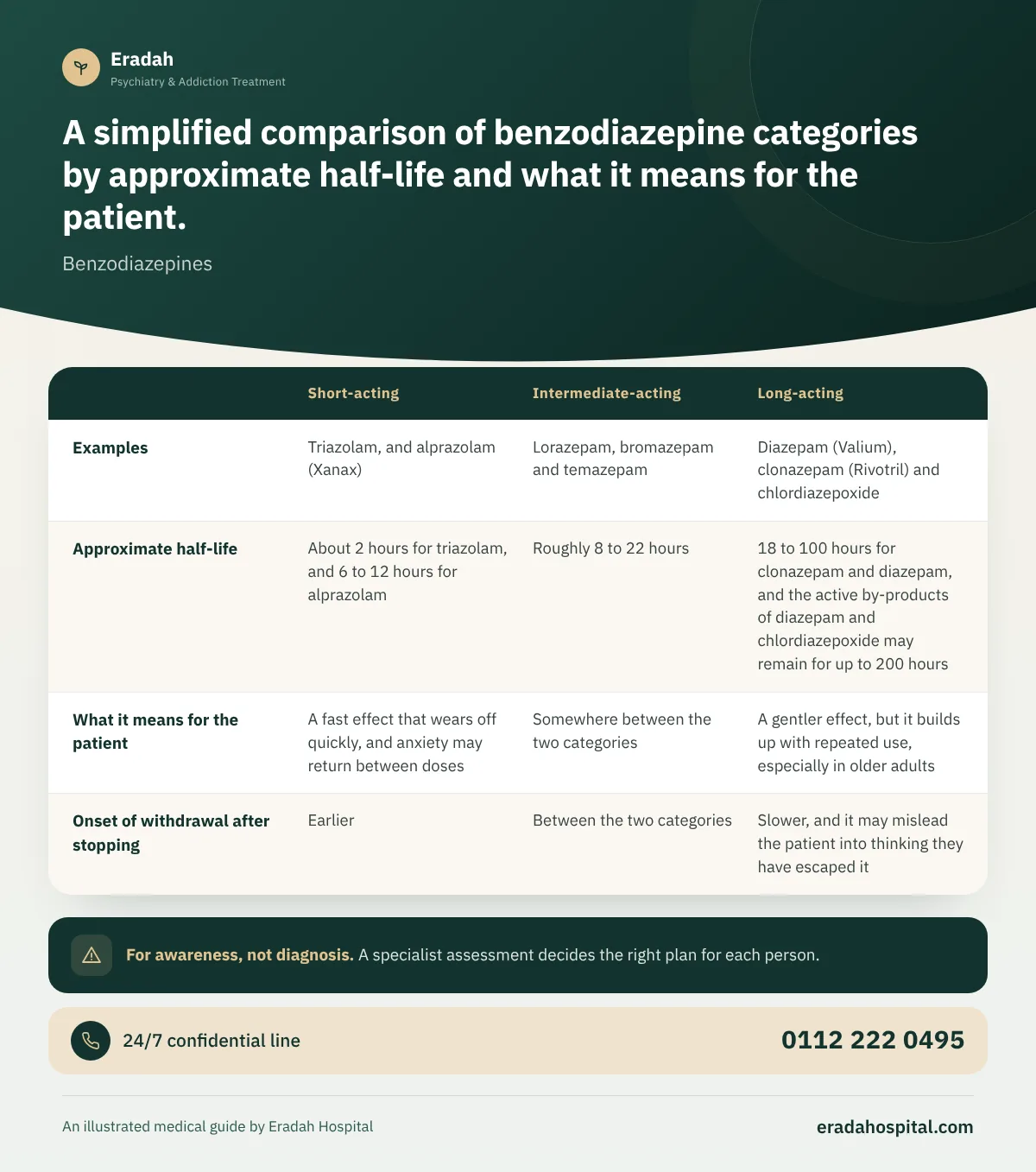
Half-lives are from the first table in Ashton’s guide; they are approximate and vary greatly between individuals. Dividing them into three categories is a common simplification, and not all references agree on fixed boundaries.
Are zolpidem and Night Calm benzodiazepines?
No. Zolpidem and Night Calm are “Z-drug” sleeping pills. Ashton’s guide classifies them as medicines that are chemically different from benzodiazepines but work by the same mechanism and have similar effects, which is why they share the risk of dependence and interaction with alcohol. Likewise, pregabalin is not a benzodiazepine; it works by a completely different mechanism, though it overlaps with them in sedation and in the risk of mixing with opioids. Barbiturates are an older generation of sedatives that benzodiazepines replaced in most uses.
Why are benzodiazepines misused?
- Staying on the medicine for months after the crisis it was prescribed for has ended.
- Raising the dose on one’s own when the effect weakens with tolerance.
- Using it to numb everyday stress or to sleep every night without follow-up.
- Mixing it with tramadol, alcohol or other substances to increase the effect.
- Getting it from a friend or from more than one doctor, or buying tablets of unknown origin.
US Food and Drug Administration data show that about 50% of patients who were dispensed oral benzodiazepines in 2018 stayed on them for two months or more, and that the harms of misuse occur mainly when they are combined with other medicines or substances. In Egypt they are often mixed with tramadol, which is among the most dangerous patterns.
The legal status of benzodiazepines in Egypt
In Egypt, benzodiazepines are prescription-only medicines, and dispensing or trading in them outside a medical setting is an offense. Decree No. 44 of 2026 of the Minister of Health and Population, published in the Egyptian Gazette on 17 February 2026, replaced the schedules attached to Narcotics Law No. 182 of 1960, and according to press reports the new schedules include some benzodiazepine compounds among the controlled psychotropic substances, while allowing pharmaceutical preparations to be circulated by prescription and within regulations. For anyone who needs help, the Fund for Drug Control and Treatment of Addiction offers hotline 16023.
This is general awareness information and not legal advice, and we do not state here which schedule each medicine falls under.
Benzodiazepines in brief: harms, withdrawal, treatment and testing
Forgetfulness, daytime drowsiness and falls in older adults, and a fatal risk when combined with opioids or alcohol.
It usually begins days after stopping, with anxiety, insomnia and tremor, and may reach seizures if stopped suddenly.
Individual gradual reduction with psychological therapy, and treatment of the cause for which the medicine was started.
They usually show up in urine for days to weeks, but some test strips do not pick up every member of the family.
Each area has a detailed page: harms of benzodiazepines, benzodiazepine withdrawal and its duration, benzodiazepine addiction treatment, and how long benzodiazepines stay in the body.
Benzodiazepines Guide: Everything You Need to Know
We have gathered everything about benzodiazepines into 5 pages, each answering one question in detail. Choose what you are looking for:
Harms of benzodiazepines to the body and mind
Harms of benzodiazepines: drowsiness, memory impairment and falls, the danger of mixing them with opioids and alcohol, the dementia debate, their effect on older adults and pregnancy, and what improves after stopping.
Symptoms of benzodiazepine addiction: signs families overlook
Symptoms of benzodiazepine addiction: the physical, behavioral and psychological signs, the difference between the dependence expected with a prescription and addiction, and danger signs that call for an ambulance.
Benzodiazepine withdrawal symptoms and how long they last
Benzodiazepine withdrawal symptoms: when they start and how long they last, the difference between acute and protracted withdrawal, the risk of seizures, and why gradual reduction under medical supervision is necessary.
Benzodiazepine addiction treatment
Benzodiazepine addiction treatment step by step: assessment, individualized gradual reduction, cognitive behavioral therapy, treatment of anxiety and insomnia, when residential care is needed, and how to prevent relapse.
How long benzodiazepines stay in the body
How long benzodiazepines stay in the body: how long they remain in urine, blood and hair, why a rapid test sometimes misses Rivotril and lorazepam, and medicines that give a false positive.
Tips for families: a sedative at home, or a growing problem?
- Keep sedatives locked away, and watch for unexplained shortages.
- Do not give anyone a sedative prescribed for someone else, even with the intention of calming them.
- Watch for daytime drowsiness, slurred speech, forgetfulness and falls, especially in older adults.
- If you notice it being mixed with tramadol or alcohol, that is a danger sign that calls for quick action.
- Do not encourage sudden stopping; the safe path is a doctor who sets a reduction plan, and you can start with the Family Guide.
Danger signs after using benzodiazepines: call ambulance (123) immediately
- Deep sleep from which the person cannot be woken by calling or shaking.
- Slow, shallow or irregular breathing, or bluish lips.
- Severe slurred speech, unsteadiness and confusion after taking a sedative with alcohol, tramadol or any opioid painkiller.
- Seizures, hallucinations or severe confusion within days of suddenly stopping a sedative that was used for a long time.
- Taking tablets of unknown origin that are said to be “Xanax” or “Rivotril.”
Call ambulance (123) immediately and do not wait for them to “sleep it off.” If the person is unconscious but breathing, place them on their side in the recovery position, stay with them and watch their breathing until the paramedics arrive, and do not give them any sedative, stimulant or food. Tell the paramedics what they took, the approximate amount and the time, bring the medicine box if you find it, and tell them if the person also drank alcohol or took an opioid painkiller.
Call the ambulance 123