What are barbiturates?
Barbiturates are medicines that slow the activity of the central nervous system. For decades they were the “sedatives” and “sleeping pills” in most pharmacies, before giving way to safer medicines.
Examples cited by the US National Institute on Drug Abuse (NIDA) include phenobarbital, secobarbital, methohexital and primidone. They belong to the family of sedatives and sleeping pills, but they are its oldest members and have the narrowest safety margin.
A scientific review published in 2021 explains that barbiturates were among the first sedatives to act on GABA receptors, and that their medical use has shrunk for most indications because of their dangerous effects and strong potential for misuse, although they are still used illicitly around the world.
What is phenobarbital used for today?
According to MedlinePlus, phenobarbital is used to control epileptic seizures, sometimes to relieve anxiety, and to prevent withdrawal symptoms in people who are dependent on other barbiturates and want to stop. Some short-acting barbiturates are also used for anesthesia in hospitals. A medical review of sedative withdrawal syndromes notes that phenobarbital is one of the medicines doctors use under monitoring to control alcohol and sedative withdrawal.
How do barbiturates work in the brain?
As the MSD Manual explains, barbiturates bind to type A GABA receptors, the same receptors that benzodiazepines act on, and strengthen their calming effect. A StatPearls review explains that they prolong the time the receptor channel stays open and, at the same time, weaken the brain’s response to the stimulating transmitter glutamate. The result is calming, drowsiness and prevention of seizures, but as the amount rises, the depression extends to the breathing centers in the brainstem, so breathing weakens and may stop.
Forms and names of barbiturates
Barbiturates come as tablets, capsules and syrup, and some are injections used in hospitals. NIDA lists some of their US brand names: Seconal for secobarbital, Brevital for methohexital, and Mysoline for primidone. In Egypt, Sominaleta is one of the best-known brand names for phenobarbital, and it is also available under its generic name. Common street names worldwide include “barbs” and “reds.”
Why are barbiturates misused?
MedlinePlus explains that most people who take these medicines for epilepsy or pain syndromes do not misuse them, and that those who do often start with a medicine prescribed to them or to a family member. Common patterns include:
- Increasing the amount without consulting the doctor, seeking deeper sleep or calm.
- Using a family member’s medicine without a prescription.
- Deliberately mixing them with alcohol or opioids to alter consciousness, which MedlinePlus warns against because it can lead to coma or death.
- Using them to soften the effect of other substances, or their withdrawal, without supervision.
The difference between barbiturates and benzodiazepines
| Barbiturates | Benzodiazepines | |
|---|---|---|
| Safety when used alone | Lower, with more serious effects | Relatively higher, which is why they replaced barbiturates |
| How they work | Prolong GABA channel opening and weaken glutamate | Increase the receptor’s affinity for GABA |
| Antidote | No direct antidote | An antidote exists, used with caution in hospital |
| Use today | Limited: epilepsy and some hospital uses | Wide: anxiety, insomnia and epilepsy |
| Withdrawal | Can be life-threatening and resembles alcohol withdrawal | Can be dangerous and needs gradual reduction |
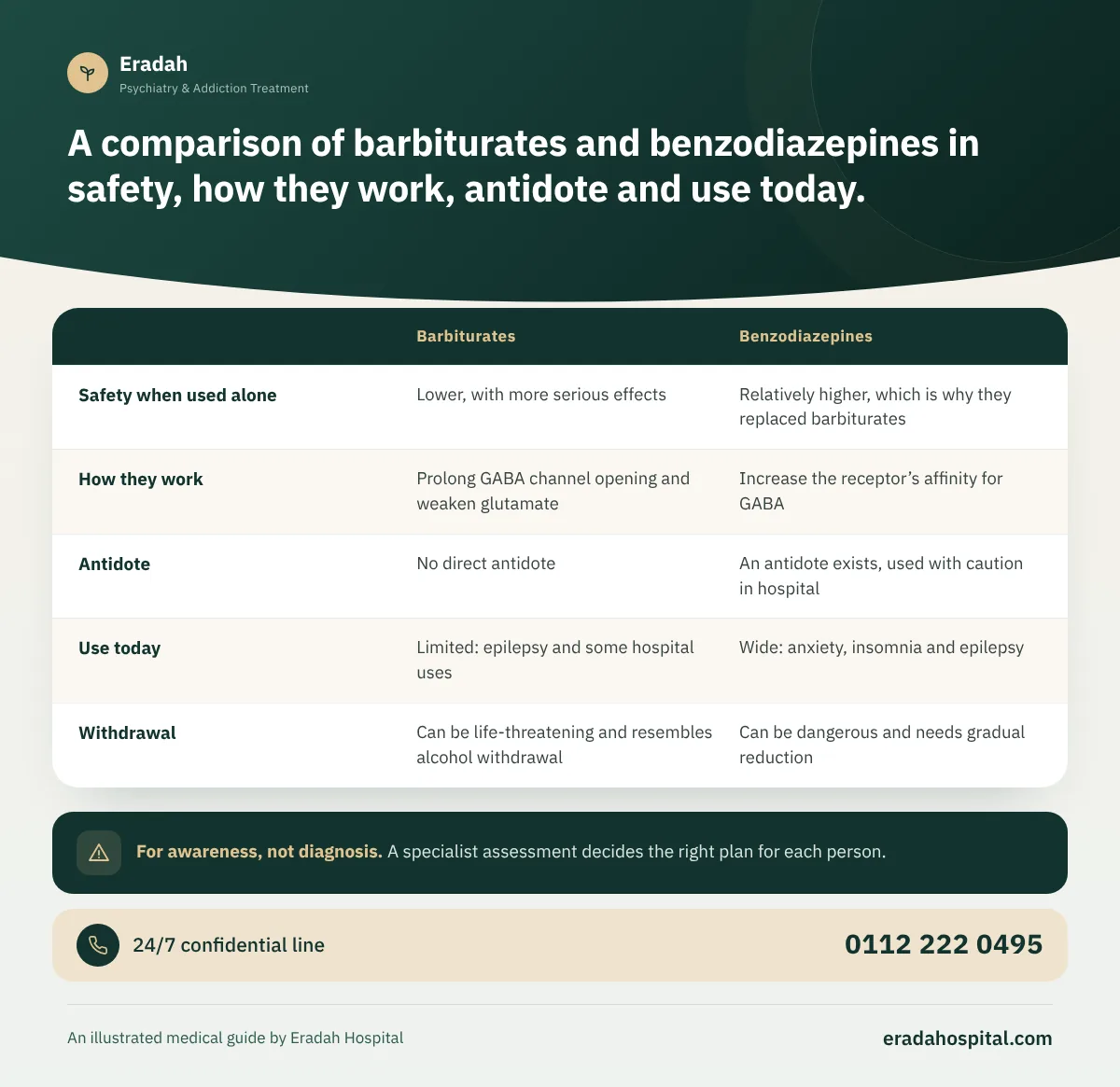
The 2021 review sums up the idea: benzodiazepines replaced barbiturates for most indications because they are less likely to cause serious effects when used alone. But this does not mean benzodiazepines are always safe; they also carry risks of addiction and withdrawal, as with Valium and Roche pills.
The legal status of barbiturates
In Egypt, barbiturates are prescription-only medicines, and trading in them or using them outside a medical setting is an offense. In the United States, for example, they fall under different controlled schedules depending on the type, according to NIDA. For anyone struggling with misuse of them, the Fund for Drug Control and Treatment of Addiction offers free, confidential treatment through hotline 16023.
This is general educational information and not legal advice.
Barbiturates Guide: Everything You Need to Know
We have gathered everything about barbiturates into 2 pages, each answering one question in detail. Choose what you are looking for:
Harms of barbiturates to the body and mind
Learn about the harms of barbiturates and phenobarbital: overdose and respiratory depression, why there is no direct antidote, complications of loss of consciousness, and effects on memory and pregnancy.
Barbiturate withdrawal symptoms and how long they last
When do barbiturate withdrawal symptoms start and how long do they last? The withdrawal timeline, why stopping phenobarbital suddenly can cause seizures and delirium, and how to stop safely.
Epilepsy medicine from the barbiturate group at home? Tips for families
- Keep the medicine locked away, out of reach of children and other family members, because much misuse begins with a relative’s medicine.
- Do not give it to anyone else, even if their symptoms are “similar.”
- Keep to the appointments for tests and follow-ups that the doctor requests, and do not change the dose without consulting them.
- Avoid alcohol completely while using it, and tell any doctor or dentist that you take it.
- If you notice unusual drowsiness, unsteadiness or slurred speech in someone who takes it, take them to the doctor.
- Learn the danger signs listed at the bottom of the page, and save the ambulance number, 123.
Harms, symptoms, withdrawal and treatment in brief
Harms: The most serious is an overdose that depresses breathing, especially with alcohol or opioids, along with chronic effects on memory and concentration. Details are in harms of barbiturates.
Symptoms: They resemble intoxication: drowsiness, slow slurred speech, unsteadiness, difficulty thinking and poor judgment, and with long-term use, irritability and impaired memory, according to MedlinePlus.
Withdrawal: It can be life-threatening and includes tremor, agitation, seizures and delirium, which is why it is done only gradually and under supervision. Details are in barbiturate withdrawal symptoms.
Treatment: According to NIDA there are no medications approved specifically for sedative addiction, but treatment is effective: medical detox with slow reduction and monitoring for seizures, then cognitive behavioral and motivational therapy, within an addiction treatment plan suited to each case.
Danger signs after using barbiturates: call ambulance (123) immediately
- A change in level of consciousness, great difficulty waking, or coma
- Shallow, slow or irregular breathing
- Slow, slurred speech, severe unsteadiness and confused thinking
- Low body temperature or blisters on the skin after taking a large amount
- Seizures, delirium or hallucinations after suddenly stopping barbiturates
Call ambulance (123) immediately. If the person is unconscious but breathing, place them on their side so they do not choke on vomit. Stay with them and do not leave them alone to “sleep it off.” Do not give them food, drink or any medicine, and tell the paramedics everything you know about what they took and when.
Call the ambulance 123