What is Valium?
Valium is a sedative whose active ingredient is diazepam. It was among the first benzodiazepines, introduced in the 1960s, and for years it was one of the most prescribed medicines in the world. It calms overactive nervous system activity, which eases anxiety, relaxes muscles and stops seizures.
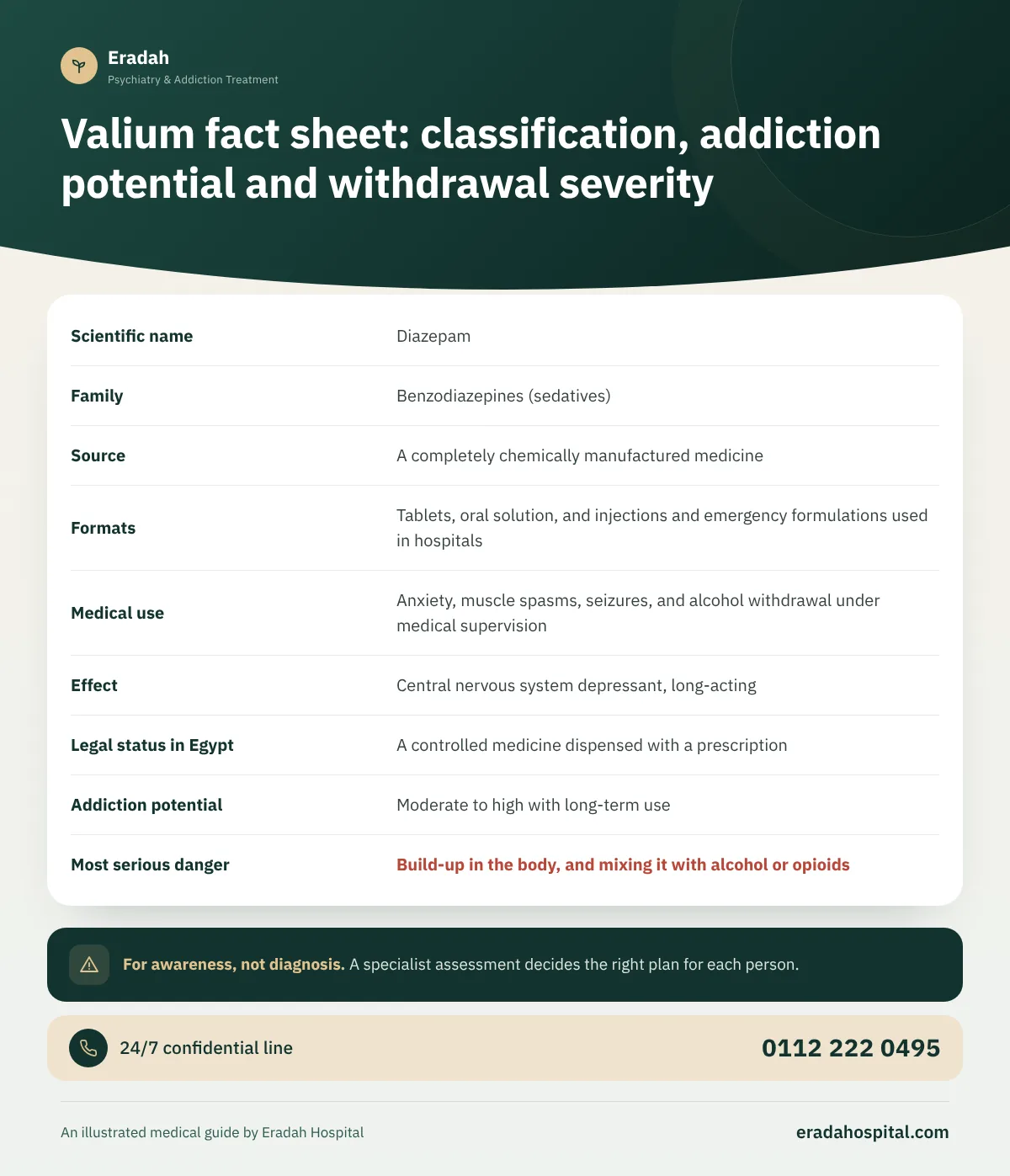
What sets Valium apart from many of its relatives is that it does not leave the body quickly. In the liver, diazepam is converted into other active substances, the most important being desmethyldiazepam, and these stay in the blood longer than the original drug. This is a double-edged property: it makes the effect smoother and steadier, but it allows the drug to build up with repeated use.
Because Valium has important medical uses, we are not urging people to avoid it when a patient needs it. What we want is for you to understand when it helps, when it becomes a problem, and why its use should be time-limited and monitored.
Forms of Valium and its medical uses
Diazepam is available under several brand names and in different forms, and the doctor chooses the one that suits the condition:
The forms most often used in clinics to treat anxiety and muscle spasms.
Used in emergencies to stop prolonged seizures and to calm acute conditions.
In some countries, emergency formulations are prescribed for people with epilepsy to use when seizures recur.
It may be given before some tests or operations to reduce tension, under the supervision of the medical team.
How does Valium affect the brain and body?
Like other benzodiazepines, diazepam enhances the action of GABA, the neurotransmitter responsible for calming activity in the brain and spinal cord. The result is a set of effects that medicine makes use of, but that become dangerous when the drug is misused:
- Anti-anxiety: eases tension and fear.
- Muscle relaxant: eases muscle spasm and stiffness, which is why it is used in some neurological conditions and injuries.
- Anticonvulsant: stops acute seizures, hence its important role in emergencies.
- Sedative and sleep-inducing: causes drowsiness, and the effect may last into the next day.
- Respiratory depressant: usually a limited effect on its own, but dangerous with alcohol or opioids.
Why does Valium stay in the body so long?
According to clinical pharmacology references, the half-life of diazepam is about 46 hours, and that of its active product, desmethyldiazepam, is about 100 hours, and it can be longer in older adults and people with liver disease. This means the body needs many days to clear the drug after the last dose.
Sources: StatPearls (Diazepam) and the diazepam page on the UK National Health Service (NHS) website. Figures are approximate and vary from person to person.
This property explains why some people feel sluggish the next morning, why the drug can build up if doses are repeated day after day, and why withdrawal symptoms are delayed after stopping compared with short-acting sedatives.
Why do doctors use Valium for alcohol withdrawal and for tapering sedatives?
It may seem strange to use a drug that can cause dependence to treat dependence itself, but there is clear medical logic behind it. Alcohol withdrawal can cause life-threatening seizures and delirium, and benzodiazepines prevent these complications because they act on the same receptors that alcohol affects.
Diazepam is often chosen in this situation because its long action provides steady cover and reduces fluctuations. By the same logic, some doctors switch people who are dependent on short-acting sedatives such as Xanax to diazepam and then reduce it slowly, a principle set out in Professor Heather Ashton's well-known guide to benzodiazepine withdrawal.
Valium compared with Xanax and Rivotril
| Point of comparison | Valium | Xanax | Rivotril |
|---|---|---|---|
| Active ingredient | Diazepam | Alprazolam | Clonazepam |
| Time in the body | Very long, with active breakdown products | Short | Long |
| Main uses | Anxiety, muscle spasms, seizures and alcohol withdrawal | Anxiety and panic attacks | Epilepsy and panic attacks |
| Risk of build-up | High, especially in older adults | Lower | Moderate |
| Timing of withdrawal after stopping | Delayed, and may go beyond a week | Early, within hours to two days | After several days |
This comparison is general and approximate, for awareness purposes only. It is not suitable for comparing doses or for switching between medicines without a doctor.
The legal status of Valium in Egypt
In Egypt, Valium and other diazepam medicines are controlled drugs dispensed by prescription under the rules for psychotropic medicines, and possessing or trading in them without a prescription exposes a person to legal liability. For anyone who needs help, the Fund for Drug Control and Treatment of Addiction offers free, confidential consultation and treatment through hotline 16023.
This is general educational information and not legal advice.
When does Valium use become a problem?
Many people start Valium on prescription for a clear reason: a tight back, anxiety after a crisis, or insomnia during a difficult period. The problem appears when use continues after the reason has passed, becomes daily for months or years without review, or is used for purposes other than what it was prescribed for, such as sleeping every night or easing the after-effects of alcohol and other substances.
Signs worth pausing over include needing a larger amount for the same effect, feeling anxious at the thought of running out, and getting the medicine from more than one source. These signs are not meant to judge the person. They are simply signals that it is time to speak honestly with a doctor.
Myths and facts about Valium
| The myth | The truth |
|---|---|
| Valium is an old, mild drug, so it does not cause addiction | Being old does not make it mild. Like other benzodiazepines, it causes dependence with long-term use. |
| Since it is long-acting, stopping it suddenly is safe | Long action delays withdrawal but does not prevent it, and delayed seizures can occur. |
| If it helped my relative, it will help me | Valium is prescribed according to each patient's condition. Sharing it with others is dangerous and against the law. |
| It can be used to treat alcohol withdrawal at home | This use should only happen within a monitored medical program, because mixing it with alcohol can stop breathing. |
Valium guide: everything you need to know
We have gathered everything about Valium into 4 pages, each answering one question in detail. Choose what you are looking for:
Valium side effects
Build-up and next-day drowsiness, falls in older adults, dependence, and most seriously, slowed breathing when taken with alcohol or opioids.
Valium withdrawal symptoms
They start late because of its long action, but they can be severe and can reach seizures, which is why medical supervision is needed.
Valium addiction treatment
A slow, gradual reduction alongside treatment of the original anxiety or insomnia, and management of any accompanying alcohol dependence.
How long Valium stays in the body
Why it may be detected in urine for weeks after long-term use, and the factors that influence this.
Tips for families if a member is taking Valium
- Find out why it was prescribed and how long it is expected to be used, and ask the doctor about a plan for stopping.
- Watch for daytime drowsiness, stumbling or forgetfulness, especially in older adults.
- Do not allow it to be mixed with alcohol or strong painkillers without the doctor's knowledge.
- Keep the medicine locked away, and do not share it with anyone else, however similar their symptoms.
- If use has gone on for months, ask for a medical review instead of stopping suddenly.
Signs of Valium poisoning: call an ambulance (123) immediately
- Great difficulty waking the person, or no response to calling out or touch
- Slow or weak breathing or unusual snoring, especially with alcohol or opioid painkillers
- Blue or pale lips and cold skin
- Severe confusion and inability to speak or stand
- Seizures days after stopping, which with Valium may come more than a week later
Call an ambulance on 123 immediately, place the person on their side to keep the airway open, and stay with them until help arrives. Bring all the medicines they take, and tell the medical team if they have been drinking alcohol.
Call the ambulance 123