Why does barbiturate withdrawal happen?
With chronic use, the brain adapts to the presence of barbiturates, which enhance the calming effect of GABA, and becomes “dependent” on them to keep its balance. With sudden stopping or a large reduction, the brain loses these brakes, and its nervous activity surges to a level that can cause tremor, seizures and delirium.
The MSD Manual explains that physical dependence develops over weeks to months in people who use them regularly, and that barbiturates and alcohol are similar in dependence and withdrawal symptoms. MedlinePlus stresses that stopping them suddenly can be life-threatening.
What are the symptoms of barbiturate withdrawal?
| Type | Symptoms |
|---|---|
| Psychological and neurological | Anxiety, irritability and agitation, and difficulty falling or staying asleep. |
| Physical | Muscle twitching and tremor in parts of the body, weakness and dizziness, nausea and vomiting, and changes in vision. |
| Circulation | Dizziness or fainting when getting up from lying down. |
| Serious | Seizures, confusion and delirium, psychosis and frightening hallucinations, high temperature and dehydration. |
Sources: MedlinePlus on symptoms of suddenly stopping phenobarbital, NIDA, and the MSD Manual.
Timeline of barbiturate withdrawal
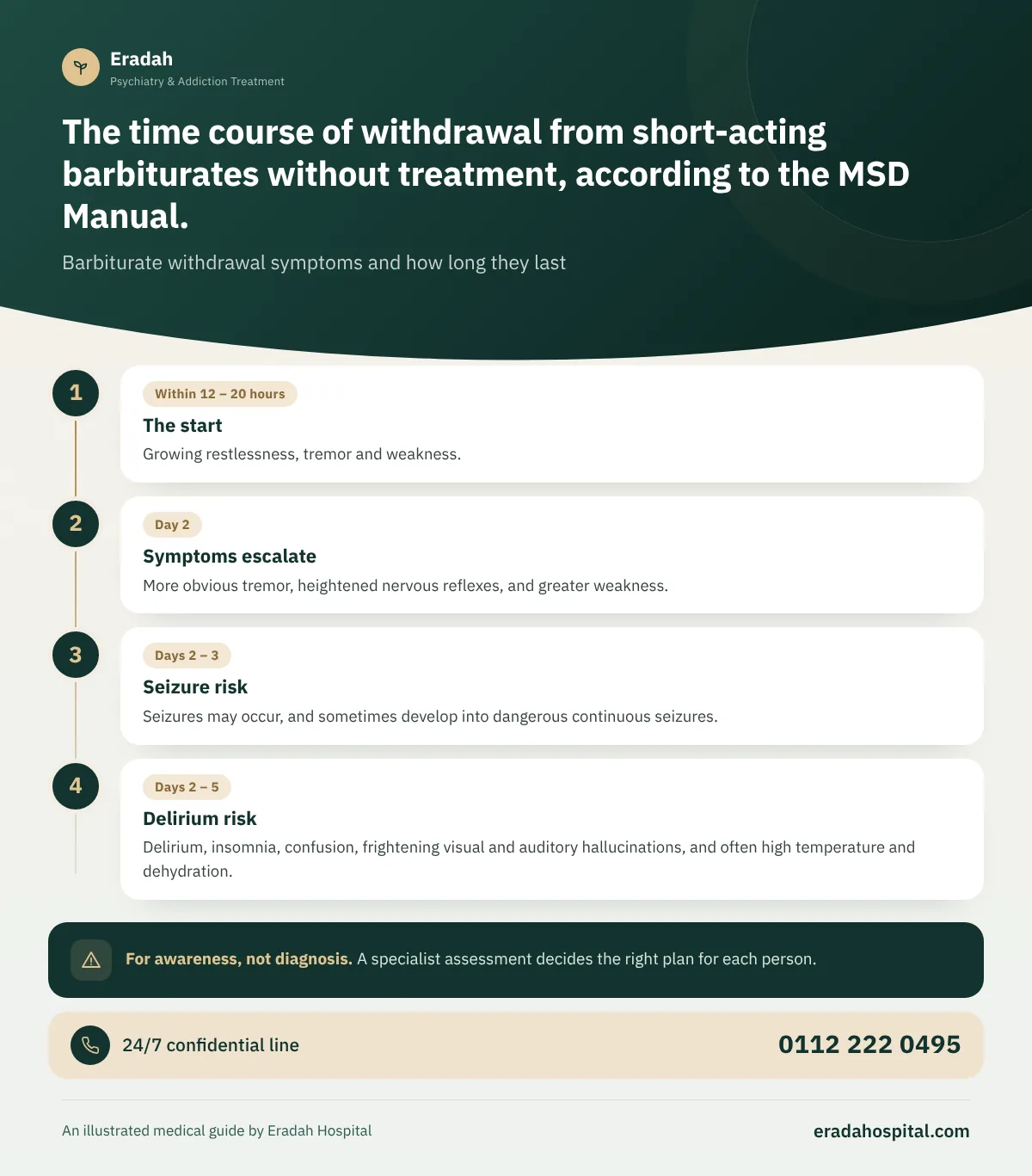
The MSD Manual describes the expected course when short-acting barbiturates are stopped suddenly without treatment. It is a course that shows why stopping at home is not allowed, not what a patient should expect to wait out:
- Within 12 – 20 hoursThe start
Growing restlessness, tremor and weakness.
- Day 2Symptoms escalate
More obvious tremor, heightened nervous reflexes, and greater weakness.
- Days 2 – 3Seizure risk
Seizures may occur, and sometimes develop into dangerous continuous seizures.
- Days 2 – 5Delirium risk
Delirium, insomnia, confusion, frightening visual and auditory hallucinations, and often high temperature and dehydration.
With long-acting types such as phenobarbital, onset may be delayed and symptoms may build gradually, but that does not mean stopping suddenly is safe.
Is barbiturate withdrawal dangerous?
Yes, and it is among the most dangerous types of withdrawal. According to the MSD Manual, people who take large amounts for a long time, or stop suddenly, may develop a life-threatening withdrawal resembling delirium tremens in alcohol, and seizures may appear in a large share of those who were taking very high amounts. It adds that a seizure may sometimes occur even after a well-managed discontinuation over one to two weeks.
If you take phenobarbital for epilepsy
MedlinePlus warns against stopping phenobarbital without talking to the doctor, and says the doctor will probably reduce the dose gradually. Stopping suddenly in a person with epilepsy carries two risks at once: a return of the epileptic seizures themselves, and withdrawal symptoms. If you feel that the medication no longer controls your symptoms as it did at first, that is a reason to see your doctor, not to increase the amount or stop it.
How is barbiturate withdrawal managed medically?
A medical review of sedative withdrawal syndromes explains that suddenly stopping these drugs after chronic use can cause life-threatening withdrawal, and that medications acting on GABA, including benzodiazepines and phenobarbital itself, can control the symptoms effectively, with a plan that takes into account the type of drug, the patient's age and their health. MedlinePlus notes that phenobarbital is used to prevent withdrawal symptoms in people who are dependent on other barbiturates and want to stop.
Put simply: uncontrolled dependence is replaced by a plan the doctor controls, and then the medication is reduced gradually while seizures and vital signs are monitored. We do not publish any doses or schedules here, because the plan differs from one person to another.
Stopping suddenly versus medically supervised discontinuation
| Aspect | Stopping suddenly at home | Discontinuation under medical supervision |
|---|---|---|
| Seizure risk | High, especially in the first days | Monitored and treated immediately |
| Delirium and hallucinations | May happen with no one knowing how to respond | Expected and managed in a safe environment |
| Accompanying substances | Alcohol or opioids add complexity | A clear plan for each substance |
| Follow-up after withdrawal | Usually none | Direct transition to treatment and rehabilitation |
For this reason, medical detox for barbiturates mostly takes place in a treatment facility, and you can find the difference between the options in home addiction treatment.
How can the family help someone who wants to stop barbiturates?
- Encourage them to seek a medical assessment before any attempt to stop, and do not encourage them to “tough it out” alone at home.
- Do not give them any sedatives or sleeping pills from the house to ease symptoms.
- Learn the danger signs: severe tremor, confusion, hallucinations or a seizure, and call the ambulance (123) immediately if they appear.
- After withdrawal ends, help them stick with psychological treatment and follow-up, as this is the stage that protects against going back.
If the use is also linked to alcohol, see alcohol withdrawal symptoms, because the two withdrawals are similar and may overlap.
Danger signs after using barbiturates: call ambulance (123) immediately
- A change in level of consciousness, great difficulty waking, or coma
- Shallow, slow or irregular breathing
- Slow, slurred speech, severe unsteadiness and confused thinking
- Low body temperature or blisters on the skin after taking a large amount
- Seizures, delirium or hallucinations after suddenly stopping barbiturates
Call ambulance (123) immediately. If the person is unconscious but breathing, place them on their side so they do not choke on vomit. Stay with them and do not leave them alone to “sleep it off.” Do not give them food, drink or any medicine, and tell the paramedics everything you know about what they took and when.
Call the ambulance 123