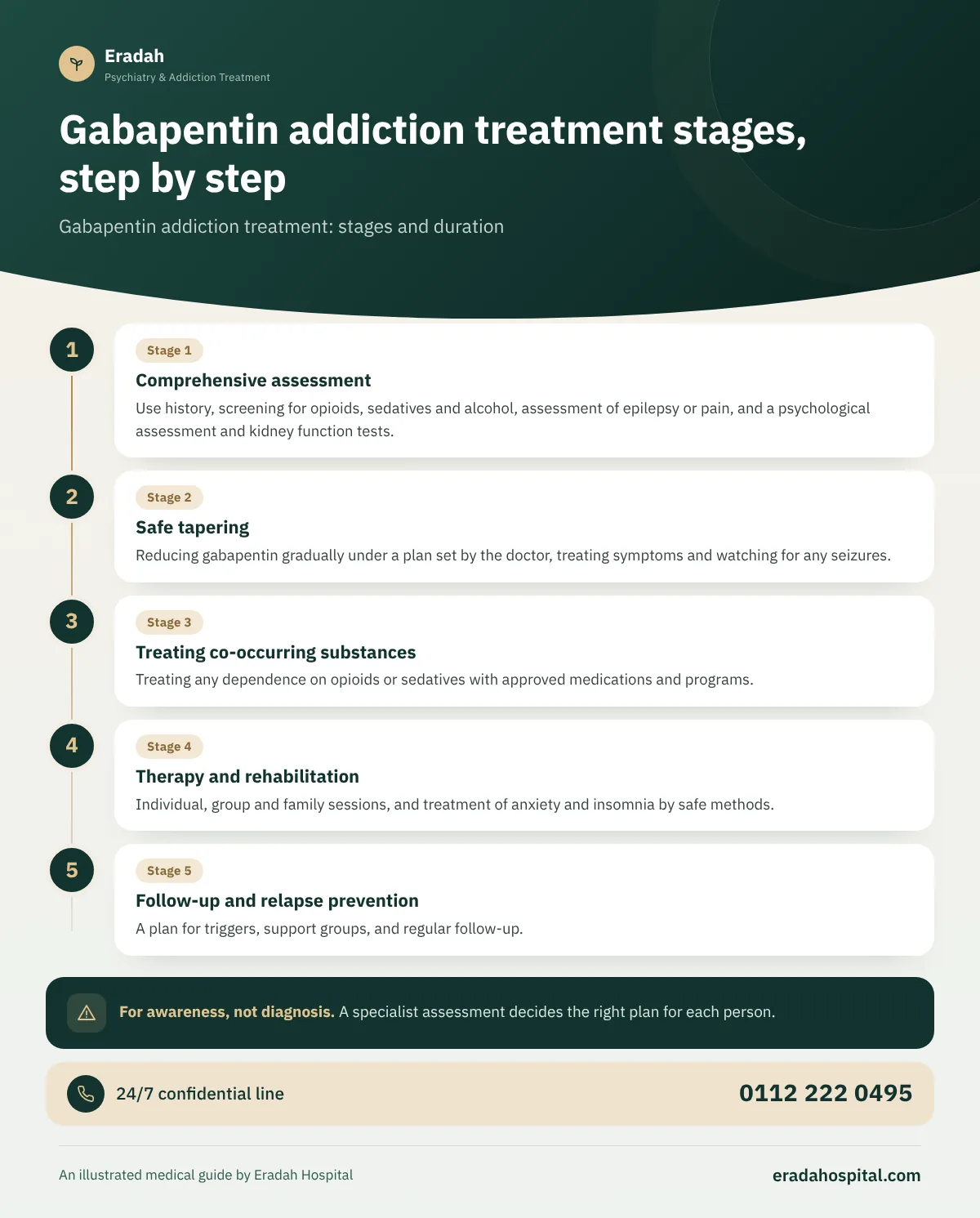
Stages of gabapentin addiction treatment
- Stage 1Comprehensive assessment
Use history, screening for opioids, sedatives and alcohol, assessment of epilepsy or pain, and a psychological assessment and kidney function tests.
- Stage 2Safe tapering
Reducing gabapentin gradually under a plan set by the doctor, treating symptoms and watching for any seizures.
- Stage 3Treating co-occurring substances
Treating any dependence on opioids or sedatives with approved medications and programs.
- Stage 4Therapy and rehabilitation
Individual, group and family sessions, and treatment of anxiety and insomnia by safe methods.
- Stage 5Follow-up and relapse prevention
A plan for triggers, support groups, and regular follow-up.
Why does treatment start with an assessment?
Gabapentin is rarely the only substance. Many people who misuse it also use tramadol or other opioids, pregabalin or sedatives. Each substance has a different withdrawal, and some can cause seizures if stopped suddenly. It is also essential to know whether the patient takes it for epilepsy, because that changes the way the taper is done entirely.
Medical tapering: the heart of gabapentin treatment
Stopping gabapentin suddenly is not recommended. It is reduced gradually over weeks and sometimes months, depending on the amount, how long it has been used and the patient's condition. The doctor monitors symptoms during the taper, slows the pace if anxiety or insomnia intensify, and watches for any sign of seizures.
Are there medications to treat gabapentin addiction?
No medication is approved specifically for treating gabapentin dependence, and treatment relies on medical tapering and treating whatever accompanies it. The doctor may use:
| Medication or class | Role |
|---|---|
| Medications for opioid dependence | Such as buprenorphine, methadone or naltrexone if there is co-occurring opioid dependence. |
| Symptom-relief medications | For anxiety, nausea and insomnia during the taper, chosen carefully by the doctor. |
| Alternative epilepsy medications | If the patient needs epilepsy treatment, the neurologist decides on the suitable alternative. |
| Treatment for depression and anxiety | If a co-occurring mental health disorder is present, the doctor chooses the appropriate type. |
None of these medications should be started or stopped without a doctor, and we do not give doses because they differ from one patient to another.
Psychological and behavioral therapy
Helps the person understand the situations and thoughts that drive them to the drug, and build new ways of coping with anxiety and pain.
A structured program to improve sleep without sedating medications, and one of the most successful treatments for chronic insomnia.
Rebuilds trust within the family and teaches it to give support without enabling substance use.
Treating co-occurring anxiety or depression within the same plan.
What if there is real nerve pain?
Some patients started gabapentin for nerve pain that is still present. Here the goal is not always to stop completely; it may be a return to controlled medical use under strict supervision, or a move to another treatment decided by a pain or nerve specialist, together with physical therapy and psychological therapies for living with pain.
How long does gabapentin addiction treatment take?
| Stage | Approximate duration |
|---|---|
| Assessment | A few days |
| Tapering | Weeks to months, depending on the case |
| Psychological rehabilitation | From 4 to 12 weeks or more |
| Follow-up and relapse prevention | At least one year |
These times are approximate, and the treatment team sets them according to each patient's progress and the presence of other substances.
Residential or outpatient treatment?
| Residential treatment | Outpatient treatment |
|---|---|
| Mixing gabapentin with opioids, sedatives or alcohol | Using gabapentin alone |
| History of seizures or unstable epilepsy | Stable neurological condition |
| Severe depression or thoughts of self-harm | Stable mental health and strong family support |
| Previous failed attempts to stop | Commitment to appointments and follow-up |
Preventing relapse after gabapentin treatment
- Knowing your triggers: anxiety, insomnia, pain, and certain friends.
- Telling every doctor about your history with gabapentin, pregabalin and opioids.
- Treating insomnia and anxiety with safe non-drug methods whenever possible.
- Not keeping spare nerve medications or sedatives at home.
- Regular follow-up with the treatment team during the first months.
Common misconceptions about gabapentin addiction treatment
| The common belief | The truth |
|---|---|
| "Just stopping once is enough" | Stopping suddenly can cause uncomfortable withdrawal and increase epileptic seizures; tapering is the safe way. |
| "The problem is only the gabapentin" | It is often part of a dependence on opioids or sedatives that needs comprehensive treatment. |
| "Treatment ends when the taper ends" | Psychological treatment and follow-up are what protect against relapse. |
How do you choose a gabapentin addiction treatment center?
- A psychiatrist who specializes in addiction, with access to a neurologist for consultation.
- The ability to manage dependence on opioids and sedatives at the same time.
- Round-the-clock medical supervision during tapering in complex cases.
- A psychological and family program, and clear follow-up after discharge.
- Official licensing, with respect for confidentiality and patient dignity.
Choosing a hospital for gabapentin addiction treatment
Gabapentin is sometimes seen as an "ordinary nerve medication," but dependence on it makes sudden stopping a risk that can end in seizures, especially for people with a history of epilepsy. More importantly, it rarely comes alone; many people use it to strengthen the effect of tramadol or other opioids, or combine it with pregabalin, and this mix raises the risk of respiratory depression. So the right place depends on the situation:
| Situation | What the facility should provide |
|---|---|
| Gabapentin alone with real nerve pain | Coordination with a neurologist or pain specialist to set the goal: full cessation or controlled use |
| Mixed with tramadol or other opioids | Experience in opioid dependence and a withdrawal plan that covers both substances together |
| History of seizures or epilepsy | A slow taper monitored by a doctor, and a night team that watches for any sign |
| Anxiety or insomnia behind the start of use | Psychological treatment of the cause so gabapentin is not simply replaced by another substance |
At Eradah, Dr. Mahmoud El-Sawy, Consultant Psychiatrist and Addiction Specialist, oversees the tapering plan, and the medical staff follow the patient around the clock in complex cases. The dual diagnosis program treats co-occurring anxiety or depression within the same plan. The page on gabapentin withdrawal symptoms explains what a patient may go through in the first weeks.
Gabapentin addiction treatment at Eradah
At Eradah we begin with a comprehensive assessment that identifies every substance used and any epilepsy, nerve pain or mental health disorder. Then comes a safe tapering plan under medical supervision, treatment of any co-occurring opioid dependence, a psychological and family program, and follow-up after discharge, with complete confidentiality from the first call.