How does the body clear gabapentin?
Unlike most medications, gabapentin is not meaningfully broken down in the liver. The kidneys remove it unchanged in the urine, which makes kidney function the most important factor in how long it stays in the body.
Five to seven hours in people with healthy kidneys, meaning its concentration in the blood falls by half in about that time.
Impaired kidneys greatly prolong how long it stays in the body and raise the risk of buildup and toxicity.
Absorption from the intestine is limited and becomes relatively smaller as the amount taken increases.
How long gabapentin stays in the body by type of test
Urine
Blood
Saliva
Hair
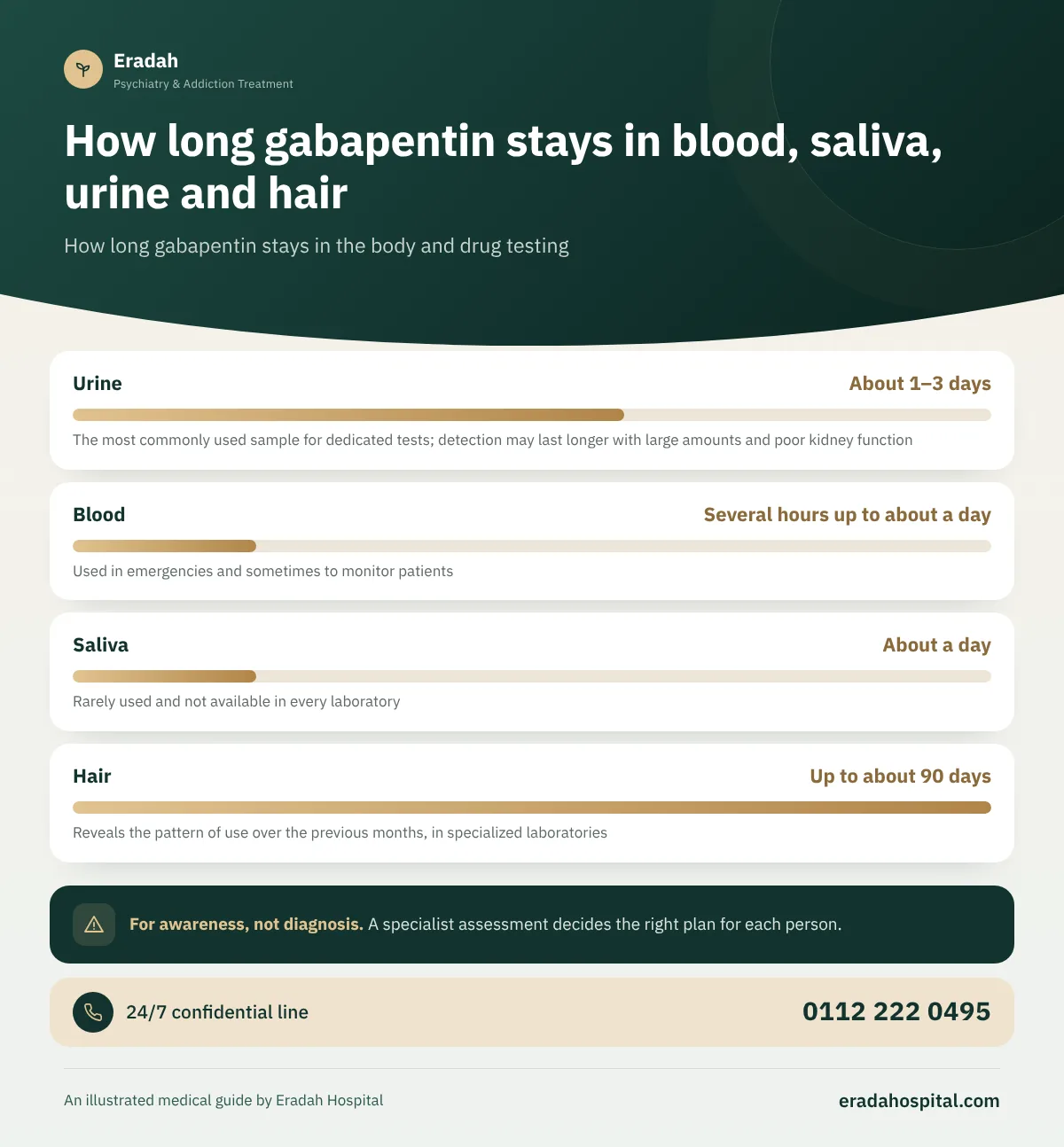
These times are approximate and vary with the laboratory, the sensitivity of the test and the cutoff level used, and published data on gabapentin detection windows are limited. For an accurate interpretation of a specific result, consult your doctor or the laboratory.
Does gabapentin show up on a standard drug test?
No. Medical references state that gabapentin does not appear on routine urine drug screens, because it is not an opioid, a benzodiazepine or a stimulant. To detect it, the laboratory needs a dedicated test that the doctor requests by name, usually using advanced equipment.
Factors that affect how long gabapentin stays in the body
- Kidney function: The most important factor; impaired kidneys clearly prolong how long the drug stays in the body.
- Age: Kidney function declines with age, so the drug stays longer.
- Amount and frequency of use: Frequent use and large amounts lengthen the detection time.
- Fluid intake and physical activity: These affect how concentrated the urine is, but they do not change much the time the body needs.
- Test sensitivity: Modern confirmatory tests detect lower concentrations.
Types of gabapentin tests
| Type of test | What it does | Limitations |
|---|---|---|
| Routine drug panel | Detects opiates, stimulants, cannabis and benzodiazepines | Does not detect gabapentin |
| Dedicated gabapentin test | Identifies the substance precisely using specialized equipment | Must be requested explicitly, and is slower and more expensive |
People with kidney disease and older adults
Because the kidneys clear gabapentin unchanged, the drug may stay in the bodies of people with kidney disease and older adults for much longer. This does not just lengthen the detection window; it also raises the risk of buildup and of severe drowsiness, confusion and slowed breathing. For this reason, the doctor adjusts the treatment plan according to kidney function.
On the other hand, the detection window cannot be used to work out when a person took gabapentin or how much they took. The test usually tells you only that the substance is present above a certain level, not the details of use.
What does a gabapentin test result mean?
A positive result on a dedicated test means the substance was found above the laboratory's cutoff. On its own, it does not mean addiction and does not show the amount taken. A negative result on a routine drug test means nothing about gabapentin, because that test does not look for it at all. That is why the doctor always interprets the result in light of symptoms, medical history and prescribed medications.
Why is its absence from tests linked to misuse?
Medical references note that the fact that gabapentin does not appear on routine drug tests is one reason some patients in opioid treatment programs misuse it. That is why good treatment programs request the dedicated test when needed, not as a punishment but to protect the patient from a combination that can stop their breathing.
If you take gabapentin by prescription and have been asked to take a test
If you are a patient taking gabapentin by prescription, a positive result on the dedicated test is expected and does not mean addiction. Keep a recent prescription and tell whoever is responsible for the test in advance. Do not stop your medication before the test out of fear of the result, especially if you take it for epilepsy; discuss it with your doctor instead.
When are gabapentin tests requested?
- In emergencies, with severe drowsiness or unexplained slow breathing, especially if mixing with opioids is suspected.
- In addiction treatment programs, to monitor adherence.
- To monitor patients with kidney disease and avoid buildup.
- In some forensic medical investigations.
Gabapentin in the emergency room
When someone arrives at the emergency room deeply drowsy or breathing slowly, doctors do not wait for a test result. They support breathing immediately, and may use naloxone if opioids are involved. Because gabapentin does not show up on the rapid test, telling the medical team what you know about the medications the person took makes a big difference.
Why don’t we mention ways to get around the test?
In the context of treatment, testing is a way to protect the patient and follow their recovery, not a means of punishment. Attempts to hide the substance by drinking large amounts of fluids or taking unknown products can be dangerous to the body's salts and the kidneys, and they do not solve the underlying problem. If you truly want to stop, the safe way is a gradual reduction under medical supervision.