Why does gabapentin withdrawal happen?
With repeated use, the nervous system adapts to gabapentin's calming effect, which reduces the release of stimulating neurotransmitters. When the drug is stopped suddenly, nerve activity rises abruptly, producing symptoms that in some ways resemble alcohol and benzodiazepine withdrawal, such as anxiety, insomnia, sweating and restlessness.
The official drug label notes that withdrawal cases have been reported after stopping amounts higher than recommended, and it warns against stopping epilepsy medications suddenly because seizures may increase.
Gabapentin withdrawal timeline
- 12 hours to 3 daysThe start
Anxiety and tension, insomnia, sweating, restlessness, nausea and headache.
- Days 2 to 7The peak
Worsening anxiety and insomnia, dizziness, palpitations and aches; confusion may occur in people who used large amounts.
- About the second weekEasing
Acute symptoms gradually settle in most people, while sleep disturbance and anxiety linger for a while.
- Weeks or longerThe prolonged phase
Anxiety, insomnia and cravings may continue in some people, especially after long-term use.
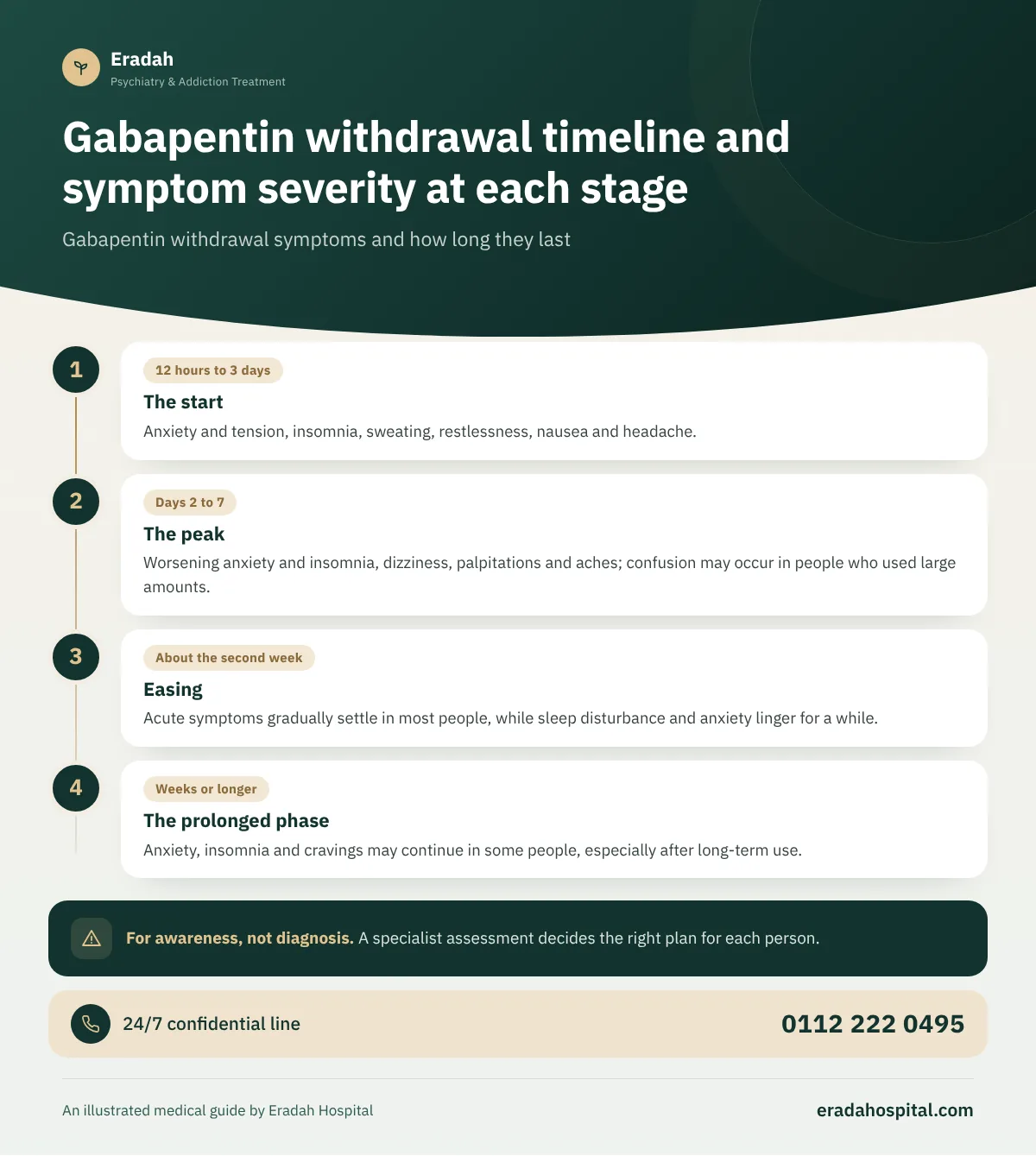
These times are approximate and based on published case reports, and they vary widely with the amount, how long the drug was used and the presence of other substances.
What are the symptoms of gabapentin withdrawal?
| Type | Symptoms |
|---|---|
| Physical | Sweating, nausea, headache, dizziness, palpitations, body aches, and a return of the original nerve pain. |
| Psychological | Severe anxiety, tension, restlessness, irritability and insomnia. |
| Mental | Confusion and disorientation, and rarely agitation or hallucinations in people who used large amounts. |
| Neurological | More seizures in people with epilepsy, and rarely convulsions in others. |
Who has more severe withdrawal?
The severity of withdrawal varies widely from person to person. Case reports note that most people who developed clear symptoms had been taking larger amounts than usual for long periods, although symptoms have occasionally been recorded with therapeutic amounts after weeks of use. Withdrawal is usually more severe in these situations:
- Daily use for a long time and in large amounts.
- Stopping suddenly instead of tapering.
- A history of epilepsy or severe anxiety.
- Mixing it with opioids, sedatives or alcohol.
Does gabapentin withdrawal cause seizures?
This is the most serious part of withdrawal. Gabapentin is an epilepsy medication to begin with, and stopping it suddenly in a person with epilepsy can increase the number of seizures and may cause status epilepticus, which is an emergency. Rare convulsions have also been reported in people with no history of epilepsy after suddenly stopping large amounts.
Return of nerve pain after stopping
Many people who take gabapentin started it for real nerve pain. When they stop, this pain may return, and may seem worse for a while. This is one of the main reasons people go back to the drug, so before the taper the doctor makes an alternative plan for pain relief if the medical need remains.
If it is used with opioids
Because many people who misuse gabapentin also use opioids, a person may go through two withdrawals at once. The symptoms overlap and are hard to tell apart, and the risk of relapse and overdose rises once tolerance has dropped. That is why a comprehensive assessment and a withdrawal plan for each substance are needed.
If you take gabapentin by prescription
Do not stop it suddenly and do not change your dose yourself, even if you feel better or worry about dependence. Ask your doctor for a tapering plan suited to your condition; gradual reduction over weeks or longer greatly reduces symptoms and protects a person with epilepsy from the return of seizures.
Stopping suddenly compared with tapering under supervision
| Aspect | Stopping suddenly | Tapering under medical supervision |
|---|---|---|
| Symptom severity | Anxiety, insomnia and heavy sweating | Much milder symptoms |
| Seizure risk | Higher, especially for people with epilepsy | Lower with monitoring |
| Mixed substances | Overlapping withdrawals that are not managed | A plan for each substance |
| Risk of relapse | High | Lower with support and treatment |
Common myths about Neurontin withdrawal
| The myth | The truth |
|---|---|
| A nerve medication does not cause withdrawal | Stopping suddenly after regular use can cause clear withdrawal. |
| Switching to Lyrica solves the problem | This moves the dependence to a drug in the same class without any real treatment. |
| Withdrawal insomnia is treated with sedatives from the pharmacy | Sedatives without supervision can create a new dependence and double the risk. |
Why stopping gabapentin alone at home is not recommended
Stopping suddenly at home means facing anxiety, insomnia and possibly seizures with no monitoring, and with no way to tell gabapentin withdrawal from withdrawal from other substances that may be involved. With medical supervision, it is possible to:
- Set a tapering plan suited to the amount and the length of use.
- Protect a person with epilepsy from the return of seizures.
- Treat anxiety and insomnia by safe methods that do not transfer the dependence.
- Treat any co-occurring dependence on opioids or sedatives at the same time.
Sleep and mood after acute withdrawal ends
Even after the acute symptoms have gone, sleep disturbance and anxiety may continue for a while. This stage is expected and improves gradually with regular sleep, physical activity and psychological therapy. If anxiety or depression remains severe, it may be an earlier disorder that gabapentin was masking, and it needs its own treatment.
How can the family support someone going through gabapentin withdrawal?
- Understand that anxiety and irritability are part of withdrawal.
- Watch for any seizure or severe confusion and call the ambulance immediately.
- Do not give them medications from home, and encourage them to stick to the doctor's plan.
- Provide a calm environment, regular sleep and enough fluids.
After withdrawal ends, the most important stage begins; you will find the details on the page about gabapentin addiction treatment.
Signs of gabapentin poisoning or overdose: call an ambulance (123) immediately
- Extreme drowsiness, or difficulty waking the person, with no response to calling
- Slow, shallow or irregular breathing, especially if the medicine was mixed with tramadol, opioids, sedatives or alcohol
- Blue or pale lips and fingernails
- Very slurred speech, or double vision with severe unsteadiness and inability to stand
- Sudden swelling of the face, lips and throat with difficulty swallowing or breathing
Call an ambulance at 123 immediately, place the person on their side so they do not choke, give them nothing by mouth, stay with them until help arrives, and keep the medicine packs they took to show the doctor. If opioids are part of the mixture, the emergency team may use naloxone to reverse their effect.
Call the ambulance 123