What is gabapentin?
Gabapentin is a chemically manufactured medicine from the gabapentinoid group, the same group that pregabalin belongs to. In Egypt it is mostly known by its best-known brand name, “Neurontin,” along with other brand names that contain the same active substance.
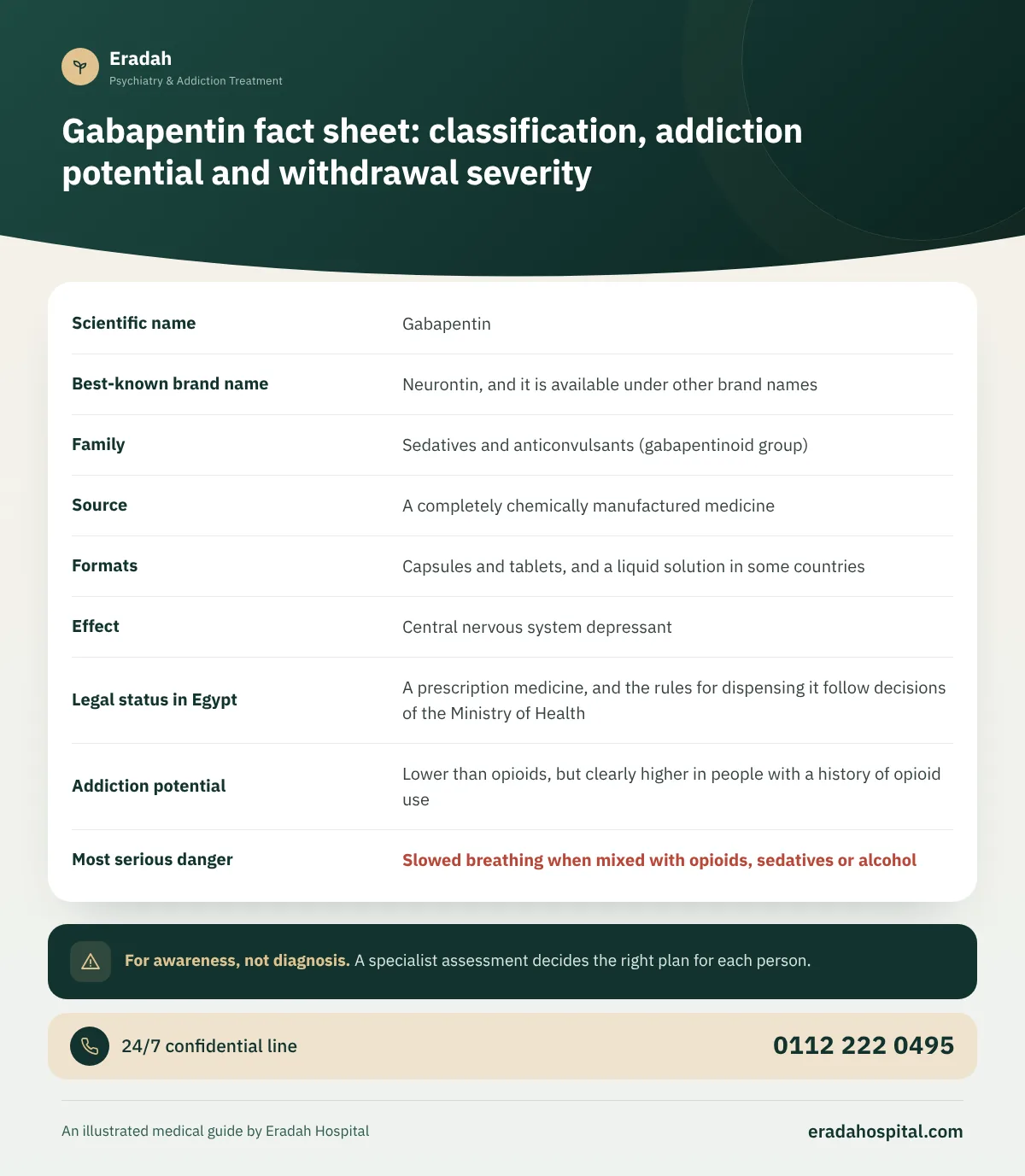
Gabapentin was originally designed to resemble, in structure, a calming neurotransmitter in the brain called GABA, which is where its name comes from. But studies later showed that it does not bind to the receptors of this neurotransmitter, or to opioid or benzodiazepine receptors, and instead works by a different mechanism on calcium channels in the nerves.
For many years gabapentin was considered a low-risk medicine in terms of addiction, and it was widely prescribed for nerve pain. But a growing number of reports around the world have noted its misuse, especially among people with a history of opioid use, and its link to poisonings and deaths when mixed with other substances.
What are the medical uses of gabapentin?
Gabapentin is a genuine medicine with its place in medicine, and doctors prescribe it after assessment for conditions such as:
Such as the pain that follows shingles and, in some countries, nerve pain caused by diabetes and other conditions.
An add-on treatment for partial seizures, added to other medicines in adults and in children above a certain age.
A special form of it is used in some countries for this condition.
Doctors sometimes prescribe it for other conditions at their discretion, which widens its spread and makes follow-up more important.
How does gabapentin affect the brain and body?
Gabapentin binds to a part of the calcium channels at the ends of nerve cells called the alpha-2-delta subunit. This binding reduces the amount of excitatory neurotransmitters the nerves release, calming the excessive nerve activity responsible for nerve pain and epileptic seizures.
- In therapeutic use: it eases nerve pain and reduces seizures, with drowsiness and dizziness in some patients.
- In large amounts: it can cause relaxation, euphoria and a feeling of calm, along with unsteadiness and slurred speech, which is what leads some people to misuse it.
- With repeated use: the nervous system adapts to its presence, so physical dependence develops, and unpleasant symptoms appear if it is stopped suddenly.
One of its features is that it is hardly metabolized in the liver; it leaves the body unchanged through the kidneys, and its half-life is five to seven hours. Its absorption from the intestine is also limited, so the share absorbed falls as the amount increases, which is one of the reasons it differs from pregabalin.
Why has gabapentin misuse increased in Egypt?
In August 2019, Egypt placed pregabalin in the drug schedules after its misuse spread. After the decision the picture changed quickly: a study published in 2025 that tracked medicine sales in Egypt found that sales of pregabalin dropped by about 99%, while sales of gabapentin jumped.
These figures do not mean that everyone who takes gabapentin is misusing it; a large part of the change is a legitimate move by nerve-pain patients to an available alternative. But they also mean that people who relied on pregabalin outside medical use found in gabapentin a close substitute, which calls for families and doctors to pay attention.
Gabapentin compared with Lyrica and similar medicines
| Medicine | Group | Medical use | Important note |
|---|---|---|---|
| Gabapentin | Gabapentinoids | Nerve pain and epilepsy | Limited absorption that falls as the amount rises |
| Pregabalin | Gabapentinoids | Nerve pain, epilepsy and, in some countries, anxiety | Absorbed faster and more consistently, which is why it is more linked to misuse |
| Rivotril | Benzodiazepines | Epilepsy and panic attacks | Dependence and a long withdrawal that can cause seizures |
| Tramadol | Opioids | Painkiller for moderate to severe pain | Mixing it with gabapentin doubles the suppression of breathing |
The most dangerous common thread is that mixing gabapentin with any opioid, sedative or alcohol multiplies the depression of the nervous system and breathing, and the US Food and Drug Administration issued an official warning about this in 2019.
Gabapentin and Lyrica: the difference in brief
Gabapentin and Lyrica (pregabalin) work by the same mechanism on calcium channels in the nerves, and the key difference is absorption: Lyrica is absorbed faster and in a steady proportion however the dose rises, while the share of gabapentin that is absorbed falls as the amount increases. This makes the effect of Lyrica faster and clearer, and it is the one more linked to misuse, without meaning that gabapentin is safer than it.
You will find the full comparison of absorption, doses, how long they stay in the body and the situation in Egypt on the page Pregabalin and gabapentin: which suits you and why?. If the use of either one turns into misuse, see gabapentin withdrawal symptoms and the plan for gabapentin addiction treatment.
Common misconceptions about gabapentin
| The common belief | The truth |
|---|---|
| “A safe substitute for Lyrica that does not cause addiction” | It is less prone to misuse than pregabalin, but the risk exists, and it causes dependence and withdrawal with non-medical use. |
| “It is a nerve medicine, so it has nothing to do with drugs” | It is misused worldwide, especially to strengthen the effect of opioids, and that mixture can be deadly. |
| “It can be stopped at any time” | Stopping suddenly after regular use can cause anxiety, insomnia and sweating, and may increase seizures. |
| “It treats tramadol withdrawal” | Using it on your own for this purpose opens the door to a new dependence and raises the risk of slowed breathing. |
Who is most at risk from gabapentin?
The group with the highest misuse, and the highest risk of stopped breathing when mixing.
They may move to it as a close substitute after pregabalin became hard to get.
The medicine builds up in their bodies, which increases dizziness, falls and drowsiness.
A recent scientific review noted a growing trend of misuse among them.
The legal status of gabapentin in Egypt and worldwide
In Egypt, gabapentin is a prescription medicine, and the rules for dispensing it follow decisions of the Ministry of Health and the Egyptian Drug Authority, which are updated from time to time. Possessing psychoactive medicines or trading in them outside the medical framework can expose a person to legal liability.
Worldwide, the United Kingdom reclassified gabapentin and pregabalin in April 2019 as Class C controlled substances after they were linked to drug-related deaths, while in the United States gabapentin is not classified as a federally controlled substance, according to its labeling.
This is general educational information and not legal advice.
Gabapentin guide: everything you need to know
We have gathered everything about gabapentin into 6 pages, each answering one question in detail. Choose what you are looking for:
Harms of gabapentin
From dizziness, drowsiness and poor balance to slowed breathing when mixed with opioids, and its effect on mood, memory, pregnancy and driving.
Causes of gabapentin addiction
Why do some people misuse a nerve medicine? The role of opioids, switching from Lyrica, anxiety, insomnia and chronic pain.
Symptoms of gabapentin addiction
The physical and behavioral signs the family notices, the diagnostic criteria, and the difference between medical use and misuse.
Gabapentin withdrawal symptoms
Anxiety, insomnia, sweating and confusion that can begin within hours to days of stopping, and may increase seizures; that is why a medically supervised taper is needed.
Treatment of gabapentin addiction
A comprehensive assessment, a safe medical taper, treatment of any opioid dependence, a plan for the underlying pain or anxiety, then psychotherapy and relapse prevention.
How long gabapentin stays in the body
It leaves unchanged through the kidneys, usually within a few days, and it does not show up in the routine drug test but needs a special test.
Found strips of Neurontin with your child without a prescription? Start here
- Stay calm first, and do not start the conversation while they are under the influence.
- Check whether the medicine was prescribed to them by a doctor; they may be taking it for a genuine medical reason.
- Talk to them with concern rather than accusation, and ask why they use it: pain, anxiety, insomnia, or friends.
- Watch for the possibility that tramadol, opioids or sedatives are involved, because the mixture is the most dangerous.
- Do not force them to stop suddenly at home; ask for a medical assessment for a safe tapering plan.
- Remember the ambulance number, 123, and learn the danger signs listed at the end of the page.
Signs of gabapentin poisoning or overdose: call an ambulance (123) immediately
- Extreme drowsiness, or difficulty waking the person, with no response to calling
- Slow, shallow or irregular breathing, especially if the medicine was mixed with tramadol, opioids, sedatives or alcohol
- Blue or pale lips and fingernails
- Very slurred speech, or double vision with severe unsteadiness and inability to stand
- Sudden swelling of the face, lips and throat with difficulty swallowing or breathing
Call an ambulance at 123 immediately, place the person on their side so they do not choke, give them nothing by mouth, stay with them until help arrives, and keep the medicine packs they took to show the doctor. If opioids are part of the mixture, the emergency team may use naloxone to reverse their effect.
Call the ambulance 123