Does gabapentin really cause addiction?
Gabapentin is less addictive than opioids and benzodiazepines, and its official leaflet states that it does not bind to opioid, benzodiazepine or cannabinoid receptors. But studies have documented its misuse, especially in particular groups, for reasons that include:
Some people who misuse it describe a feeling of calm, relaxation and euphoria with large amounts.
Some people who use opioids take it to amplify their effect, the most dangerous pattern of use.
With repeated use the nervous system adapts, and distressing withdrawal appears on stopping.
Its wide use as a nerve medication makes it available in many homes.
The relationship between gabapentin and opioids
References agree that gabapentin misuse is much more common in people with opioid use disorder than in the general population. Some use it to strengthen the effect of opioids, some to ease their withdrawal symptoms, and some because it does not show up on routine drug tests.
This relationship makes gabapentin, in many cases, part of a bigger picture rather than a stand-alone problem. So discovering its misuse should always prompt questions about tramadol, other opioids and sedatives.
From Lyrica to Neurontin: the effect of tighter controls
After pregabalin was placed on the drug schedules in Egypt in 2019, a published study recorded a large rise in gabapentin sales, more than fivefold within a year. Part of this rise was a legitimate shift among neurological patients, but another part reflects people who had relied on Lyrica outside medical care moving to a close substitute.
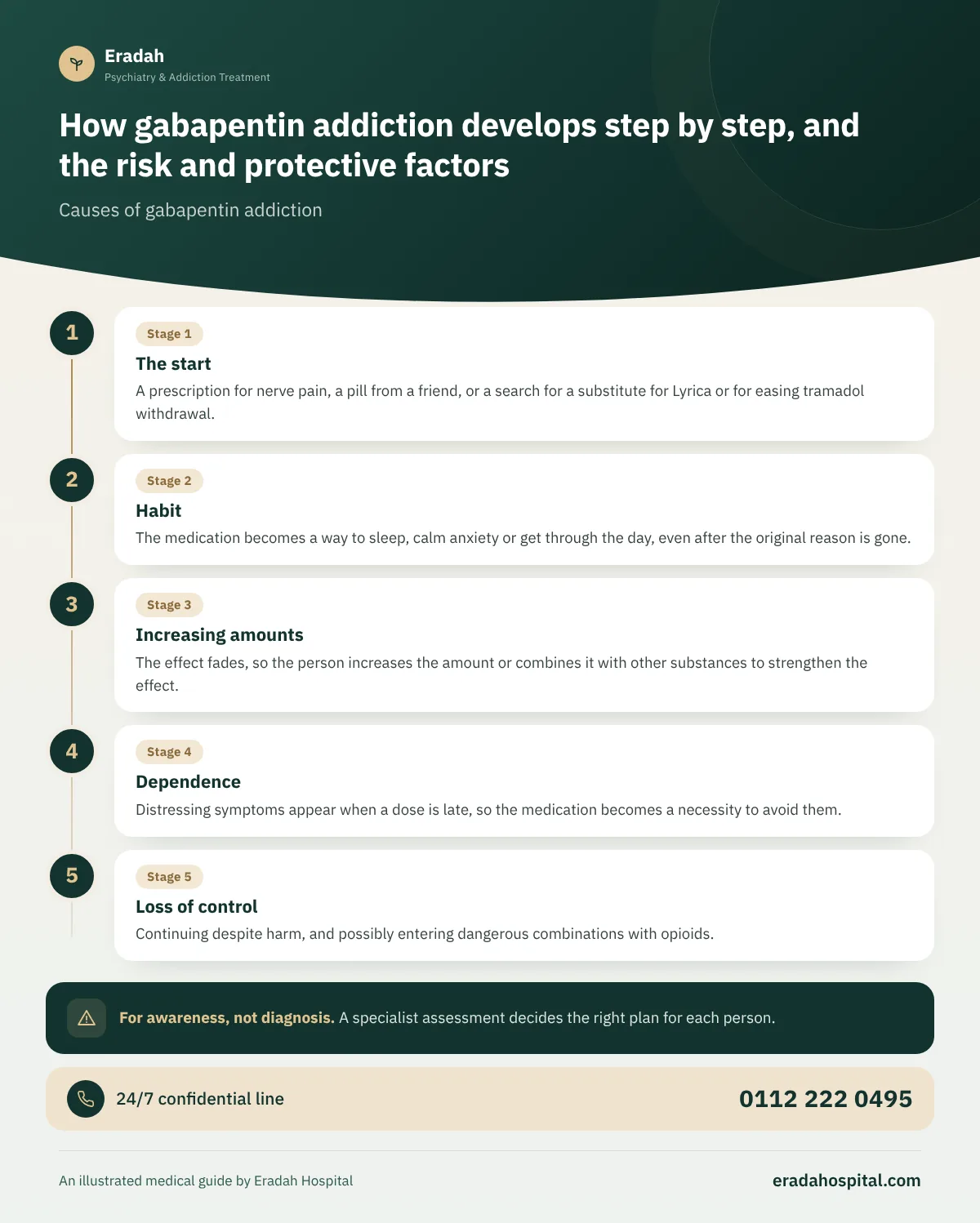
How does gabapentin misuse develop?
- Stage 1The start
A prescription for nerve pain, a pill from a friend, or a search for a substitute for Lyrica or for easing tramadol withdrawal.
- Stage 2Habit
The medication becomes a way to sleep, calm anxiety or get through the day, even after the original reason is gone.
- Stage 3Increasing amounts
The effect fades, so the person increases the amount or combines it with other substances to strengthen the effect.
- Stage 4Dependence
Distressing symptoms appear when a dose is late, so the medication becomes a necessity to avoid them.
- Stage 5Loss of control
Continuing despite harm, and possibly entering dangerous combinations with opioids.
Anxiety, insomnia and dual diagnosis
Some people find in gabapentin a calming effect for anxiety or insomnia that was not properly treated. The conditions most linked to its misuse include:
- Anxiety disorders and panic attacks.
- Depression.
- Chronic insomnia.
- Post-traumatic stress disorder (PTSD).
Chronic pain: between medical need and dependence
Many people who take gabapentin are patients with real nerve pain, and the physical dependence that may develop in them with long-term use is an expected adaptation, not addiction. Addiction means increasing the amount on one's own, using it for reasons other than pain, and continuing despite harm. For this reason, a pain patient does not stop their medication themselves but goes back to their doctor with any concern.
Environment and social factors
- Social acceptance: seeing it as a “nerve medication” with no danger.
- Sharing pills: passing them between friends or family members.
- People who use around you: especially those who use opioids.
- Stress and unemployment: and the search for quick relief from tension.
Genetic and personality factors
Genetics explains part of the susceptibility to addiction in general, and the risk is higher in people with a family history of addiction, those who began using substances at an early age, or those with high impulsivity. These factors do not mean addiction is inevitable, but they call for greater caution when prescribing any psychoactive medication.
Why do some young people try gabapentin?
Some young people start gabapentin because it is available in the home medicine cabinet, or because friends told them it “calms the nerves” or is like Lyrica. A young person may not know that mixing it with tramadol, hashish or sedatives multiplies the danger. The risk rises when the young person has anxiety or study or family pressures and has found no one to listen.
Mistaken beliefs that pave the way to gabapentin misuse
| Common belief | The truth |
|---|---|
| “It doesn't show on the test, so there's no problem” | Not showing on routine tests does not reduce its harm; it only delays discovering the problem. |
| “A mild nerve medication” | In large amounts or mixed with opioids it can be fatal. |
| “It helps me stop tramadol” | Using it on your own for this purpose adds a new dependence and does not treat the first. |
Risk factors and protective factors
| Area | Risk factor | Protective factor |
|---|---|---|
| History | Current or past dependence on opioids or pregabalin | Full treatment of the earlier dependence and follow-up afterward |
| Mental health | Untreated anxiety, insomnia or depression | Early diagnosis and treatment, and skills for handling stress |
| Medicine | Use without a prescription or without follow-up | A clear prescription and regular review with the doctor |
| Family | No dialogue, or addiction in the family | Open communication, support and clear boundaries |
How do you protect yourself and your family?
- Take gabapentin only by prescription, and do not share it with anyone.
- Tell your doctor about any history with opioids or sedatives before it is prescribed.
- Do not use it to ease withdrawal from another substance without medical supervision.
- Ask for help early for anxiety, insomnia and depression.
- Keep medications in a safe place, and dispose of leftovers the way your pharmacist advises.