What are the stages of treating inhalant addiction?
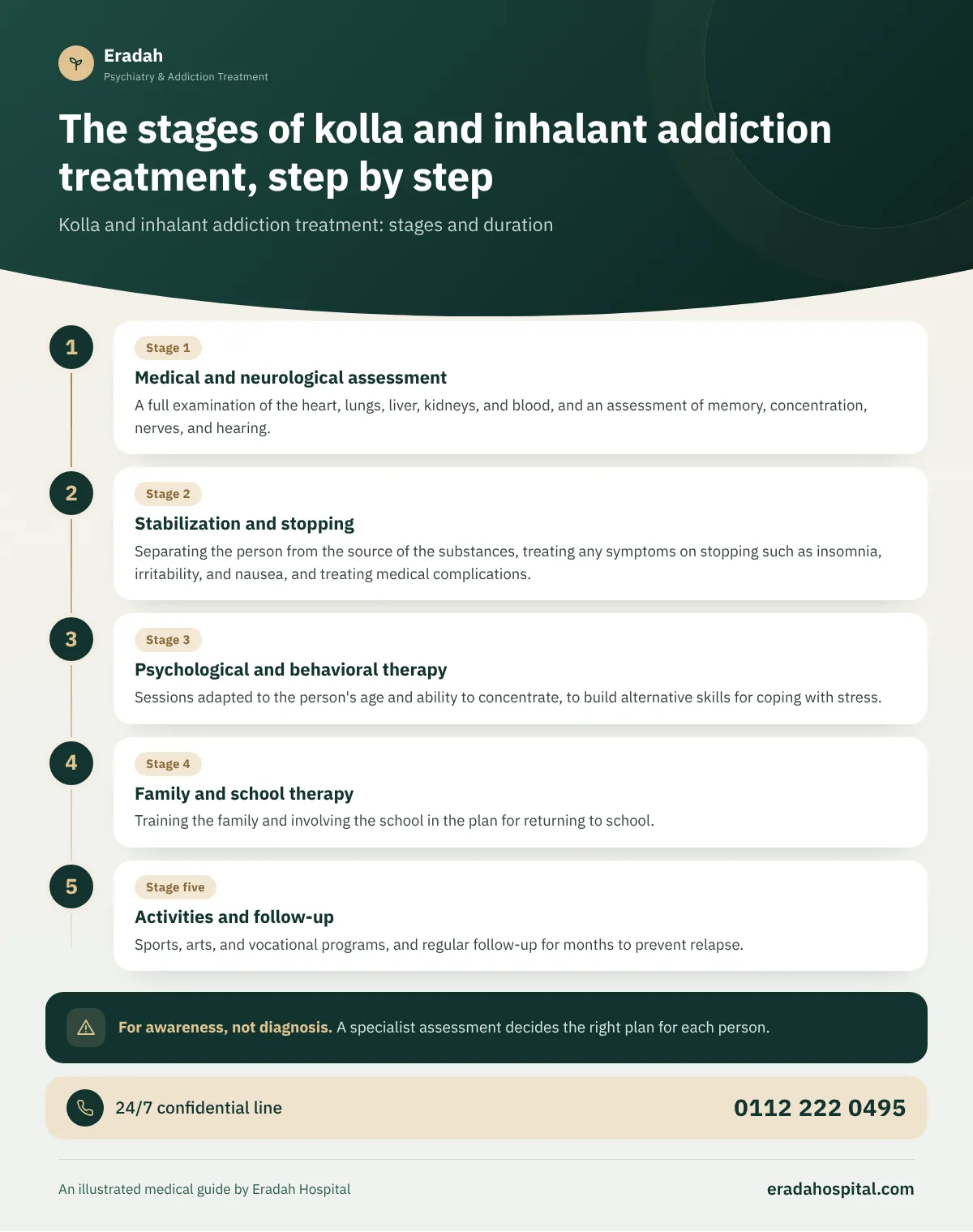
- Stage 1Medical and neurological assessment
A full examination of the heart, lungs, liver, kidneys, and blood, and an assessment of memory, concentration, nerves, and hearing.
- Stage 2Stabilization and stopping
Separating the person from the source of the substances, treating any symptoms on stopping such as insomnia, irritability, and nausea, and treating medical complications.
- Stage 3Psychological and behavioral therapy
Sessions adapted to the person's age and ability to concentrate, to build alternative skills for coping with stress.
- Stage 4Family and school therapy
Training the family and involving the school in the plan for returning to school.
- Stage fiveActivities and follow-up
Sports, arts, and vocational programs, and regular follow-up for months to prevent relapse.
Why does treatment begin with a medical and neurological assessment?
Because inhalants can damage several organs without obvious symptoms at first. A comprehensive assessment reveals what needs urgent treatment and helps adapt the psychological plan to the patient's current abilities:
- An electrocardiogram (ECG) to assess heart rhythm.
- Liver and kidney tests, blood salts, and a complete blood count.
- A neurological assessment of balance, sensation, and muscle strength, and hearing and vision tests when needed.
- A cognitive assessment of memory, attention, and learning.
- A psychological assessment for depression, anxiety, trauma, and any use of other substances.
Are there withdrawal symptoms when stopping kolla?
Some people who inhaled for a long time may experience irritability, insomnia, nausea, sweating, headache, and cravings when they stop. These symptoms are usually milder than alcohol or opioid withdrawal, but they are unpleasant and can push a person back to use, so the person needs follow-up and support in the first weeks, and the doctor decides whether specific symptoms need treatment.
Are there medications to treat inhalant addiction?
There is currently no approved medication that treats inhalant addiction or prevents cravings for them. But the doctor may prescribe medications to treat complications and accompanying disorders, such as severe insomnia, depression, anxiety, or psychotic symptoms, depending on each case.
The choice of medication and its duration are decided only by the treating doctor after assessment, and you should never give a child any sedative or sleeping pill on your own.
What types of psychotherapy are used?
It helps identify the situations and feelings that drive inhaling and build practical alternatives, with short, simplified sessions when needed.
It addresses communication patterns within the family and teaches parents how to set supportive limits.
It strengthens the teenager's own wish to change, rather than relying on orders.
Sports, arts, and skills that fill free time and build self-confidence.
A plan with the school to make up for lost ground, allowing for the temporary difficulty concentrating.
For children who have experienced violence, neglect, or life on the street.
The family's role in treatment
- Keep chemical products in a locked place throughout treatment and afterward.
- Take part in family therapy sessions regularly, even if you believe the problem lies with the child alone.
- Praise every bit of progress, even small, and avoid comparing the child with others or constantly reminding them of the past.
- Keep a clear daily routine for sleep, study, and activities.
- Learn the early signs of relapse, handle them calmly, and contact the treating team.
How are children in difficult circumstances helped?
For street children or those living without family care, medical and psychological treatment alone is not enough. The child first needs safety, shelter, food, and care, then a long treatment and education program that reintegrates them into society. The relevant authorities in Egypt regard these children as victims who need support, and any child in danger can be reported through the Child Helpline (16000).
Does treatment require a residential stay?
| Inpatient treatment (residential) | Outpatient treatment | |
|---|---|---|
| When is it suitable? | Chronic, repeated inhalation, medical or neurological complications, an unsafe environment, or earlier failed attempts | Early cases with a supportive family and a safe environment |
| Advantages | Complete separation from the substances, and continuous medical and psychological care | Study and family life continue |
| Duration | Weeks to months, depending on the case | Regular sessions over several months |
How do we prevent relapse?
- Recognizing triggers: friends, places, free time, and feelings linked to inhaling.
- Reducing access to chemical products at home and at school.
- Continuing alternative activities and supportive relationships.
- Regular follow-up with the treating team for months after improvement.
- Seeing a relapse, if it happens, as a signal to adjust the plan, not the end of the road.
How do you choose a suitable place to treat your child?
- Experience treating children and teenagers, not programs designed for adults only.
- Ability to carry out medical, neurological, and cognitive assessment, not psychological assessment alone.
- Regular involvement of the family in the treatment plan.
- Coordination with the school, and activity and education programs during treatment.
- An official license, full respect for the child's confidentiality and dignity, and refusal of any punitive or humiliating methods.
Choosing a Hospital for Kolla and Inhalant Addiction Treatment
A person who uses kolla, gasoline, or paint remover is usually young, and these substances can quietly harm the nerves, heart, and liver. So a place designed to treat an adult man addicted to pills is not suitable for them. What matters most is that the place combines a real neurological and cognitive assessment with an understanding of a child's or teenager's world: their family, school, and friends. Use this table when comparing providers:
| Criterion | Good sign | Warning sign |
|---|---|---|
| Initial assessment | ECG, lab tests, and an assessment of memory and balance | One talking session, then a ready-made plan |
| Working with young people | A team experienced in working with children and teenagers | Adult programs applied to everyone |
| Family | Regular sessions for the parents | Only blaming the parents, or excluding them |
| School | A plan for returning to school | Neglecting education during treatment |
| Approach | Respect for dignity and motivation | Threats, punishment, or confinement |
At Eradah we receive children and teenagers for assessment, treatment, and follow-up through outpatient treatment and the day program, along with a family program that guides parents. Residential stays, however, are reserved for adult men. Call us or message us on WhatsApp at 01122220495 at any hour, or book an assessment session for your child; the first consultation is free and the child's name is not disclosed to anyone. And read the harms of inhalants on the body to learn what the assessment looks for.
Inhalant addiction treatment at Eradah
At Eradah we begin with a confidential medical, psychological, and neurological assessment, then build an individual plan suited to the patient's age and abilities, including behavioral and family therapy, activity programs, and coordination with the school, with follow-up after discharge. A family can start with a consultation even if the child is not yet ready.