What are the immediate harms of inhalants?
These harms appear within minutes of inhaling and can be fatal even the first time:
| The risk | How does it happen? |
|---|---|
| Sudden cardiac death | The heart muscle becomes extremely sensitive to adrenaline, so its rhythm is disrupted by any sudden emotion or exertion. |
| Suffocation and oxygen deprivation | The fumes displace oxygen in the lungs, so less oxygen reaches the brain. |
| Choking on vomit | Loss of consciousness together with vomiting can block the airway. |
| Loss of consciousness and seizures | Severe depression of the nervous system with repeated inhalation. |
| Accidents and injuries | Dizziness and impaired balance and judgment lead to falls and accidents. |
| Burns and fires | Many of these substances ignite easily, and some gases can cause frostbite-like cold burns to the skin and throat. |
How do inhalants harm the brain?
The brain is one of the organs most affected by inhalants, because solvents dissolve in fat and build up in brain tissue. With repeated use they damage myelin, the fatty sheath that insulates nerve fibers and carries signals quickly, which leads to problems resembling chronic neurological diseases:
Poor attention, memory, and learning, and slowed thinking and problem-solving.
Tremor, unsteady walking, and poor coordination.
Hearing or vision loss in some people who inhale for long periods.
Irritability, emotional blunting, and personality changes.
Brain scans of some people who inhaled for years show shrinkage in parts of the brain and changes in the white matter. Part of this damage may be permanent and may not heal fully even after stopping.
How do inhalants affect the peripheral nerves and muscles?
Some solvents damage the peripheral nerves in the arms and legs, causing numbness, tingling, and muscle weakness, which can progress to difficulty walking or gripping objects. This damage needs to be assessed by a neurologist, and it may improve partly after stopping and with physical therapy.
How do inhalants harm the body's organs?
| System | Possible harms |
|---|---|
| Heart | Abnormal heart rhythm, and a weakened heart muscle with long-term use. |
| Lungs | Irritation of the airway, repeated infections, and worsening of asthma. |
| Liver | Inflammation and damage to liver cells with some solvents. |
| Kidneys | Reduced kidney function and imbalance of blood salts. |
| Bone marrow and blood | Some solvents interfere with the production of blood cells. |
| Skin, nose, and mouth | Rash and sores around the nose and mouth, nosebleeds, and eye irritation. |
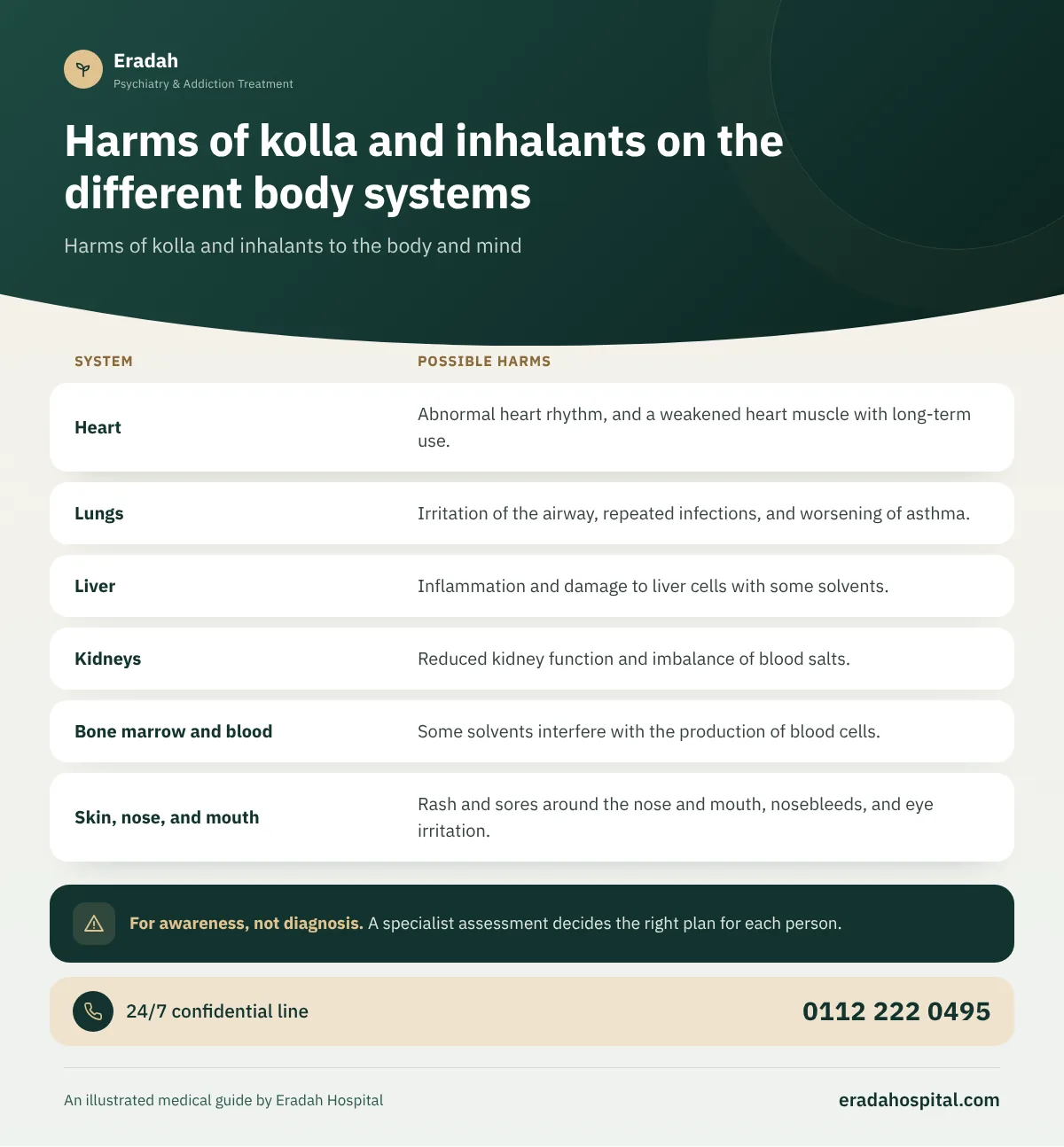
Much of this harm improves after stopping and treatment if it is detected early, so anyone who has been inhaling for a while needs a full medical checkup.
What are the psychological harms of inhalants?
- Depression, anxiety, irritability, and sharp mood swings.
- Hallucinations or paranoia while under the influence, which in some people who use inhalants can last for long periods.
- Poor impulse control, which raises the risk of aggressive or dangerous behavior.
- Psychological dependence and strong cravings to use again, and continued use despite the harm.
Harms of inhalants in children and teenagers
Children and teenagers are the most exposed and the most harmed, because the brain is still growing and building its neural connections, and any damage at this stage can leave a lasting mark on learning and emotional maturity. Parents and teachers usually notice declining school performance, delayed development, poor memory and concentration, and withdrawal from activities normal for their age.
Early experimentation with inhalants may also open the door to other substances later. That is why early intervention, together with the family and school, protects the child from a chain of greater harms.
Inhalants and children in difficult circumstances
For street children and those living in harsh conditions, further risks are added to the health harms: malnutrition, exposure to violence and exploitation, injuries, and difficulty reaching health care. These children need protection, shelter, and psychological and medical care, and any child in danger can be reported through the Child Helpline (16000).
What is the danger of mixing inhalants with other substances?
Some teenagers use inhalants together with other substances, which multiplies the risk many times over:
- With alcohol or sedatives: depression of breathing and consciousness is compounded, and the risk of choking on vomit rises.
- With stimulants: the strain on the heart and the chance of an abnormal rhythm increase.
- With hashish or Strox: confusion, hallucinations, and poor judgment increase, and accidents become more likely.
How do inhalants affect pregnancy and the fetus?
Inhaling during pregnancy can expose the fetus to growth problems and low birth weight, and the newborn may show problems similar to those linked to alcohol use in pregnancy. Speaking honestly with a doctor is a safe step that protects both mother and child.
Can the harms of inhalants be reversed?
It depends on how long the person has been inhaling, the type of substance, and their age. Much of the liver, kidney, and lung damage improves after stopping, and some of the poor concentration and memory may improve with time and rehabilitation. Severe brain and nerve damage after years of inhaling, however, may be permanent, which is one more reason for early intervention.
Danger signs with kolla and inhalants: call ambulance (123) immediately
- Loss of consciousness, or no response to calling or touch
- Difficulty breathing, or breathing that is very slow or has stopped
- Chest pain, or a fast or irregular heartbeat
- Seizures
- Vomiting with severe confusion, or pallor and blue lips
Call ambulance (123), move the person into fresh air and remove the source of the fumes, and place them on their side if they are unconscious but breathing. Do not frighten, chase or shout at them, because a sudden emotional shock can cause a fatal heart rhythm disturbance. Stay with them calmly until help arrives.
Call the ambulance 123
20What are the social and family harms?
The harms of inhalants spread through the child's whole life: dropping out of school, repeated conflicts with the family, being drawn to groups who use other substances, and greater exposure to exploitation and violence outside the home. Over time, self-confidence falls and the child feels stigmatized, which pushes them further from seeking help. This is why treatment must include rebuilding the relationship with the family and school, not focusing on the substance alone.