What do we mean by alcohol and inhalants?
This family brings together two substances that differ in form and in who uses them most, but share two things: both are legally available for other purposes, and both depress the central nervous system.
Alcohol is the ethanol found in alcoholic drinks, one of the oldest and most widespread substances people have known. Inhalants are the fumes of household and industrial products sold for legitimate purposes, such as solvents, adhesives, sprays and gases, which are misused to get a quick, short-lived high.
Because getting these substances needs no dealer and no prescription, their danger is often underestimated within the family, until it shows up as an accident, a poisoning, a drop in school performance, or obvious addiction.
How do these substances affect the brain?
Both act as central nervous system depressants: they slow brain activity and weaken coordination, judgment and reaction time. Alcohol boosts the calming neurotransmitter GABA and weakens the stimulating neurotransmitter glutamate. With repeated use the brain adapts to its presence, and withdrawal appears when use stops.
Relaxation, loosening up and less caution, then confusion and slowed movement and speech.
Deeper depression of the nervous system that can lead to loss of consciousness, weak breathing and choking on vomit.
Tolerance and dependence, and gradual damage to the brain, nerves and liver.
Inhalants reach the brain within seconds through the lungs, and their effect is very brief, which pushes some people to repeat them many times in a row and raises the risk of oxygen deprivation and an irregular heart rhythm.
Types of alcohol and inhalants
Each substance in this family has a full guide and separate pages. Here is a short card for each:
Alcohol
AlcoholAlso known as: liquor
A nervous system depressant that damages the liver and brain, and severe withdrawal can cause seizures and delirium that require hospital care.
- Classification
- Nervous system depressant
- Medical use
- Not used medically
- Addiction potential
High- Withdrawal
Very high
Main risk: cirrhosis and delirium tremens
Kolla (solvent glue) and inhalants
InhalantsAlso known as: kolla, Silsion
Solvent fumes such as kolla (solvent glue) and gasoline, widely inhaled by teenagers, which can cause sudden cardiac arrest.
- Classification
- Volatile solvents
- Medical use
- Not used medically
- Addiction potential
Moderate- Withdrawal
Moderate
Main risk: sudden cardiac arrest, even on the first use
The difference between alcohol and inhalants
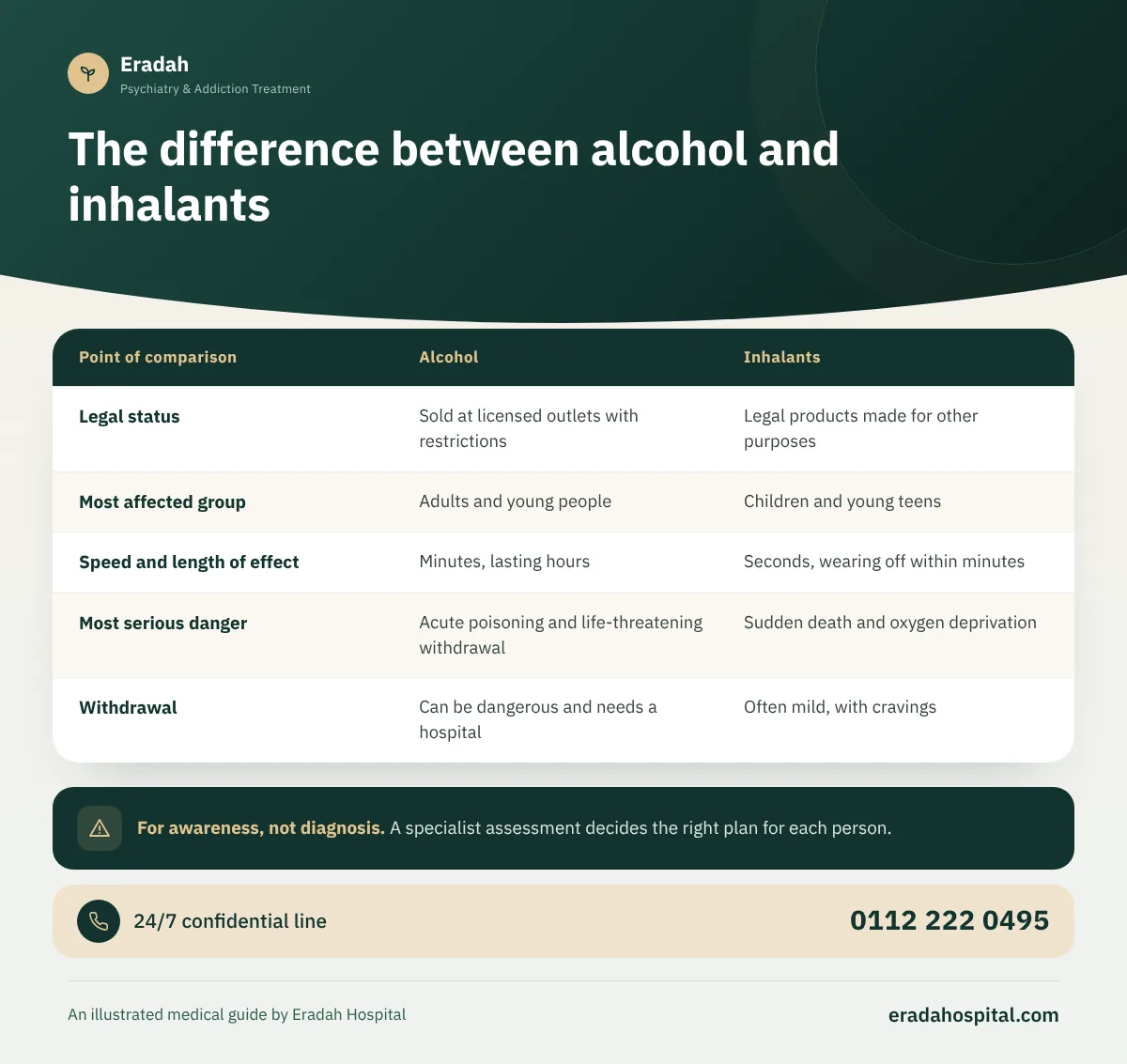
| Point of comparison | Alcohol | Inhalants |
|---|---|---|
| Legal status | Sold at licensed outlets with restrictions | Legal products made for other purposes |
| Most affected group | Adults and young people | Children and young teens |
| Speed and length of effect | Minutes, lasting hours | Seconds, wearing off within minutes |
| Most serious danger | Acute poisoning and life-threatening withdrawal | Sudden death and oxygen deprivation |
| Withdrawal | Can be dangerous and needs a hospital | Often mild, with cravings |
Alcohol and inhalants in numbers
World Health Organization figures show the scale of a problem that is underestimated because the substance is easy to get. Alcohol alone is responsible for millions of deaths each year, a large share of them among young people:
Men bear the largest share of these deaths, and a notable proportion are concentrated in the 20 to 39 age group, the years of work and building a family. Figures for inhalants are hard to pin down because their use mostly happens out of sight, among street children and young teens, but their danger is not measured by the number of users; it lies in the possibility of death the very first time.
Source: World Health Organization alcohol fact sheet.
Does “legally available” mean safe?
This is one of the most dangerous common ideas. A substance not being banned changes nothing about its effect on the body; in fact, being easy to get makes trying it easier and continuing easier. The World Health Organization stresses that no level of drinking is considered safe when it comes to cancer risk, and inhaling fumes can stop the heart even in a healthy person trying it for the first time.
| The myth | The truth |
|---|---|
| “Alcohol is a social drink; you can't get addicted” | Alcohol is among the most dependence-causing substances, and alcohol use disorder is a medically recognized illness. |
| “Kolla is child's play and will end by itself” | It can cause sudden death and permanent damage to the brain and nerves, and it needs early intervention. |
| “Coffee or cold water sobers up a drunk person” | Nothing speeds up the clearing of alcohol, and severe intoxication is an emergency. |
| “You can stop drinking suddenly at home” | Alcohol withdrawal in people who are dependent can cause seizures and delirium tremens, which are life-threatening. |
Risks shared across this family
- Depressed breathing and consciousness, with the danger multiplied when they are mixed with sedatives or opioids.
- Accidents, falls, drowning and burns while under the effect.
- Damage to the brain and nerves with continued use, and poor memory and concentration.
- Harm to the liver and heart, and with inhalants, harm to the kidneys and bone marrow.
- Depression and anxiety, and a higher risk of self-harm during intoxication.
- Falling behind at school or work, and family and legal problems.
The details of harm differ from one substance to another, so we have given separate pages to the harms of alcohol and the harms of kolla and inhalants.
Why do many teens start with these substances?
Some children and teens try inhalants or alcohol before any other substance, because they are cheap, close at hand and do not raise suspicion at first, and because curiosity, peer pressure and the wish to escape pressure at home or school are all strong factors at this age. The teenage brain is more sensitive to the harms of these substances and quicker to develop dependence.
Is withdrawal from these substances dangerous?
It differs a great deal between the two. Alcohol withdrawal in people who drink regularly can begin within hours of the last drink and progress from tremor and anxiety to seizures, and may reach delirium tremens, a medical emergency; that is why alcohol detox must be done under medical supervision. Withdrawal from inhalants is usually mild, such as irritability, insomnia, headache and cravings, but the real danger there is going back to use.
You will find the full details and the timeline on the page about alcohol withdrawal symptoms.
How is alcohol and inhalant addiction treated?
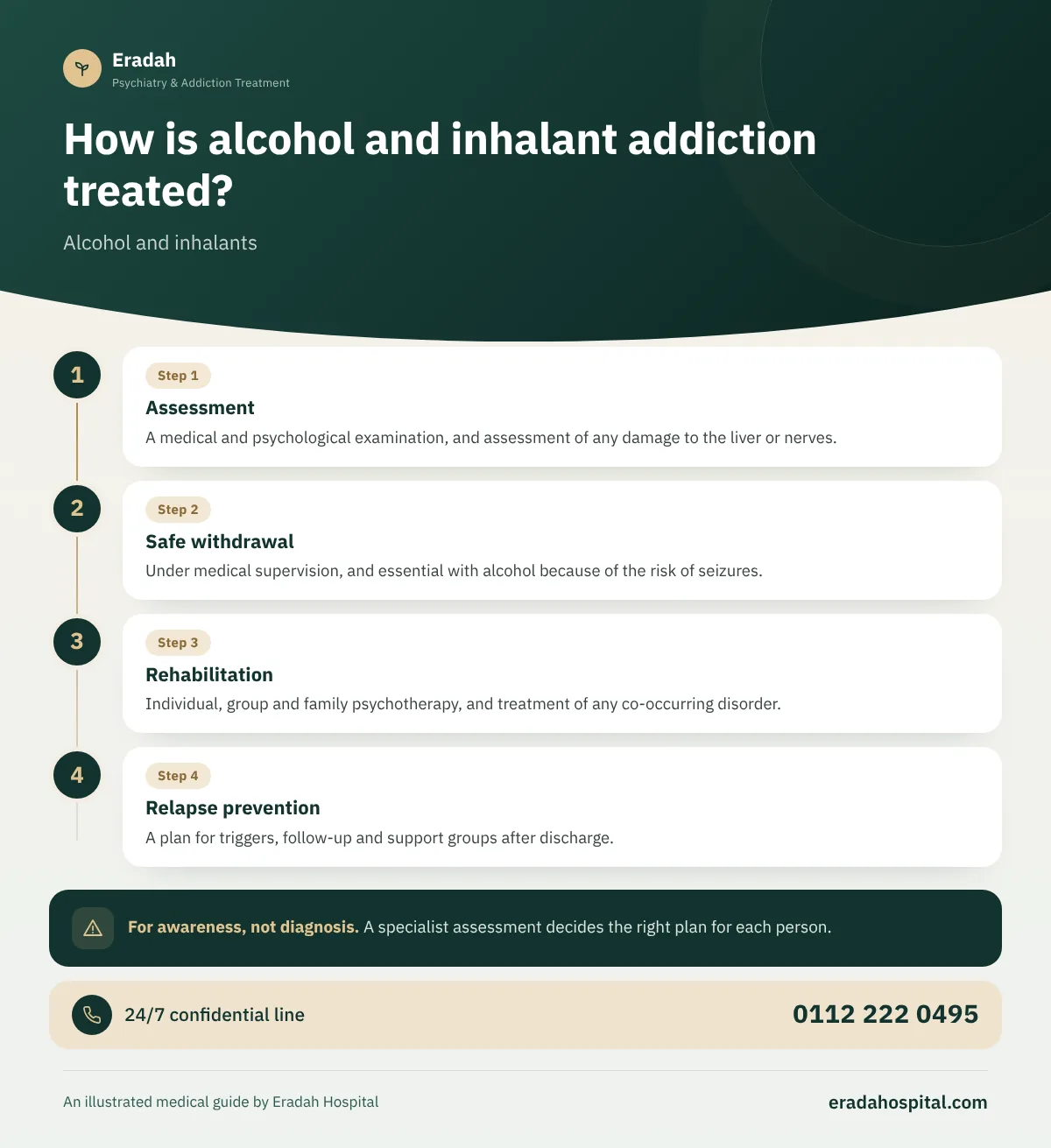
Treatment begins with a comprehensive medical and psychological assessment, then safe detox from the substance, followed by a rehabilitation program that addresses the causes of use and builds new skills for coping with stress. With alcohol there are approved medicines that help prevent relapse, chosen by the doctor; with inhalants, treatment relies on psychological, family and educational support and follow-up of any nerve damage.
- Step 1Assessment
A medical and psychological examination, and assessment of any damage to the liver or nerves.
- Step 2Safe withdrawal
Under medical supervision, and essential with alcohol because of the risk of seizures.
- Step 3Rehabilitation
Individual, group and family psychotherapy, and treatment of any co-occurring disorder.
- Step 4Relapse prevention
A plan for triggers, follow-up and support groups after discharge.
Read more in alcohol addiction treatment and kolla and inhalant addiction treatment.
How can families protect their children?
- Talk with your children early about the fact that “easy to get” is not necessarily safe, in a calm tone without exaggerated scare tactics.
- Keep household chemical products out of children's reach, and watch for repeated disappearances.
- Set an example in handling stress without turning to any substance.
- Keep track of friends, places and changes at school without humiliating spying.
- Ask for help early; you can contact the Child Helpline 16000 if a child is in danger.
Danger signs with alcohol and inhalants: call ambulance (123) immediately
- Loss of consciousness or difficulty waking the person
- Slow, irregular or stopped breathing
- Vomiting while semi-conscious
- Seizures, whether during intoxication or within days of stopping alcohol
- Chest pain or an obvious irregularity of the heartbeat
- Cold, pale skin or bluish lips
Call ambulance on 123, place the person on their side so they do not choke on vomit, and do not leave them alone. With inhalants, move them to fresh air and do not frighten or chase them. Coffee, cold water and walking do not treat poisoning.
Call the ambulance 123