What is pethidine?
Pethidine is one of the oldest synthetic opioid painkillers. Its official label from the US Food and Drug Administration (FDA) states that it was first approved there in 1942. It is not extracted from the opium poppy like morphine but is made entirely in the laboratory, yet most of its effects resemble those of morphine.
Pethidine goes by more than one name: "pethidine" in most countries including Egypt, "meperidine" in the United States, and "Demerol" as its best-known brand name. As a result, a patient may read one name on a hospital form and not connect it with the same medicine they have heard of under another name.
For decades, many people associated it with the "pain shot" in the emergency room. But this fame does not mean it is safe. Its official label opens with a prominent warning about addiction, misuse, slowed breathing, and overdose, like other powerful opioids.
Medical uses of pethidine
MedlinePlus states that it is used to relieve severe pain and is limited to cases where alternatives are not enough.
The UK National Health Service (NHS) explains that it is given by injection into the thigh or buttocks, starts working within about 20 minutes, and lasts 2 to 4 hours.
A systematic review published in 2023 found it to be among the most effective treatments for stopping the shivering that occurs after general anesthesia.
Why has pethidine use declined?
A Canadian study published in 2016 summarizes the problem: pethidine offers little advantage over other opioids, and it has drawbacks including limited potency, a short duration of action, and the production of a metabolite that is toxic to nerves. The FDA label explains that the half-life of pethidine in healthy people is 3 to 8 hours, while the average half-life of norpethidine is 20.6 hours, and that both are eliminated through the kidneys.
This means pain may return after a few hours and the patient asks for another dose, while the toxic metabolite from earlier doses remains in the body and accumulates, especially in older adults and people with reduced kidney function. For this reason, the Institute for Safe Medication Practices suggested avoiding it in older adults and not using it for more than 48 hours.
How does pethidine affect the brain?
Pethidine is a full opioid receptor agonist, and the FDA label describes its actions as qualitatively similar to those of morphine, the most important therapeutically being pain relief and sedation. When it binds to these receptors in the brain and spinal cord, it dampens pain signals and produces a feeling of relief and euphoria, which makes repeating the experience tempting.
- Weak serotonin effect: A review published in 2005 explains that pethidine, like tramadol and methadone, weakly inhibits serotonin reuptake, unlike morphine and codeine.
- A nerve-stimulating metabolite: Norpethidine does not relieve pain in the same way; instead, it irritates the nervous system if it builds up.
- Adaptation with repeated use: Tolerance and physical dependence develop, and this may progress to opioid use disorder.
Forms of pethidine
In hospitals, pethidine is usually given by injection into a muscle or vein, and in some countries it is available as tablets and syrup. The FDA label states that only about 50% of the tablet dose reaches the bloodstream, so doses differ between forms, and doctors warn about measuring errors with the syrup that can cause an overdose. Pethidine has no widely known street name, since it usually leaks out of the medical pathway itself.
Why is pethidine misused?
The story often begins with a genuine prescription for acute pain, such as renal colic or an injury. The person then discovers the relief the injection gives and continues after the pain has gone. The FDA label states that the risk of misuse is higher in people with a long history of opioid use, a history of alcohol or drug misuse, or those who combine it with other substances.
Pethidine compared with morphine and tramadol
| Pethidine | Morphine | Tramadol | |
|---|---|---|---|
| Origin | Entirely synthetic | Natural, from opium | Synthetic |
| Effect on serotonin | Weak, but dangerous with MAO inhibitors | Does not inhibit its reuptake | Clear, and dangerous with serotonergic drugs |
| Metabolite toxic to nerves | Yes, norpethidine | No | Seizure risk is known |
| Main risk | Seizures with repeated use and drug interactions | Respiratory depression and addiction | Seizures and addiction |
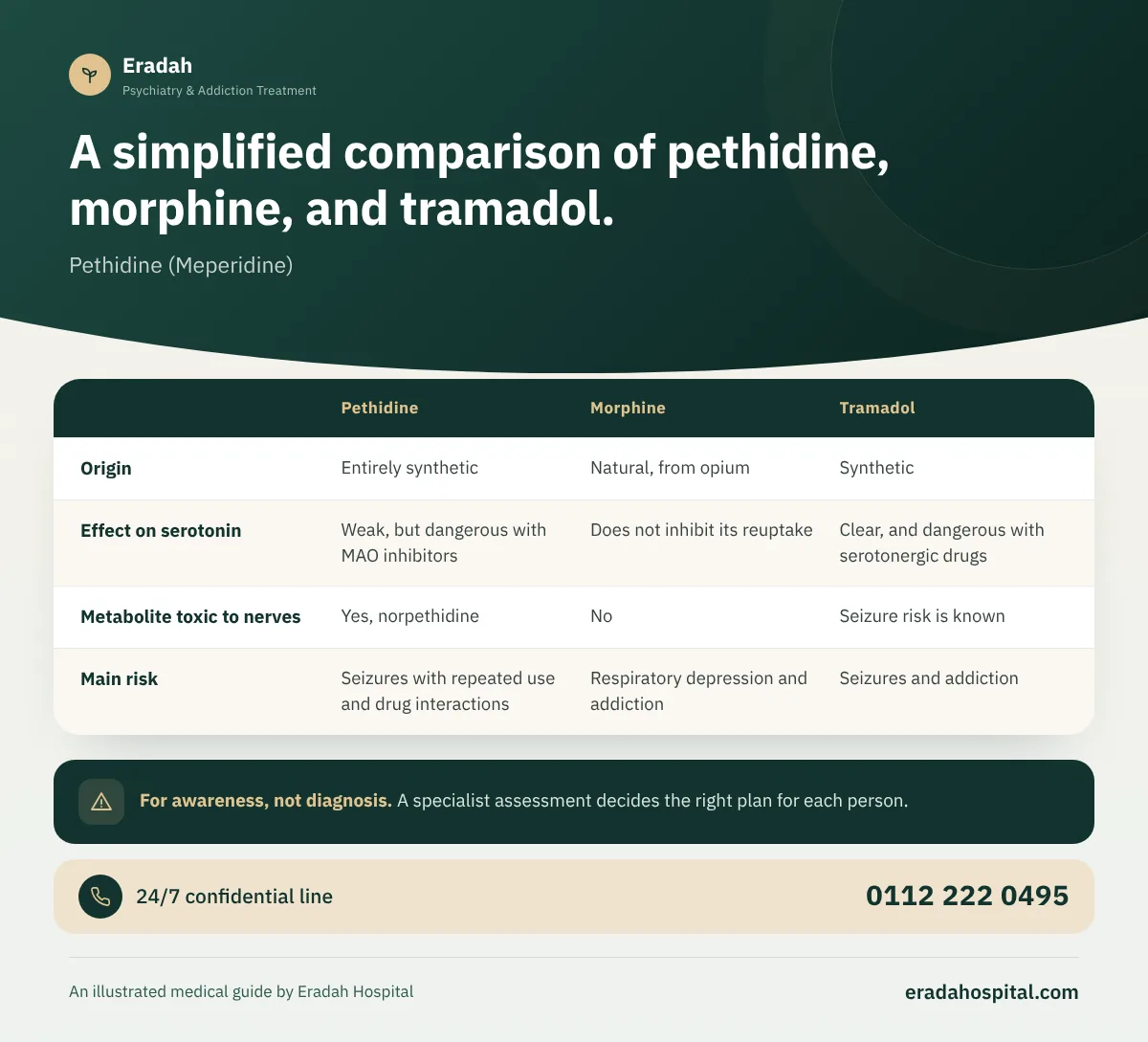
The 2005 review notes that pethidine, tramadol, and methadone have been implicated in serotonin toxicity reactions with MAO inhibitors, some of them fatal, whereas morphine, codeine, and oxycodone do not cause this.
Legal status of pethidine
Pethidine is listed in Schedule I of the 1961 Single Convention on Narcotic Drugs, on the Yellow List issued by the International Narcotics Control Board, and the FDA label classifies it in the United States as a Schedule II controlled substance. In Egypt it is an opioid medicine dispensed only by prescription and under controls, and possessing or trading it outside the medical framework is an offense. The Fund for Drug Control and Treatment of Addiction offers free, confidential treatment through hotline 16023.
This is general educational information and not legal advice.
Pethidine in numbers
Source: the official Demerol prescribing information issued by the US Food and Drug Administration (FDA).
Harms, symptoms, withdrawal, and treatment of pethidine in brief
Harms: Slowed breathing, seizures and hallucinations from the buildup of the toxic metabolite, serotonin toxicity with some antidepressants, and addiction. Details are in Harms of pethidine.
Symptoms: Drowsiness, sweating, dizziness, repeated requests for the injection on the grounds of pain, and changes in mood and behavior. Read Symptoms of pethidine addiction.
Withdrawal and treatment: Stopping suddenly after regular use causes opioid withdrawal and the return of pain, and treatment combines safe detox, a pain plan, and psychological therapy. See Pethidine withdrawal symptoms and Pethidine addiction treatment.
Pethidine guide: everything you need to know
We have gathered everything about pethidine into 4 pages, each answering one question in detail. Choose what you are looking for:
Harms of pethidine to the body and mind
Harms of pethidine (meperidine): slowed breathing, seizures and hallucinations from norpethidine buildup, serotonin toxicity with antidepressants, and its effects on the kidneys, hormones, pregnancy, and older adults.
Pethidine addiction symptoms and signs of use
How can you tell that someone is misusing pethidine? Physical, behavioral, and psychological signs, signs of toxic metabolite buildup, when prescribed use turns into addiction, and how to start the conversation.
Pethidine withdrawal symptoms and how long they last
When do pethidine withdrawal symptoms start and how long do they last? The physical and psychological symptoms of stopping meperidine, the return of pain, abrupt withdrawal with some painkillers, and why gradual tapering is needed.
Pethidine addiction treatment: stages and duration
How is pethidine addiction treated? The stages of treatment, from assessment and gradual tapering or detox to supporting medications, psychological therapy, an alternative pain plan, and relapse prevention.
If a family member keeps asking for pethidine
- Do not assume the pain is fake, but notice how often the requests come and their pattern.
- Ask for one doctor to follow the case instead of moving between emergency departments.
- Tell the doctor about all the medicines the person takes, especially antidepressants.
- Learn the signs of overdose and poisoning listed below, and save the ambulance number, 123.
- Seek specialist advice if signs of dependence appear. Treatment is possible.
Danger signs after taking pethidine: call an ambulance on 123 immediately
- Slow, shallow, or stopped breathing, or unusual snoring during sleep
- Extreme drowsiness and not responding when called, or loss of consciousness
- Cold, clammy skin, bluish lips and nails, and a slow pulse
- Tremors, muscle twitching, seizures, or hallucinations, especially after repeated use
- High temperature, agitation, heavy sweating, and muscle rigidity if taken with antidepressants
Call an ambulance on 123 immediately. If the person is unconscious but breathing, place them on their side (recovery position) so they do not choke on vomit, stay with them and do not leave them alone, and do not give them anything by mouth. Tell the paramedics that the person took pethidine and about all other medicines they take, especially antidepressants and sedatives, and keep the packaging or ampoule.
Call the ambulance 123