What are stimulants?
Stimulants are a family of substances that share the fact that they “press the accelerator” in the brain and body together: they increase alertness, activity and heart rate, and reduce the sense of tiredness, hunger and the need for sleep.
Some members of this family are completely prohibited substances made in clandestine laboratories, such as crystal meth and Captagon; some are extracted from plants, like cocaine from coca leaves; and some are approved medicines with real medical use, like Ritalin. Amphetamine stands in the middle: it is the origin of the family, has a medicinal use in some countries, and is at the same time the active ingredient in most illicit stimulant tablets.
These substances differ in form and source, and share one effect: excess energy and heightened confidence for hours, then a drop in energy and mood. With repetition the brain learns that this energy comes only from the substance, and addiction begins.
How do stimulants affect the brain?
Stimulants act on the brain’s reward system, raising the concentration of dopamine, linked to pleasure and motivation, and norepinephrine, linked to alertness and the “fight or flight” response. The method differs among members of the family: cocaine and Ritalin block the reuptake of these neurotransmitters so they stay longer in the synapses, while amphetamine and crystal meth push nerve cells to release them in large amounts.
Alertness, energy, talkativeness and excess confidence, with a racing pulse, higher blood pressure and temperature, and reduced appetite and sleep.
A sharp drop in energy and mood, long sleep or insomnia, irritability, and cravings to repeat the experience.
Tolerance that drives increased use, and a disrupted reward system that makes ordinary life joyless without the substance.
Because these substances activate the sympathetic nervous system, their effect is not limited to mood; it extends to the heart, blood vessels and temperature regulation, which explains their link to heart attacks and strokes even in young people.
Types of stimulants
Each substance in this family has a full guide and separate pages. Here is a short card for each:
Crystal meth (shabu)
MethamphetamineAlso known as: methamphetamine, ice, crystal meth
A powerful synthetic stimulant, also known as ice, whose psychological harms are severe and fast, most notably hallucinations, violence and psychosis.
- Classification
- Synthetic stimulant
- Medical use
- Not used medically
- Addiction potential
Very high- Withdrawal
High
Main risk: psychosis, violence and strain on the heart
Cocaine
CocaineA stimulant extracted from the leaves of the coca plant, short-acting and linked to heart attacks even in young people.
- Classification
- Natural stimulant from coca
- Medical use
- Limited medical use as a local anesthetic
- Addiction potential
Very high- Withdrawal
Moderate
Main risk: heart attacks and strokes
Amphetamine
AmphetamineA synthetic stimulant that is the parent of the stimulant family, and an ingredient in most illicit stimulant tablets.
- Classification
- Synthetic stimulant
- Medical use
- Prescribed in some countries for hyperactivity
- Addiction potential
High- Withdrawal
Moderate
Main risk: high blood pressure and psychosis
Captagon
CaptagonAlso known as: Captagon pills
Illicit stimulant tablets, most of which contain amphetamine and caffeine, common among young people and students.
- Classification
- Illicit stimulant tablets
- Medical use
- Not used medically
- Addiction potential
High- Withdrawal
Moderate
Main risk: unknown composition and adulterated substances
Ritalin
MethylphenidateAlso known as: Methylphenidate
A stimulant medication for hyperactivity and attention deficit, misused to stay up late, to study and to lose weight.
- Classification
- Stimulant (medication)
- Addiction potential
Moderate- Withdrawal
Moderate
Main risk: heart rhythm disturbance when misused
Khat
KhatAlso known as: Qat, Chat, Miraa
A plant whose fresh leaves are chewed for their stimulant cathinone, linked to high blood pressure, oral lesions and psychological dependence.
- Classification
- Plant-based stimulant
- Medical use
- Not used medically
- Addiction potential
Moderate- Withdrawal
Low
Main risk: high blood pressure, oral lesions and psychosis with excessive use
Caffeine
CaffeineAlso known as: coffee, tea, energy drinks
The world's most popular stimulant, safe in moderation, but it can cause dependence and headaches on stopping, and concentrated products are dangerous.
- Classification
- Stimulant (methylxanthine)
- Medical use
- Apnea in premature infants
- Addiction potential
Low- Withdrawal
Low
Main risk: poisoning from concentrated tablets and powders
Flakka
Flakka (α-PVP)Also known as: alpha-PVP, zombie drug, bath salts
An extremely potent synthetic cathinone that can cause delirium with agitation and a dangerous rise in body temperature, and is often not detected by routine tests.
- Classification
- Synthetic stimulant cathinone
- Medical use
- Not used medically
- Addiction potential
High- Withdrawal
Moderate
Main risk: delirium, agitation and a dangerous rise in temperature
Anabolic steroids
Anabolic SteroidsAlso known as: steroids, gym hormones
Synthetic hormones similar to testosterone, used in gyms to build muscle, which can cause dependence and heart damage.
- Classification
- Anabolic steroids
- Medical use
- Testosterone deficiency and delayed puberty
- Addiction potential
Moderate- Withdrawal
Moderate
Main risk: heart attacks, blood clots and severe depression on stopping
What is the difference between amphetamine-type stimulants, cocaine and pharmaceutical stimulants?
The family can be divided into three main groups. The first is amphetamine-type stimulants, which include amphetamine, crystal meth (methamphetamine) and Captagon; these are synthetic substances whose effect usually lasts for hours. The second is cocaine, a plant extract with a short action, which is why it drives the person who uses it to repeat doses close together. The third is pharmaceutical stimulants such as Ritalin, which are approved medicines for treating hyperactivity and attention deficit, but whose misuse turns them into a doorway to addiction.
| Point of comparison | Crystal meth (shabu) | Cocaine | Amphetamine and Captagon | Ritalin |
|---|---|---|---|---|
| Source | Synthetic, made in clandestine laboratories | Extracted from coca leaves | Synthetic; Captagon tablets are clandestine and of unknown composition | A drug made by pharmaceutical companies |
| Duration of effect | Very long | Short | Relatively long | Depends on the type of formulation |
| Medical use | Not found in Egypt | None | For amphetamine in some countries; Captagon was withdrawn from the markets | Approved for hyperactivity and attention deficit |
| Main risk | Psychosis, violence and high body temperature | Heart attack and stroke | Psychosis, heart attacks and unknown composition | Heart rhythm disturbance and psychosis when misused |
| Status in Egypt | Prohibited | Prohibited | Prohibited outside licensed settings | By prescription, under control |
The legal status mentioned is general educational material and not legal advice.
Stimulants by the numbers
Stimulants hold a prominent place on the world drug map. According to the World Drug Report 2025 from the United Nations Office on Drugs and Crime, amphetamines and cocaine come directly after cannabis and opioids in the number of people who use them, and cocaine is the fastest-growing drug market:
The United Nations warns that a decline in Captagon production in some regions may push traffickers toward more dangerous stimulants such as methamphetamine, which makes awareness about the whole family, rather than a single substance, essential.
Sources: World Drug Report 2025 (UNODC), UN News in December 2025, and the European Monitoring Centre for Drugs and Drug Addiction paper on the Captagon market.
Common myths about stimulants
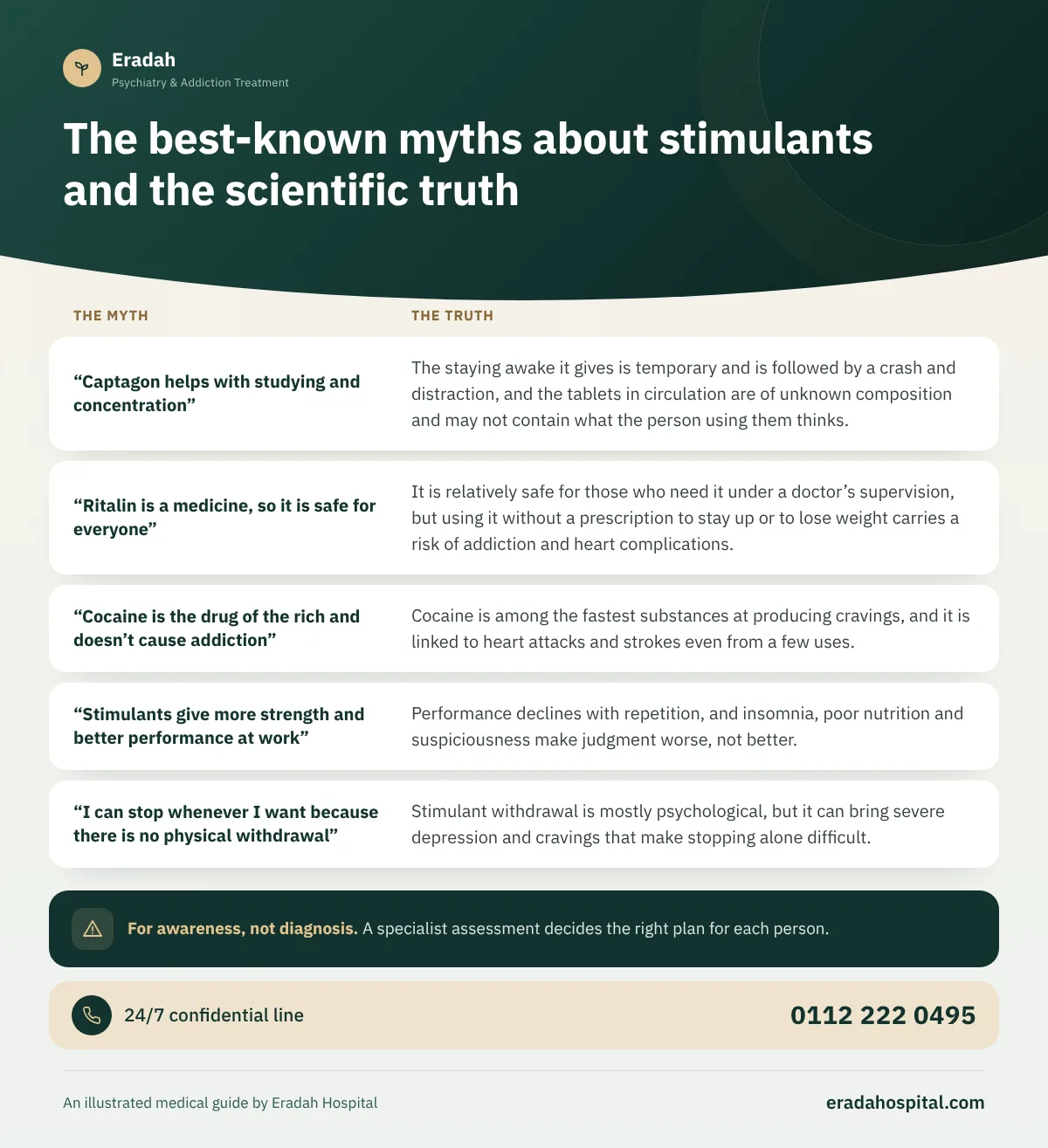
| The myth | The truth |
|---|---|
| “Captagon helps with studying and concentration” | The staying awake it gives is temporary and is followed by a crash and distraction, and the tablets in circulation are of unknown composition and may not contain what the person using them thinks. |
| “Ritalin is a medicine, so it is safe for everyone” | It is relatively safe for those who need it under a doctor’s supervision, but using it without a prescription to stay up or to lose weight carries a risk of addiction and heart complications. |
| “Cocaine is the drug of the rich and doesn’t cause addiction” | Cocaine is among the fastest substances at producing cravings, and it is linked to heart attacks and strokes even from a few uses. |
| “Stimulants give more strength and better performance at work” | Performance declines with repetition, and insomnia, poor nutrition and suspiciousness make judgment worse, not better. |
| “I can stop whenever I want because there is no physical withdrawal” | Stimulant withdrawal is mostly psychological, but it can bring severe depression and cravings that make stopping alone difficult. |
What dangers do stimulants share?
- High blood pressure, heart rhythm disturbance and heart attacks, even in young people.
- Strokes and seizures.
- A dangerous rise in body temperature, especially with staying up late, dancing and dehydration.
- Anxiety, panic attacks and chronic insomnia.
- Stimulant-related psychosis: suspiciousness, paranoia and hallucinations, which may be accompanied by violence.
- Weight loss, malnutrition, and deterioration of the teeth and skin with continued use.
- Severe depression after stopping, which may be accompanied by thoughts of self-harm.
The risk rises when stimulants are mixed with alcohol or other substances, or when tablets of unknown composition are used. The details differ from one substance to another, so we have dedicated separate pages to harms of crystal meth, harms of cocaine and harms of Captagon.
Why are stimulants widespread among young people and students?
In many young people’s minds, stimulants are tied to staying up late, studying, productivity and parties. The student before exams, the driver on a long trip, someone working back-to-back shifts, and someone who wants to lose weight may all be offered a tablet that “opens up the brain”. The story often begins with Ritalin or Captagon for a practical reason, then turns into a daily need.
The risk is greater in adolescence and early adulthood, because the brain is still maturing, and because the feeling of excess confidence lowers caution and increases accidents and impulsive behavior. At parties, staying up late, dancing and dehydration increase the risk of overheating.
What about stimulants prescribed by a doctor?
Ritalin and similar medicines are used medically to treat hyperactivity, attention deficit and narcolepsy, and under a doctor’s supervision they help many patients live better lives. The US Food and Drug Administration has updated the warnings on these medicines to draw attention to the risk of misuse and addiction, and to the importance of keeping them away from others and not sharing them.
Is stimulant withdrawal dangerous?
Stimulant withdrawal differs from alcohol or sedative withdrawal; it mostly does not cause seizures, but comes as a crash: severe exhaustion, long sleep, hunger, depression, distress and cravings to use. The real danger is psychological, as the depression can reach suicidal thoughts, and the cravings make relapse quick without support.
You can find the full details in the pages on crystal meth withdrawal symptoms, cocaine withdrawal symptoms and amphetamine withdrawal symptoms.
How is stimulant addiction treated?
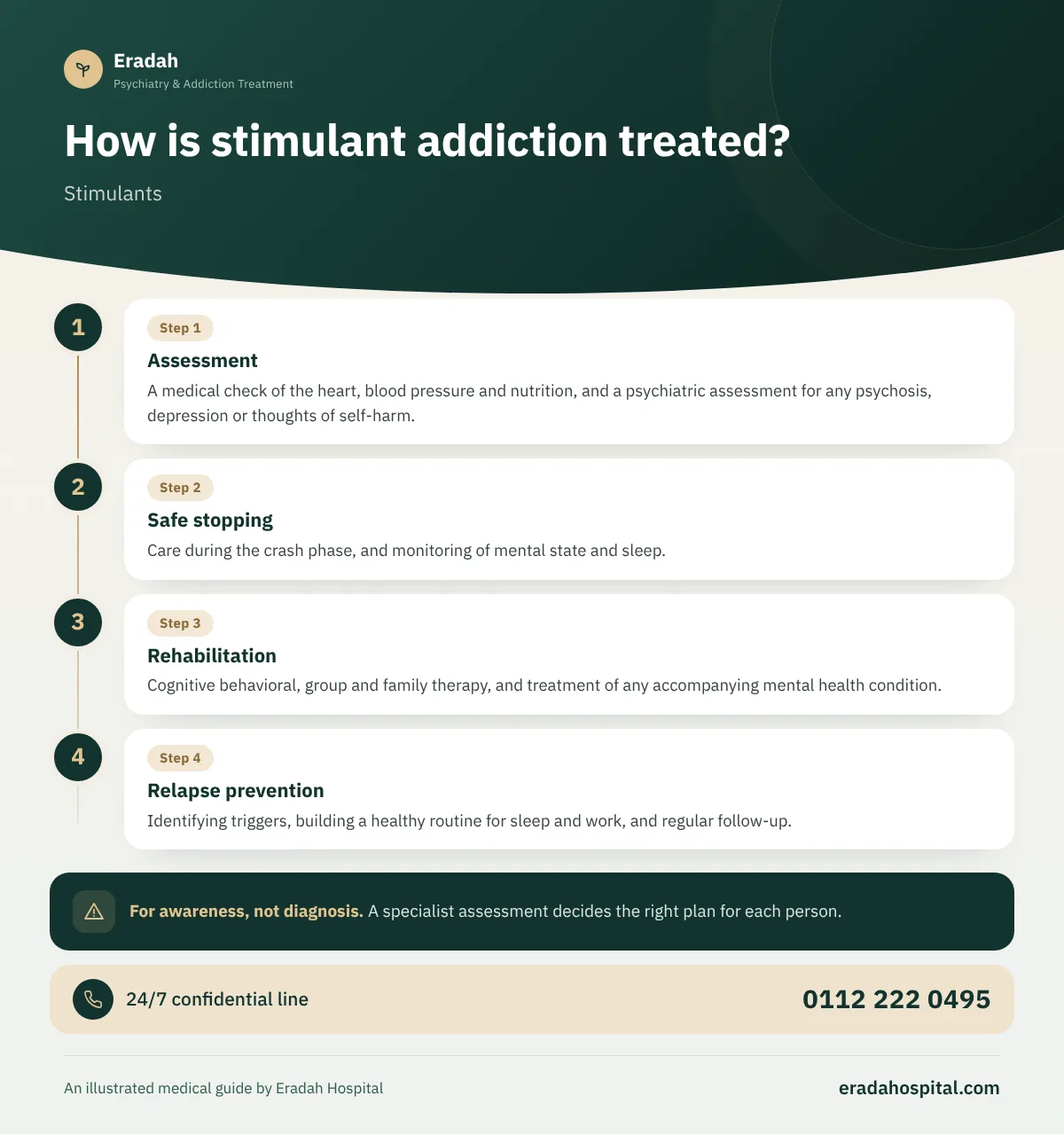
So far there is no medication approved specifically to treat stimulant addiction, so treatment relies mainly on psychological and behavioral interventions that have proven effective, such as cognitive behavioral therapy, contingency management (positive reinforcement of abstinence), and family therapy. The doctor uses medications to treat accompanying symptoms such as insomnia, depression and psychosis when needed.
- Step 1Assessment
A medical check of the heart, blood pressure and nutrition, and a psychiatric assessment for any psychosis, depression or thoughts of self-harm.
- Step 2Safe stopping
Care during the crash phase, and monitoring of mental state and sleep.
- Step 3Rehabilitation
Cognitive behavioral, group and family therapy, and treatment of any accompanying mental health condition.
- Step 4Relapse prevention
Identifying triggers, building a healthy routine for sleep and work, and regular follow-up.
Read more in crystal meth addiction treatment, cocaine addiction treatment, amphetamine and Captagon addiction treatment and Ritalin addiction treatment. The Fund for Drug Control and Treatment of Addiction provides free, confidential treatment through hotline 16023.
Do stimulants show up on a drug test?
Most initial screening tests include a category for amphetamines and another for cocaine. Detection windows vary by substance, sample type and pattern of use, and they are always approximate and vary by laboratory. Some medicines can give a false positive on the initial screen, so the result is confirmed with a confirmatory test. Details are in crystal meth testing and Captagon testing.
How can the family deal with someone who uses stimulants?
- Choose a calm time after the effect has worn off to talk, and avoid confrontation while the person is under the influence or at peak irritability.
- Talk about your concern for their health, sleep and future, not about shame or punishment.
- If suspiciousness, hallucinations or aggression appear, seek an urgent psychiatric assessment, and do not argue with their thoughts.
- Watch for signs of severe depression after stopping, and do not leave them alone if they talk about harming themselves.
- Seek specialized family counseling even if they refuse treatment at first; a trained family increases the chances they will accept it.
Danger signs with stimulants: call ambulance (123) immediately
- Chest pain or pressure, or severe palpitations and an irregular heartbeat
- Very high body temperature with hot skin and heavy sweating, or sweating that has stopped
- Seizures or loss of consciousness
- Severe agitation, violence, or suspiciousness and hallucinations that make the person a danger to themselves or others
- Signs of a stroke: a drooping face, sudden weakness in an arm or leg, difficulty speaking, or a sudden severe headache
Call ambulance (123) immediately, move the person to a quiet, cool place away from crowds, and speak to them calmly without restraining or arguing with them. If they lose consciousness, place them on their side and stay with them until help arrives, and do not give them any medicine or other substance.
Call the ambulance 123