What is Nalufin?
Nalbuphine is a synthetic opioid painkiller approved for marketing in the United States in 1979 under the name “Nubain” and known in Egyptian pharmacies as “Nalufin.” The US Drug Enforcement Administration (DEA) describes it as a “mixed-action” opioid, chemically close both to naloxone, the opioid antagonist, and to oxymorphone, a strong painkiller.
Nalbuphine is available only as an injectable solution; there are no tablets or syrup. The DEA notes that it is mostly used inside hospitals and that it is rarely prescribed outside them compared with other opioid painkillers. It belongs to the opioid family but differs from morphine in how it works, and that difference is the key to understanding both its benefits and its dangers.
Many people wrongly assume that Nalufin is a “mild painkiller” because it is less well known than others. According to its official label from the US Food and Drug Administration (FDA), its pain-relieving strength is roughly equal to that of morphine, and the label itself opens with a prominent warning about addiction, misuse, overdose and death.
Medical uses of Nalufin
The FDA label specifies its use for severe pain that requires an opioid painkiller and for which alternatives are not sufficient. It can also be used as a supplement to anesthesia, for pain relief before and after surgery, and during labor. The doctor decides the dose and the route of administration according to the case.
When non-opioid painkillers are not enough; it is given under medical observation.
As part of the anesthesia and pain-relief plan set by the anesthesia team.
Only on careful medical judgment, because it crosses the placenta and may affect the baby’s heart rate.
A scientific review published in 2018 notes that it is used in small amounts, under supervision, to ease side effects of other opioids.
How does Nalufin affect the brain?
The brain has several types of opioid receptors. According to the FDA label, nalbuphine activates kappa receptors, which relieves pain and causes calm and drowsiness, while at the same time blocking the mu receptors on which most opioids such as heroin and morphine act.
- A ceiling on respiratory depression: the label notes that increasing the dose beyond a certain point does not increase respiratory depression when it is taken alone, but this ceiling does not protect someone who combines it with sedatives or alcohol.
- Blocking other opioids: because it displaces opioids from the mu receptors, it can trigger sudden withdrawal in someone whose body has become used to them.
- Pinpoint pupils: it causes constricted pupils even in complete darkness, as the label notes.
- Adaptation with repeated use: tolerance and physical dependence develop, so the person needs more, and withdrawal symptoms appear when it is stopped.
The dual nature of Nalufin does not make it safe; it makes it unpredictable: it reduces one danger in one situation and creates another in a different situation.
Forms and names of Nalufin
Nalbuphine comes as ampoules or vials for injection into a vein, a muscle or under the skin. Its brand names include “Nubain” worldwide and “Nalufin” in Egypt. According to the FDA label, its effect begins within 2 to 3 minutes after an intravenous injection and in under 15 minutes after an intramuscular or subcutaneous injection, and pain relief lasts 3 to 6 hours.
There is no widely used street name for Nalufin, and it is usually passed around under its brand name. But ampoules that reach people who are not patients come from outside the medical chain, so neither their storage nor the safety of the syringes used with them can be guaranteed.
Why is Nalufin misused?
The DEA notes that nalbuphine is less attractive to people who use heroin because it triggers withdrawal in them, but it points to reports of misuse among health care workers and bodybuilders who use anabolic steroids. In South Korea, its misuse began in late 1991 as a substitute for methamphetamine when that became scarce, according to a study published in 1995.
- Relieving the pain of intense workouts and injuries without seeing a doctor.
- Looking for relaxation and sleep after an exhausting day.
- Believing it is “not a drug” because it is a little-known medicine.
- Copying others in gyms where it is common.
Nalufin compared with other opioids
| Nalbuphine | Morphine | Tramadol | |
|---|---|---|---|
| How they work | Activates kappa, blocks mu | Fully activates mu | Activates mu and affects serotonin and norepinephrine |
| Format | Injection only | Injection and tablets | Tablets and injection |
| In people who use opioids | May trigger withdrawal | Increases the effect and the risk | Increases the effect and the risk |
| Main risk | Respiratory depression with sedatives, and dependence | Respiratory depression and addiction | Seizures and addiction |
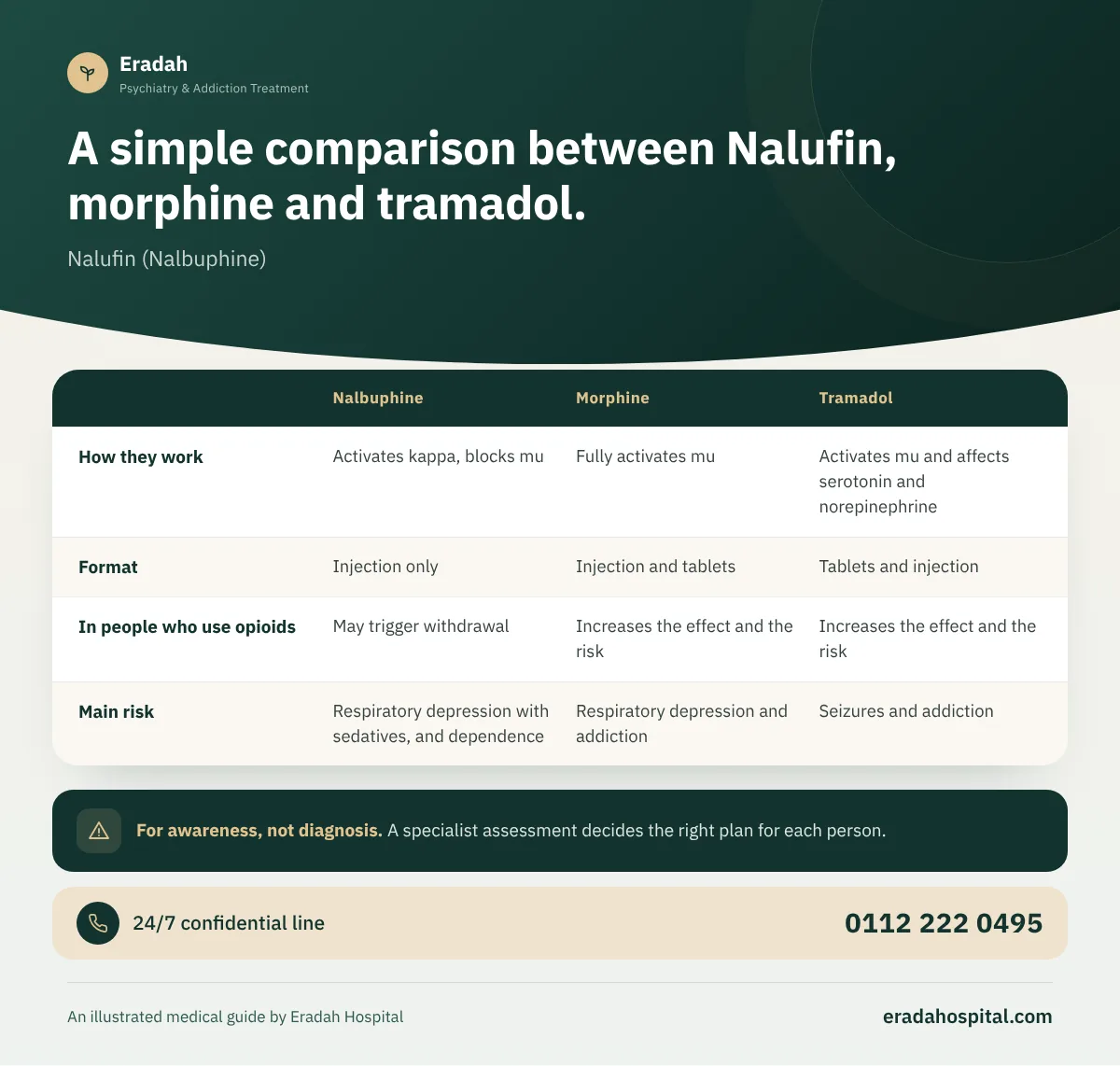
Nalufin resembles buprenorphine in its ability to trigger withdrawal, but buprenorphine is an approved medicine for treating opioid addiction, whereas the 2018 review explains that nalbuphine is not suitable for treating opioid withdrawal syndrome.
The legal status of Nalufin
Internationally, nalbuphine does not appear on the Yellow List of narcotic drugs under international control issued by the International Narcotics Control Board, and the DEA notes that it is not listed in the controlled substance schedules in the United States. For that reason, researchers have called since the 1990s for a review of its status after its misuse was detected.
In Egypt, Nalufin is dispensed by prescription only, and it was named among the substances covered by amendments to the narcotics schedules before the Supreme Constitutional Court ruled in February 2026 that the decision regulating them was unconstitutional, after which new regulatory decisions followed. For that reason, always refer to the latest decisions of the Ministry of Health and the Egyptian Drug Authority. The Fund for Drug Control and Treatment of Addiction offers free, confidential treatment through hotline 16023.
This is general educational information and not legal advice.
Nalufin in numbers
Sources: the official FDA label for Nubain, and the study by Wines and colleagues in the American Journal on Addictions.
Nalufin harms, symptoms, withdrawal and treatment in brief
Harms: the main ones are drowsiness and respiratory depression when it is combined with sedatives or alcohol, sudden withdrawal in people who use opioids, and diseases from shared injecting equipment. Details are on the harms of Nalufin page.
Symptoms and signs: drowsiness and pinpoint pupils, injection marks, repeated searching for ampoules, and irritability if the injection is delayed. Read symptoms of Nalufin addiction.
Withdrawal and treatment: stopping after regular use causes symptoms similar to opioid withdrawal, and treatment starts with an assessment and safe detox, followed by psychological treatment and follow-up. Details are in symptoms of Nalufin withdrawal and treatment of Nalufin addiction.
Nalufin guide: everything you need to know
We have gathered everything about Nalufin into 5 pages, each answering one question in detail. Choose what you are looking for:
Harms of nalbuphine to the body and mind
Harms of Nalufin (nalbuphine): drowsiness and respiratory depression, the danger of mixing it with sedatives and alcohol, sudden withdrawal in people who use opioids, the harms of repeated injection, and its effect on hormones and pregnancy.
Nalbuphine addiction symptoms and signs of use
How do you know if someone is using Nalufin? The physical, behavioral and psychological signs of Nalufin addiction, signs specific to gyms, when use becomes addiction, and how to start the conversation.
Nalbuphine withdrawal symptoms and how long they last
When do Nalufin withdrawal symptoms start and how long do they last? Symptoms of stopping after regular injection, the sudden withdrawal it triggers in people who use opioids, and why stopping needs medical supervision.
Nalbuphine addiction treatment: stages and duration
How is Nalufin addiction treated? The stages of treatment from assessment and safe detox to psychological treatment, follow-up for anabolic steroids and infections, and relapse prevention, and when you need residential care.
How long nalbuphine stays in the body and drug testing
How long does Nalufin stay in the body? Its half-life and duration of effect, whether a rapid drug test detects it or a confirmatory test is needed, hair testing, and the factors that affect how fast it is cleared.
Found Nalufin ampoules with your son? Start here
- Do not accuse him right away; calmly ask where they came from and why he used them, since they may be part of a prescribed treatment.
- Ask about anabolic steroids and supplements, since they are often found together in the gym environment.
- Do not try to stop him on your own if he injects regularly; seek a medical assessment.
- Learn the overdose signs listed below and the ambulance number, 123.
- Dispose of used syringes safely, and do not touch them with bare hands.
Danger signs after using Nalufin: call an ambulance (123) immediately
- Severe drowsiness that makes it hard to wake the person, or loss of consciousness and no response to calling or touch
- Slow, shallow or irregular breathing, or unusual snoring during sleep
- Very small pupils, or blue lips and nails with cold, clammy skin
- Seizures, especially in someone with a history of epilepsy
- Vomiting, sweating, shaking and sudden agitation after the injection in someone who uses other opioids
Call an ambulance on 123 immediately. If the person is unconscious but breathing, place them on their side (recovery position) so they do not choke on vomit, stay with them and do not leave them alone, and do not give them food or drink. Tell the paramedics what the person took and any other substances used with it, such as sedatives, alcohol or tramadol, and keep the ampoule or packaging if you find it.
Call the ambulance 123