Short-term harms of nalbuphine
The harms of nalbuphine can begin with the first injection, before any dependence develops. A medicine given in the hospital under observation becomes, outside it, an injection taken without knowing the state of the heart and lungs, and with no one noticing slow breathing.
The FDA label lists the most common side effects in studies of 1,066 patients who received nalbuphine under medical supervision:
| Effect | How often it occurred |
|---|---|
| Drowsiness and sedation | 36% |
| Sweating and clammy skin | 9% |
| Nausea or vomiting | 6% |
| Dizziness or vertigo | 5% |
| Dry mouth | 4% |
| Headache | 3% |
These are rates in patients in a medical setting with measured amounts. With repeated injection outside the hospital, the amounts rise and the injections come closer together, so drowsiness and poor concentration increase, and driving or operating machinery becomes a real danger, as the DEA warns.
Suppressed breathing: does nalbuphine have a ceiling that protects against it?
The FDA label states that nalbuphine can suppress breathing to the same degree as morphine at a similar level of pain relief, but it has a “ceiling”; that is, increasing the dose beyond a certain point does not increase the suppression of breathing when it is taken alone. A review published in 2018 indicates that deaths linked to it alone are few, partly because of this ceiling and partly because it is little used.
Triggered withdrawal: a harm opioid users do not expect
Because nalbuphine blocks mu receptors, it can push out of them other opioids the body is used to. In a 1989 study of volunteers dependent on methadone, nalbuphine showed no opioid-like effect in them; instead, it produced withdrawal symptoms that could not be told apart from those caused by naloxone, the opioid antagonist.
In practical terms, this means that someone who regularly uses tramadol or heroin and then injects nalbuphine may fall within minutes into acute withdrawal: sweating, vomiting, diarrhea, pain and agitation. This may push them to use more of the original opioid to stop the symptoms, raising the risk of overdose after the effect of nalbuphine wears off.
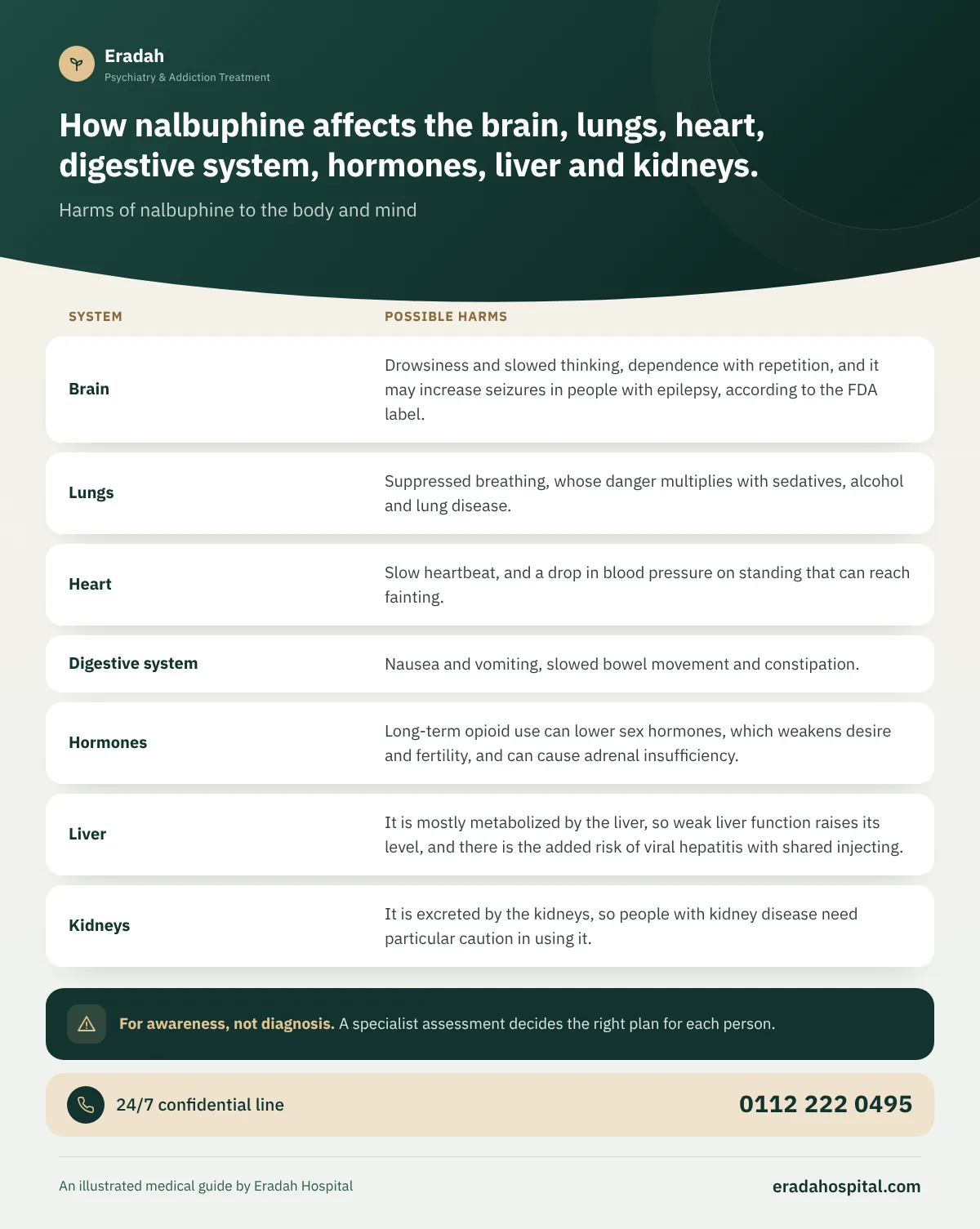
Harms of nalbuphine to the body’s systems
| System | Possible harms |
|---|---|
| Brain | Drowsiness and slowed thinking, dependence with repetition, and it may increase seizures in people with epilepsy, according to the FDA label. |
| Lungs | Suppressed breathing, whose danger multiplies with sedatives, alcohol and lung disease. |
| Heart | Slow heartbeat, and a drop in blood pressure on standing that can reach fainting. |
| Digestive system | Nausea and vomiting, slowed bowel movement and constipation. |
| Hormones | Long-term opioid use can lower sex hormones, which weakens desire and fertility, and can cause adrenal insufficiency. |
| Liver | It is mostly metabolized by the liver, so weak liver function raises its level, and there is the added risk of viral hepatitis with shared injecting. |
| Kidneys | It is excreted by the kidneys, so people with kidney disease need particular caution in using it. |
Harms of repeated injection
The FDA label notes that misuse of medicines by injection is commonly associated with the spread of infectious diseases such as viral hepatitis and HIV. In a US study published in 1999, researchers interviewed 11 nalbuphine users and found that 8 of them began injecting into a vein with it even though they had never injected any drug before, and that their physical complications and psychological symptoms were wide-ranging.
Added to this are the infections and abscesses at the injection site and damage to the veins that accompany repeated injection, especially when non-sterile needles are used or shared by more than one person. These harms need medical treatment and should not be left to get worse.
When nalbuphine and anabolic steroids come together
The same US study noted that nalbuphine users in gyms had a high rate of accompanying mental health disorders, including misuse of other substances. British reports in 1996 described three cases of nalbuphine dependence linked to the use of anabolic steroids, and warned that moving from injecting steroids to injecting psychoactive substances is a real danger. That is why the medical assessment should cover both substances, not nalbuphine alone.
Psychological harms of nalbuphine
- Mood swings between relief and distress; the official label lists feeling uneasy, nervousness and depression among its less common effects.
- Confusion and unusual dreams, and sometimes hallucinations or a feeling that the surroundings are not real.
- Anxiety, tension and insomnia if the injection is delayed, in someone who has developed dependence.
- Growing preoccupation with getting hold of ampoules, and declining interest in work and family.
If the person already has depression or anxiety, treatment needs to deal with both conditions together, which is known as dual diagnosis.
Nalbuphine, pregnancy and breastfeeding
The FDA label states that nalbuphine crosses the placenta quickly, and that giving it during labor has been linked to a markedly slow fetal heart rate and suppressed breathing in the newborn, which is why it is used in pregnancy and childbirth only on a medical decision and with monitoring. Long-term opioid use during pregnancy can also cause withdrawal syndrome in the newborn, and during breastfeeding the infant is monitored for excess drowsiness and slow breathing. The decision in all of this belongs to the doctor alone.
Do the harms of nalbuphine go away after stopping?
Most harms improve gradually after stopping: sleep and concentration return, hormones settle, and anxiety eases with time. Infections spread by injection, however, need separate testing and treatment, which is why nalbuphine addiction treatment begins with a comprehensive medical assessment, followed by detox under supervision, not at home.
Danger signs after using Nalufin: call an ambulance (123) immediately
- Severe drowsiness that makes it hard to wake the person, or loss of consciousness and no response to calling or touch
- Slow, shallow or irregular breathing, or unusual snoring during sleep
- Very small pupils, or blue lips and nails with cold, clammy skin
- Seizures, especially in someone with a history of epilepsy
- Vomiting, sweating, shaking and sudden agitation after the injection in someone who uses other opioids
Call an ambulance on 123 immediately. If the person is unconscious but breathing, place them on their side (recovery position) so they do not choke on vomit, stay with them and do not leave them alone, and do not give them food or drink. Tell the paramedics what the person took and any other substances used with it, such as sedatives, alcohol or tramadol, and keep the ampoule or packaging if you find it.
Call the ambulance 123