What is krokodil?
Photos of rotting arms and legs that spread online led to krokodil being described as “the deadliest drug in the world.” Behind those images lies an important scientific reality: the opioid alone does not explain what happens. It is made under crude conditions, and the person who uses it injects a mixture into their veins without anyone knowing exactly what is in it.
Krokodil is a street name for an opioid mixture made at home from medicines containing codeine. According to a review published in 2013 in the International Journal of Drug Policy, its active drug is believed to be desomorphine. But the injected liquid may also contain various opium alkaloids and high concentrations of the chemicals used in preparation, which are responsible for the local and systemic harms. Another review, published in 2015, describes the result as a light brown liquid.
Desomorphine itself is not a new substance. It is an opioid closely related to morphine that has been known for decades. A systematic review published in 2012 described it as highly likely to cause dependence and noted that the first reports of krokodil use came from Russia in 2003.
Why is it called krokodil?
The word “krokodil” means crocodile in Russian. According to the 2013 review, the drug earned the name from the extreme harms linked to it, such as sores, skin that changes color and looks scaly, and amputation in advanced cases. For this reason it is sometimes called the “crocodile drug” in Arabic.
How does krokodil affect the brain?
Desomorphine is an opioid, so like other opioids it acts on opioid receptors in the brain: it causes calm and euphoria, relieves pain, and slows breathing. NIDA explains that opioids in general can cause addiction and overdose that stops breathing. With repeated use, tolerance and dependence develop, so the person needs more and is exposed to new toxic substances with every injection.
Why did krokodil spread?
The 2013 review links its emergence to disruption of the heroin market in the region, easy access to codeine medicines, and a long-standing culture of preparing drugs at home, in an environment where injection-related infections such as HIV and hepatitis C are widespread. Other reviews describe it as a cheap substitute for heroin. In other words, its spread was tied to poverty and a lack of alternatives, not to it being “stronger” or “better” than other drugs.
Where did krokodil spread? And what about the photos in circulation?
The 2013 review estimated that at least 100,000 people in Russia and about 20,000 in Ukraine injected krokodil in 2011. A review published in 2017 mentions reports of its use in several countries in Eastern Europe and in the Americas. But some of these reports are disputed: in 2014, American toxicologists described talk of its spread in the United States as an “urban legend” with no established medical basis. There are no documented reports of its spread in Egypt, but that does not make any unknown liquid safe to inject.
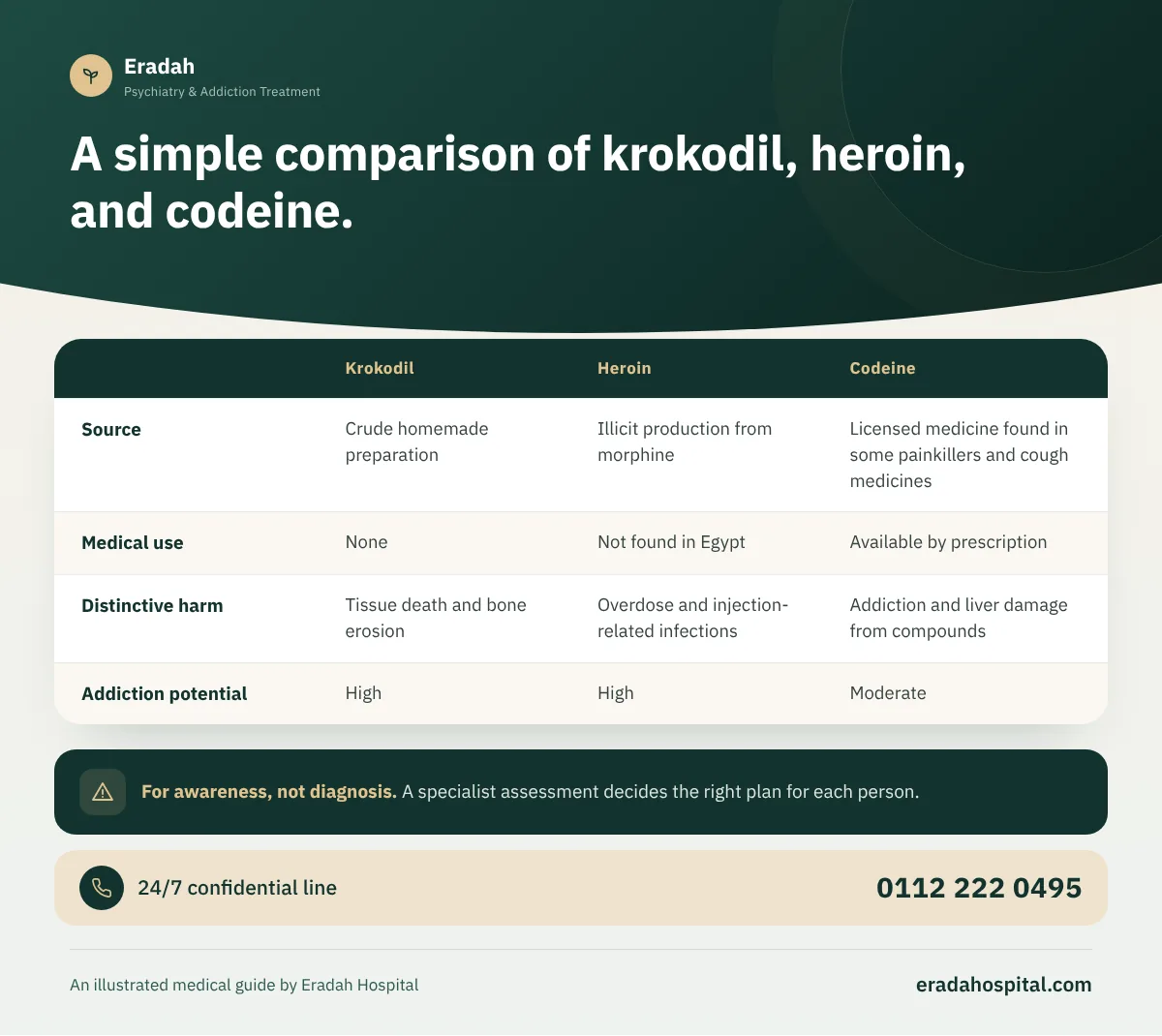
Krokodil compared with heroin and codeine
| Krokodil | Heroin | Codeine | |
|---|---|---|---|
| Source | Crude homemade preparation | Illicit production from morphine | Licensed medicine found in some painkillers and cough medicines |
| Medical use | None | Not found in Egypt | Available by prescription |
| Distinctive harm | Tissue death and bone erosion | Overdose and injection-related infections | Addiction and liver damage from compounds |
| Addiction potential | High | High | Moderate |
The legal status of krokodil
Desomorphine is listed in Schedules I and IV of the 1961 Single Convention on Narcotic Drugs, on the yellow list issued by the International Narcotics Control Board, and Schedule IV is reserved for the most dangerous substances with little or no therapeutic value. Krokodil has no medical use, and possessing, trading in, or using it is an offense punishable by law. The Fund for Drug Control and Treatment of Addiction (hotline 16023) offers free, confidential treatment.
This is general educational information and not legal advice.
Krokodil in numbers
Sources: a review by Grund and colleagues in the International Journal of Drug Policy, 2013, and a review by Gahr and colleagues, 2012.
Facts and myths about krokodil
- Myth: Krokodil itself “eats flesh.” Fact: Studies attribute the damage mainly to the toxic substances left from preparation and to infection.
- Myth: The damage appears only at the injection site. Fact: It can affect distant areas, most notoriously the jaw bones.
- Myth: There is no point treating people who use it. Fact: Opioid addiction is treatable, and wounds improve with early care.
Krokodil harms, symptoms, and treatment in brief
Harms: Sores and tissue death that can reach the bone and lead to amputation, jawbone erosion, infection, and overdose. Details are in Krokodil harms.
Symptoms: Signs of opioid use together with unusual wounds, skin changes, and mouth problems. Read symptoms of krokodil use.
Withdrawal and treatment: Its withdrawal is opioid withdrawal, similar to heroin withdrawal, and treatment combines opioid addiction treatment with medicines such as buprenorphine and surgical and dermatological care for the wounds.
The krokodil guide: everything you need to know
We have gathered everything about krokodil into 4 pages, each answering one question in detail. Choose what you are looking for:
Harms of krokodil to the body and mind
Krokodil harms: sores, tissue death, gangrene, and amputation, jawbone erosion, vein inflammation, infection with hepatitis and HIV viruses, and overdose. And why all of this happens.
Krokodil use symptoms and signs of addiction
How can you tell whether someone is using krokodil? Signs of opioid use, skin changes and unusual wounds, mouth and jaw problems, behavioral signs, and when to call an ambulance.
Heroin withdrawal symptoms and how long they last
When do heroin withdrawal symptoms start and how long do they last? The withdrawal timeline, early and late symptoms, long-term withdrawal, and why it needs medical supervision.
Heroin addiction treatment: stages and duration
How is heroin addiction treated? The stages of treatment from assessment and detox to approved medications, psychotherapy, rehabilitation and relapse prevention, and how long each stage takes.
If you notice strange wounds on a family member
- Do not wait: any wound that is spreading, turning black, or giving off a smell needs a doctor the same day.
- Ask calmly what they are injecting, without threats, because the information helps doctors.
- Ask for hepatitis and HIV testing if injecting equipment has been shared.
- Learn the overdose signs below and the ambulance number, 123.
- Contact an addiction treatment center, because treating the wounds alone is not enough.
Danger signs after using krokodil: call an ambulance (123) immediately
- Slow, shallow, or stopped breathing, or no response when called
- Pinpoint pupils with blue lips and fingernails and cold skin
- A wound that is spreading quickly, turning black, or giving off a foul smell
- Fever and chills with severe pain or swelling in a limb
- Exposed bone in the mouth, or severe facial swelling with fever
Call an ambulance on 123 immediately. If the person is unconscious but breathing, place them on their side (recovery position) so they do not choke on vomit, stay with them and do not leave them alone, and give them nothing by mouth. Tell the paramedics that they injected a home-made substance and any other substances they used. Infected wounds cannot wait: seek medical care the same day.
Call the ambulance 123