How is ketamine processed inside the body?
Ketamine is broken down in the liver mainly by enzymes of the cytochrome family. Its most important product is a substance called norketamine, followed by other metabolites that are excreted in the urine. Pharmacology references indicate that most of what enters the body is excreted in the urine within days, and that only a small portion leaves as unchanged ketamine.
The parent substance. It disappears from the blood within hours and is detected in recent use.
The main metabolite. It stays longer than ketamine, which is why many confirmatory tests look for it.
How long ketamine stays in the body, by type of test
Urine
Blood
Saliva
Hair
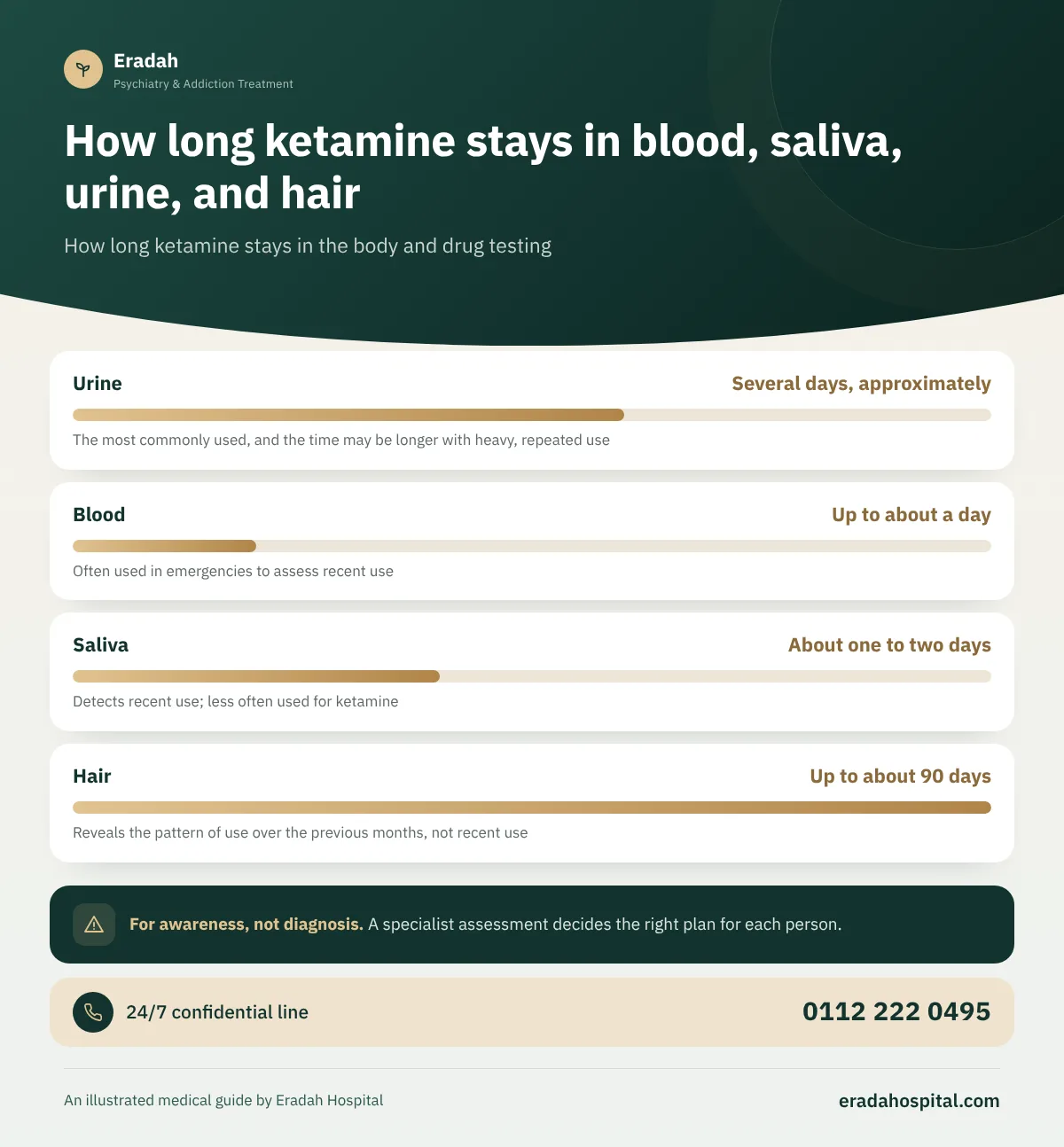
These times are approximate and vary by laboratory, test sensitivity, and pattern of use, and there is less research on ketamine detection windows specifically than on other substances. For an accurate interpretation of a particular result, consult the doctor or the laboratory.
Does ketamine show up in a standard drug test?
Not always. Many basic rapid urine strips and tests target specific groups such as opioids, cannabis, stimulants, and sedatives, and do not include ketamine. To detect it, the doctor or laboratory needs to order a dedicated test or an expanded panel. So a negative result on a basic rapid test does not rule out ketamine use, and ordering the right test depends on the patient being honest with their doctor.
Factors that affect how long ketamine stays in the body
- Frequency and duration of use: daily or heavy use lengthens the detection time compared with a single use.
- Amount: larger amounts take longer to clear.
- Liver and kidney function: weaker function slows metabolism and excretion, which can happen in a chronic user as a result of the use itself.
- Drug interactions: some medications affect the activity of the liver enzymes that break down ketamine.
- Age, general health, and body water content.
Which sample is best for detecting ketamine?
The doctor chooses the type of sample according to the question they want to answer, not just whichever is easiest or cheapest:
| Goal | The most suitable sample, usually |
|---|---|
| Assessing an emergency right now | Blood or urine, because they reflect recent use. |
| Monitoring adherence during treatment | Urine at regular, unannounced intervals. |
| Finding out the pattern of use over months | Hair, bearing in mind that it does not help with recent use. |
| A rapid workplace screen | Saliva or urine, with confirmation in a laboratory if positive. |
In every case, interpreting the result remains the doctor's responsibility, linking it to the medical history, the symptoms, and the medications the person takes.
The difference between a screening test and a confirmatory test
| Type | What it does | Limitations |
|---|---|---|
| Immunoassay screening test | Gives a quick positive or negative result | May be affected by other substances, and is not available for ketamine on every strip |
| Confirmatory test by chromatography and mass spectrometry | Identifies ketamine and its metabolites precisely | Higher cost, and needs a specialized laboratory and more time |
The medical rule is that a positive screening result needs confirmation in a specialized laboratory before it is relied on for a treatment or legal decision.
Can the result be positive without drug use?
Yes, in some cases. The person may have received ketamine medically during surgery or an emergency procedure, or may be receiving esketamine for depression under supervision. Screening tests may also react to other substances and give an inaccurate result, which is why a confirmatory test is needed.
What does a positive result mean, and what is the next step?
A confirmed positive result means the person was exposed to ketamine within the detection window for that type of sample, but it does not determine precisely how much they took or how many times, and it is not enough on its own to diagnose addiction. Diagnosis rests on medical and psychological assessment and defined criteria, not on a laboratory result alone.
- Make sure the result came from a confirmatory test, not only from a rapid strip.
- Review with the doctor any possible medical exposure, such as surgery or an emergency procedure.
- If use is confirmed, ask for an assessment that determines the size of the problem and a plan for dealing with it.
- Do not turn the result into a punishment; make it the start of a conversation and of help.
Testing during addiction treatment: a tool for support, not punishment
In treatment programs, periodic tests are used as a means of follow-up, not to punish the patient. Consecutive negative results strengthen the patient's confidence in themselves and the family's confidence in them, and may be linked to rewards within a reward-based motivation approach. A positive result means the plan needs adjusting, and opens the door to an honest conversation about triggers and moments of weakness.
When are ketamine tests ordered?
- In an emergency, with loss of consciousness or unexplained confusion, especially after parties.
- When assessing unexplained urinary symptoms in a young person, if there is a possibility of use.
- When starting an addiction treatment program, and during it to follow adherence.
- In some workplace procedures or legal proceedings.