Short-term harms of ketamine
These harms appear during the effect and the hours after it, and can occur from the first use:
- Detachment from reality and distorted perception that can turn into panic and intense fear.
- Reduced sensation of pain, so a person can be injured without feeling it.
- Staggering, poor balance and coordination, and sometimes inability to move.
- Nausea and vomiting, with a risk of choking if vomiting occurs while consciousness is impaired.
- Raised blood pressure and heart rate, with greater risk in people with heart disease.
- Impaired judgment and ability to act, which leaves a person vulnerable to exploitation or assault.
Why is ketamine linked to accidents and injuries?
Ketamine combines three dangerous things at once: detachment from one's surroundings, pain relief, and impaired movement. That is why accidents are among the most common causes of harm linked to it: falls from heights, drowning, burns, road accidents, and injuries that go unnoticed. A person in a dissociated state also cannot protect themselves or ask for help, which is why ketamine may be used to weaken a victim's resistance.
How does ketamine damage the bladder?
One of the best-known chronic harms of ketamine is what doctors call "ketamine-associated cystitis," an inflammation and ulceration of the bladder lining that appears with repeated use. The European Union Drugs Agency describes it as one of the most prominent harms of heavy use, to the point that some countries have set up specialist clinics for it. It includes:
A repeated, urgent need to go to the bathroom, day and night, passing small amounts.
Pain in the lower abdomen and when urinating, and sometimes blood in the urine.
In advanced cases the bladder becomes scarred and its capacity shrinks, and urinary incontinence may occur.
The damage may extend to the ureters and kidneys, obstructing urine drainage and harming kidney function.
The most important news is that stopping ketamine early may halt the bladder's deterioration and allow it to improve, while advanced cases may need long treatment with a urologist and sometimes major surgery. That is why any urinary symptoms in a person who uses ketamine call for stopping and seeing a doctor right away.
Ketamine's harms to the abdomen and liver
Some people who use ketamine heavily suffer attacks of severe abdominal pain, and medical reviews indicate that chronic use may be linked to abnormal liver function and bile duct problems. These problems need tests and follow-up, and should not be treated with random painkillers.
| System | Possible harms |
|---|---|
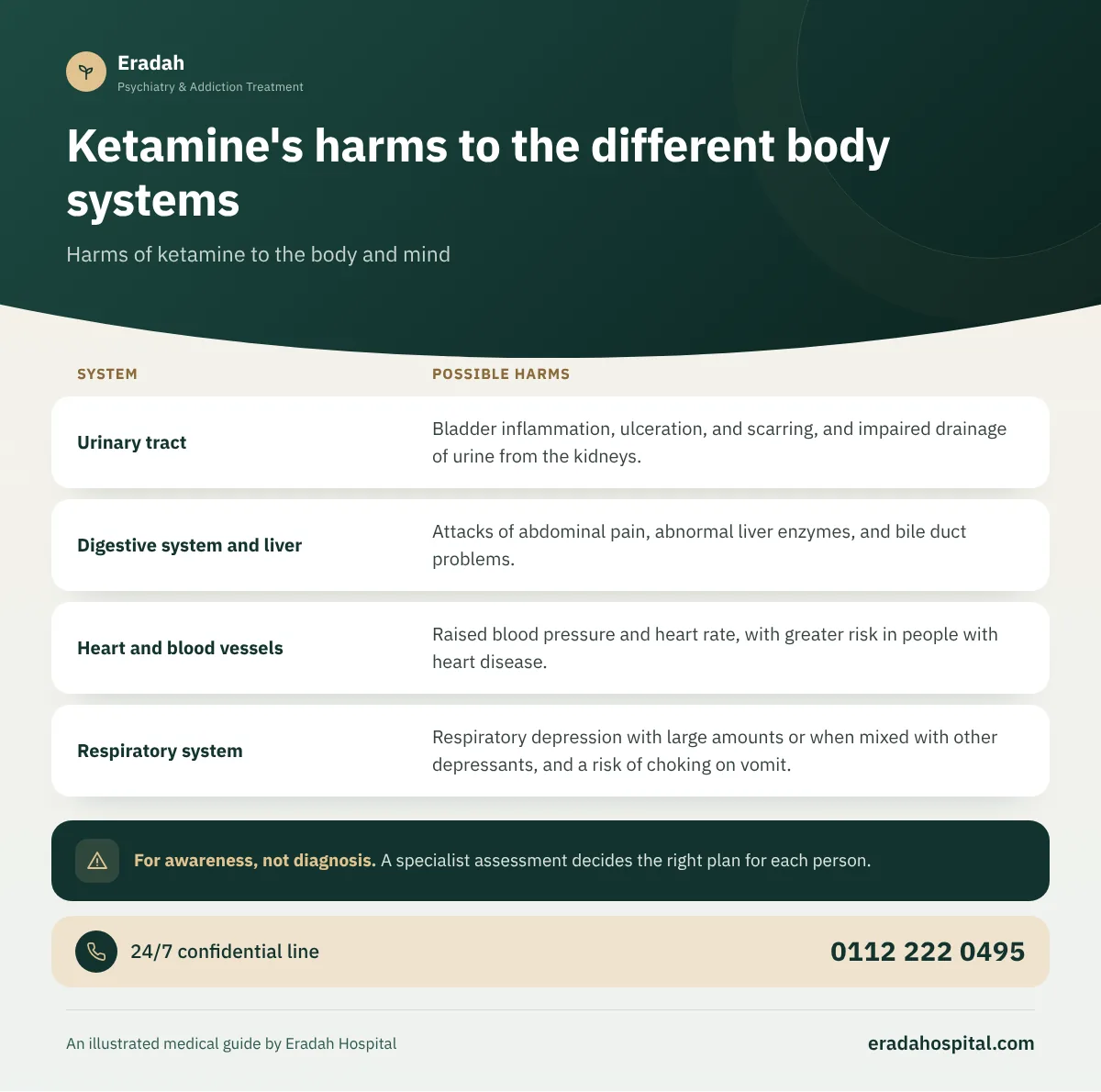
| Urinary tract | Bladder inflammation, ulceration, and scarring, and impaired drainage of urine from the kidneys. |
| Digestive system and liver | Attacks of abdominal pain, abnormal liver enzymes, and bile duct problems. |
| Heart and blood vessels | Raised blood pressure and heart rate, with greater risk in people with heart disease. |
| Respiratory system | Respiratory depression with large amounts or when mixed with other depressants, and a risk of choking on vomit. |
Ketamine's harms to the brain and mental health
With repeated use, effects appear on brain function and mood, and medical reviews list the following:
Impaired short-term memory, concentration, and speed of thinking.
Low mood and anxiety, especially after the effect wears off, even though some people start using it to escape them.
A recurring feeling that oneself or the world is unreal, in some heavy users.
Needing larger amounts for the same effect, and strong cravings that are hard to resist.
The risk of these harms is higher in people with a prior mental disorder, so treatment then needs to address both conditions together, in what is called dual diagnosis.
Harms of mixing ketamine with other substances
| The mix | The main risk |
|---|---|
| Ketamine + alcohol | Doubled depression of consciousness and breathing, and vomiting with a risk of choking. |
| Ketamine + sedatives or opioids | A high risk of respiratory depression and loss of consciousness. |
| Ketamine + stimulants or ecstasy | Strain on the heart and raised blood pressure, with unpredictable behavior. |
| An unknown powder sold as ketamine | A different or mixed substance with unpredictable effects and risks. |
A StatPearls review notes that most serious poisonings and deaths linked to ketamine occur with other substances taken alongside it, not with ketamine alone.
Ketamine's harms to teenagers and pregnant women
The teenage brain is still developing, so use at this age raises the risk of dependence and affects memory, school performance, and psychological development. Teenagers are also more prone to accidents and exploitation while under the influence. As for pregnancy, ketamine must not be used outside a medical setting, and a pregnant woman who uses it should seek medical follow-up immediately, speaking openly and confidentially.
Do ketamine's harms go away after stopping?
Many of them improve: memory, concentration, and mood improve gradually with time and treatment, and bladder symptoms may clearly recede if the person stops early. Advanced bladder scarring or kidney damage, however, may leave a permanent effect that needs long-term follow-up. So the most important step to protect the body is to stop now, with a suitable treatment plan, which you will find on the page Ketamine Addiction Treatment.
Danger signs after using ketamine: call ambulance (123) immediately
- No response to calling or touch, or loss of consciousness
- Slow, weak or intermittent breathing, especially with alcohol, sedatives or opioids
- Severe confusion, agitation or panic that does not settle, or behavior that puts the person at risk of harm
- Vomiting while drowsy or with reduced consciousness
- Injury, a fall, drowning or an accident while under the effect, or chest pain and a very fast pulse
Call ambulance (123) immediately. If the person is unconscious but breathing, place them on their side so they do not choke on vomit. Stay with them and do not leave them alone, do not give them food or drink, and tell the paramedics everything they took.
Call the ambulance 123
17Social and legal harms