What is ketamine?
Ketamine is a manufactured pharmaceutical substance developed in the 1960s and medically classified as a "dissociative anesthetic": it takes away the patient's sensation of pain and detaches them from their surroundings, while breathing and protective reflexes are preserved better than with many other anesthetics.
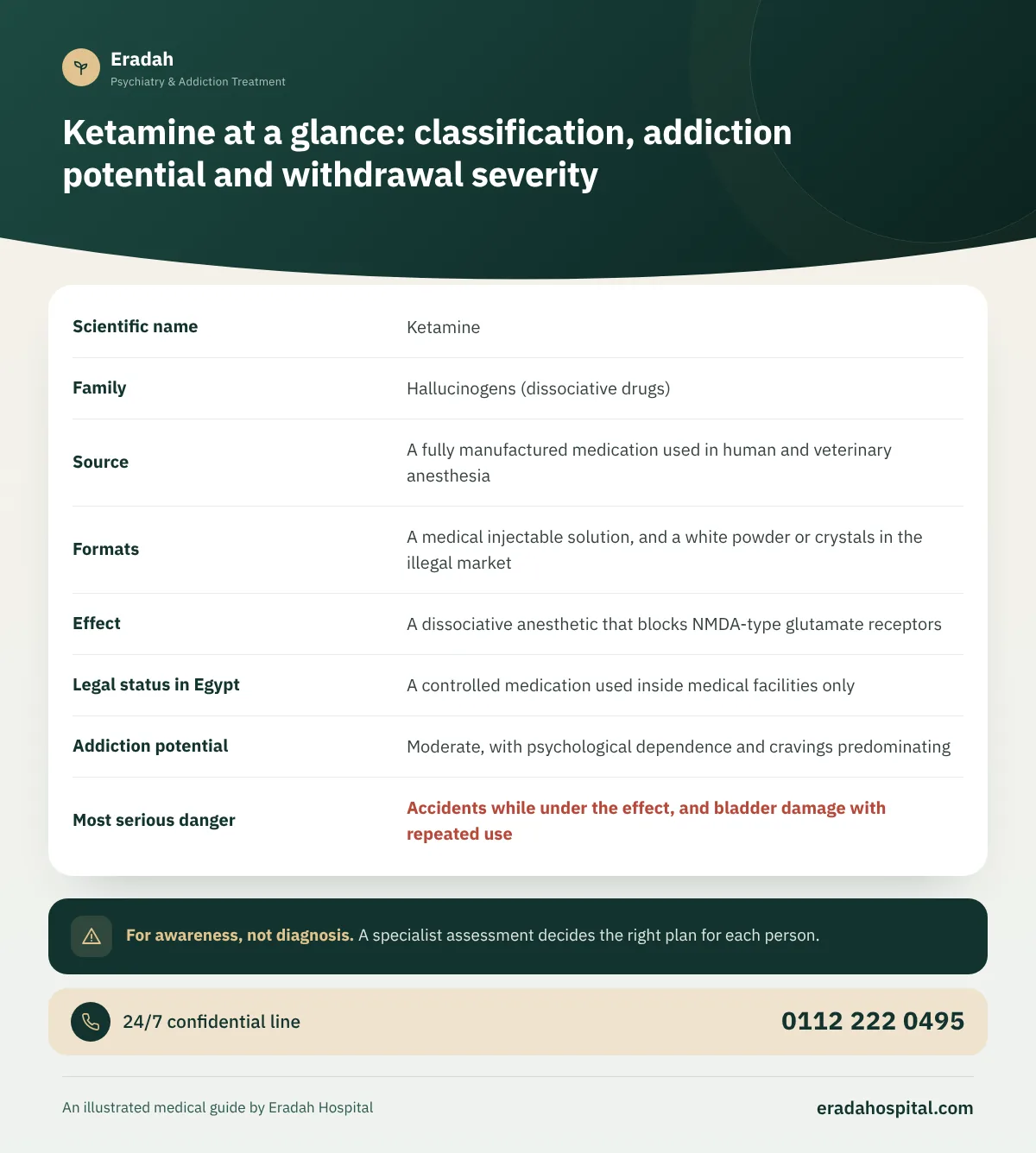
For this advantage, ketamine is an important medication in operating rooms and emergency care, especially in settings with limited resources, and it is widely used in veterinary medicine. But the very effect that makes it medically useful, dissociation from the body and reality, is what drives some people to misuse it.
On our site, ketamine is classified with the hallucinogens because it alters perception and the sense of time and place, although its mechanism differs from traditional hallucinogens such as LSD and magic mushrooms.
What are the medical uses of ketamine?
Starting general anesthesia and performing short operations. It is given in hospital under full monitoring.
Sedation during painful procedures, and sometimes in cases of injury and fractures.
Used at low doses in some acute pain protocols under medical supervision.
Its derivative esketamine is approved in some countries for treatment-resistant depression under strict controls.
Ketamine and treating depression: what is the truth?
In 2019 the US Food and Drug Administration approved esketamine, one of the two mirror-image halves of the ketamine molecule, as a nasal spray for treatment-resistant depression in adults, and later for symptoms of major depression with acute suicidal thoughts. This was an important development for patients who had not benefited from usual treatments.
But approval came with strict restrictions: it is not dispensed for the patient to take at home but is given inside a certified health facility under direct observation, and the patient stays under monitoring for at least two hours after each session, with official warnings about sedation, dissociation, suppressed breathing and misuse.
The existence of a medical treatment derived from ketamine does not mean that using it outside the hospital treats depression; the difference is the difference between surgery in an operating room and a knife wound in the street.
How does ketamine affect the brain and body?
Ketamine blocks receptors called NMDA receptors, on which glutamate acts; glutamate is the most important excitatory neurotransmitter in the brain. When these receptors are blocked, messages between the brain areas responsible for perception, consciousness and memory are partly interrupted, which causes the following:
- Dissociation: a feeling of being outside the body or that the world is unreal, and distorted perception of time, distance and sounds.
- Pain relief and numbness: reduced sensation of pain, which means a person can be seriously injured without feeling it.
- Movement disturbance: unsteadiness and poor balance and coordination, which with large amounts can reach an inability to move, a state people who use it call the "K-hole".
- On the heart: it usually raises the pulse and blood pressure, and may cause increased saliva and involuntary eye movements.
Forms and names of ketamine
Medical ketamine comes as an injectable solution inside hospitals. In the illegal market it usually appears as a white powder or crystals, and sometimes tablets, and is known worldwide by street names such as "K" and "Special K". European Union Drugs Agency reports indicate that a large share of illicit ketamine comes from diversion of legitimate pharmaceutical production.
Why is ketamine misused?
Motives differ from person to person, but the most common ones seen in clinics are:
- Curiosity and experimenting at parties and night-time gatherings, believing it is "lighter" than other substances.
- Thinking it is safe because it is a medication used in hospitals.
- Trying to escape sadness, anxiety or painful memories by detaching from reality.
- Self-treating depression after hearing about its medical use, without assessment or supervision.
- Peer pressure, or mixing it with other substances to change their effect.
What these motives share is that the person sees the immediate benefit and not the delayed cost: bladder damage, memory impairment and psychological dependence do not appear in the first few times, but creep in with repetition until they become a problem that is hard to ignore. That is why understanding the real motive is the first step in any conversation or treatment.
Ketamine compared with other hallucinogens
| Substance | How it acts | Medical use | Main risk |
|---|---|---|---|
| Ketamine | A dissociative that blocks NMDA receptors | Anesthesia, and a derivative for resistant depression | Accidents and bladder damage |
| LSD | A hallucinogen that acts on serotonin receptors | No approved use | Panic, accidents and the return of hallucinations |
| Magic mushrooms | A hallucinogen that acts on serotonin receptors | Ongoing research only | Panic, and poisoning with a similar toxic mushroom |
| Ecstasy | A stimulant and hallucinogen that releases serotonin | No approved use | High temperature and salt imbalance |
Ketamine differs from traditional hallucinogens in that its effect is relatively shorter, that it causes pain relief and impaired movement, and that it is linked to chronic physical harm, most notably bladder damage.
The legal status of ketamine in Egypt
In Egypt, ketamine is a controlled anesthetic that circulates inside hospitals and medical and veterinary facilities under strict controls, and it is not dispensed to individuals to use outside them. Possessing, trading or using it outside the medical framework exposes a person to legal liability. The Fund for Drug Control and Treatment of Addiction offers free, confidential advice and treatment through hotline 16023.
This is general educational information and not legal advice.
The ketamine guide: everything you need to know
We have gathered everything about ketamine into 5 pages, each answering one question in detail. Choose what you are looking for:
Harms of ketamine
From accidents and injuries while under the effect to bladder and kidney damage, abdominal and liver pain, and memory impairment and depression with repeated use.
Symptoms of ketamine addiction
The physical, behavioral and psychological signs a family may notice, how to tell it from other substances, and when use is addiction.
Ketamine withdrawal symptoms
What are ketamine withdrawal symptoms? Fatigue, poor appetite, cravings, anxiety and low mood, why the physical symptoms are milder, when it can be dangerous, and how to stop safely.
Treatment of ketamine addiction
A comprehensive assessment that includes the bladder and kidneys, safe supervised cessation, psychological and behavioral therapy, and follow-up to prevent relapse.
How long ketamine stays in the body
How long ketamine and its metabolites remain in urine, blood, saliva and hair, and why not every rapid test detects it.
Ketamine in numbers
Sources: European Drug Report 2026 from the European Union Drugs Agency (EUDA), and the StatPearls review on ketamine.
Found out your son is using ketamine? Start here
- Stay calm first, and do not start the conversation while he is under the influence or in a dissociated state.
- Ask about the setting: parties? friends? an attempt to escape sadness or pressure?
- Watch for any complaint of pain when urinating, going to the bathroom very often, or blood in the urine, and take him to a doctor right away if you see any.
- Explain the real risks, especially accidents and bladder damage, without exaggerating.
- Ask for a psychological assessment, since many people who use it have untreated depression or anxiety.
- Learn the emergency signs, and save the ambulance number (123).
Danger signs after using ketamine: call ambulance (123) immediately
- No response to calling or touch, or loss of consciousness
- Slow, weak or intermittent breathing, especially with alcohol, sedatives or opioids
- Severe confusion, agitation or panic that does not settle, or behavior that puts the person at risk of harm
- Vomiting while drowsy or with reduced consciousness
- Injury, a fall, drowning or an accident while under the effect, or chest pain and a very fast pulse
Call ambulance (123) immediately. If the person is unconscious but breathing, place them on their side so they do not choke on vomit. Stay with them and do not leave them alone, do not give them food or drink, and tell the paramedics everything they took.
Call the ambulance 123