Why do the harms of methadone differ from other opioids?
Methadone shares many harms with other opioids, but its particular nature adds dangers that are not present to the same degree with the others. Its long half-life, which varies between people, means the body does not clear it quickly, and the amount in the blood keeps rising during the first days even if nothing changes.
This is why someone who takes methadone without a medical assessment may not feel any danger on the first day, then suffer severe respiratory depression on the second or third day. Its effect on the heart and its many drug interactions also make it a medicine that needs close monitoring, not one to be passed around among people.
What are the short-term harms of methadone?
- Drowsiness, slowed thinking, and poor concentration and reaction time, with a risk of accidents when driving or operating machinery.
- Nausea, vomiting and dizziness, especially when standing up suddenly because of a drop in blood pressure.
- Excess sweating, itching and dry mouth.
- Constipation, which may be severe and persistent.
- Pinpoint pupils and slow breathing, which can progress to an overdose.
Why is respiratory depression the most serious harm of methadone?
Official drug labels warn that methadone can cause serious or life-threatening breathing problems, especially during the first one to three days of treatment or after any increase. The reason is that the peak of respiratory depression comes late and lasts longer than the peak of pain relief or craving relief.
- The first hoursAn effect that seems mild
The person may not feel a strong effect and assume the substance is "weak," and this is where many make the mistake of repeating the dose.
- Days 1-3Buildup
The amount in the blood rises gradually because the body does not clear it quickly, and the risk of respiratory depression grows, especially during sleep.
- After stopping and then restartingLoss of tolerance
After days without it, tolerance falls, and returning to the previous amount can be fatal.
Does methadone affect the heart?
Yes. Methadone can lengthen an interval on the heart tracing called QT, which can set the stage for a rare but dangerous heart rhythm disturbance that causes fainting or sudden death. The risk rises with large amounts, existing heart disease, low potassium or magnesium, and taking other medicines that lengthen the same interval.
- The doctor orders a heart tracing (ECG) before starting and during follow-up when needed.
- He asks about fainting, palpitations or a family history of sudden death.
- He reviews other medicines that may lengthen the QT interval.
- None of this can be done when methadone is taken without a prescription.
What is the danger of mixing methadone with sedatives, alcohol and other medicines?
The World Health Organization considers mixing opioids with alcohol or sedatives such as benzodiazepines one of the most important risk factors for overdose, because each suppresses breathing in a different way, so the effect multiplies. With methadone in particular there is an additional problem: it is broken down in the liver by enzymes whose activity is affected by many medicines.
| Type of substance | What may happen |
|---|---|
| Sedatives and benzodiazepines | Severe respiratory depression and deep drowsiness that may end in death. |
| Alcohol | Doubled depression and a higher risk of choking on vomit. |
| Pregabalin and sleeping pills | Increased drowsiness and respiratory depression. |
| Some antibiotics and antifungals | May raise the methadone level in the blood, increasing the risk of overdose. |
| Some epilepsy and tuberculosis medicines | May suddenly lower its level so withdrawal symptoms appear, then it rises again when they are stopped. |
| Medicines that lengthen the QT interval | Raise the risk of heart rhythm disturbance. |
That is why every doctor who prescribes any new medicine must know that the patient takes methadone, and no medicine should be started or stopped without consultation.
What are the long-term harms of methadone on the body?
| System | Possible harms |
|---|---|
| Digestive system | Chronic constipation, bloating and poor appetite. |
| Hormonal system | Reduced sex hormones, low desire, and menstrual irregularity. |
| Skin and sweating | Troublesome excess sweating that may continue throughout the period of use. |
| Mouth and teeth | Dry mouth, which raises the risk of tooth decay and gum disease. |
| Sleep | Sleep-disordered breathing in some patients. |
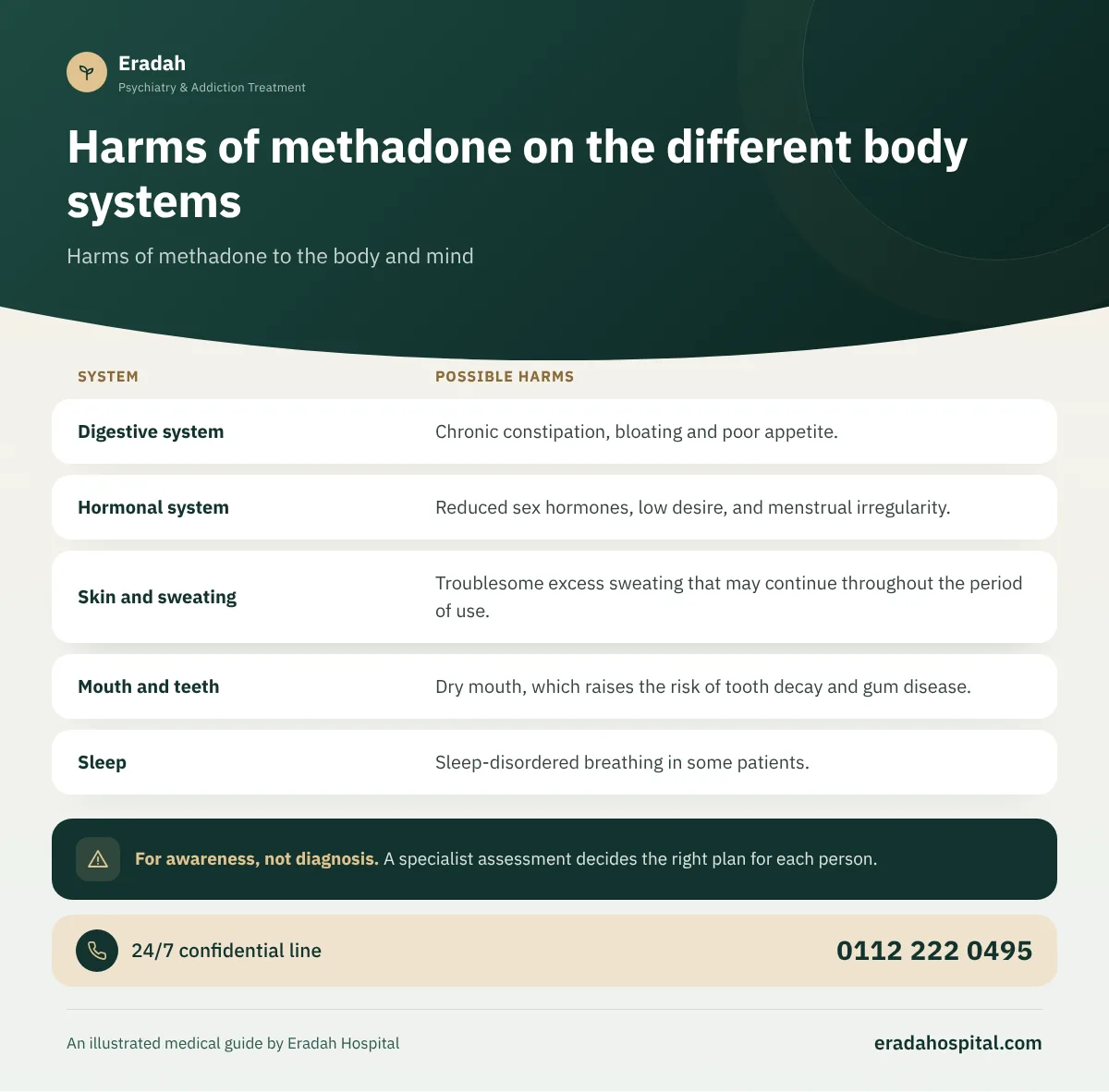
Many of these harms can be monitored and managed within the treatment program, and do not necessarily mean the treatment is unsuitable. They mean that regular follow-up is an essential part of it.
What is the effect of methadone on the brain and mental health?
Slowed thinking and concentration, especially at the start of treatment or with large amounts, which usually improves with stability.
Some patients may have low mood or anxiety and need a psychological assessment, especially when there is a dual diagnosis.
With regular use, an expected physical dependence develops, and it becomes addiction when control is lost and use goes outside the plan.
Physical dependence during replacement therapy is not the same as addiction: the stable patient takes a defined medicine by prescription and regains his work and family, while addiction means compulsive use despite harm. Someone with a co-occurring psychiatric disorder needs a plan that treats both conditions together; learn about it on the dual diagnosis page.
Is methadone dangerous in pregnancy and for the fetus?
Pregnancy is a special situation that needs a specialist medical decision. A mother with opioid dependence is advised not to stop methadone suddenly, because withdrawal may harm the fetus, and replacement therapy under supervision is usually safer than returning to use. On the other hand, the baby may be born with withdrawal symptoms that need hospital care, so the obstetrician and pediatrician must be told in advance, and the doctor may decide that another alternative suits some cases better.
Why is methadone dangerous to children and family members?
Drug labels warn that methadone can harm or kill anyone other than the patient who takes it, especially children. A child has no tolerance to opioids, a small amount may stop his breathing, and symptoms may be delayed for hours so the family notices only late.
Do the harms of methadone go away?
Most physical harms such as constipation, sweating, and hormone and sleep disturbances improve gradually after an organized reduction and stopping, or after the treatment is adjusted. The biggest danger, overdose, cannot be undone once it happens; that is why prevention through medical supervision, not mixing, and safe storage matters more than anything else. If you are taking methadone without a prescription, the safe step is a specialist assessment, not sudden stopping; read about methadone withdrawal symptoms and their duration.
Signs of methadone overdose: call an ambulance (123) immediately
- Pupils that are extremely small, like pinpoints
- Very slow, shallow or irregular breathing
- Severe drowsiness and difficulty waking, or loss of consciousness
- Blue lips and fingernails and cold skin
- Slow heart rate, fainting, or irregular palpitations
Call an ambulance on 123, place the person on their side so they do not choke, and stay with them until help arrives. Naloxone, available in emergency departments, reverses the effect of an overdose, but the effect of methadone lasts much longer than naloxone's, so the patient must stay under observation in hospital even after improving.
Call the ambulance 123
21What are the social harms of methadone misuse?