What is morphine?
Morphine is a natural opioid and the most important active compound in opium, the dried latex from the poppy plant's seed pods. To this day it is the reference against which the strength of other opioid painkillers is measured.
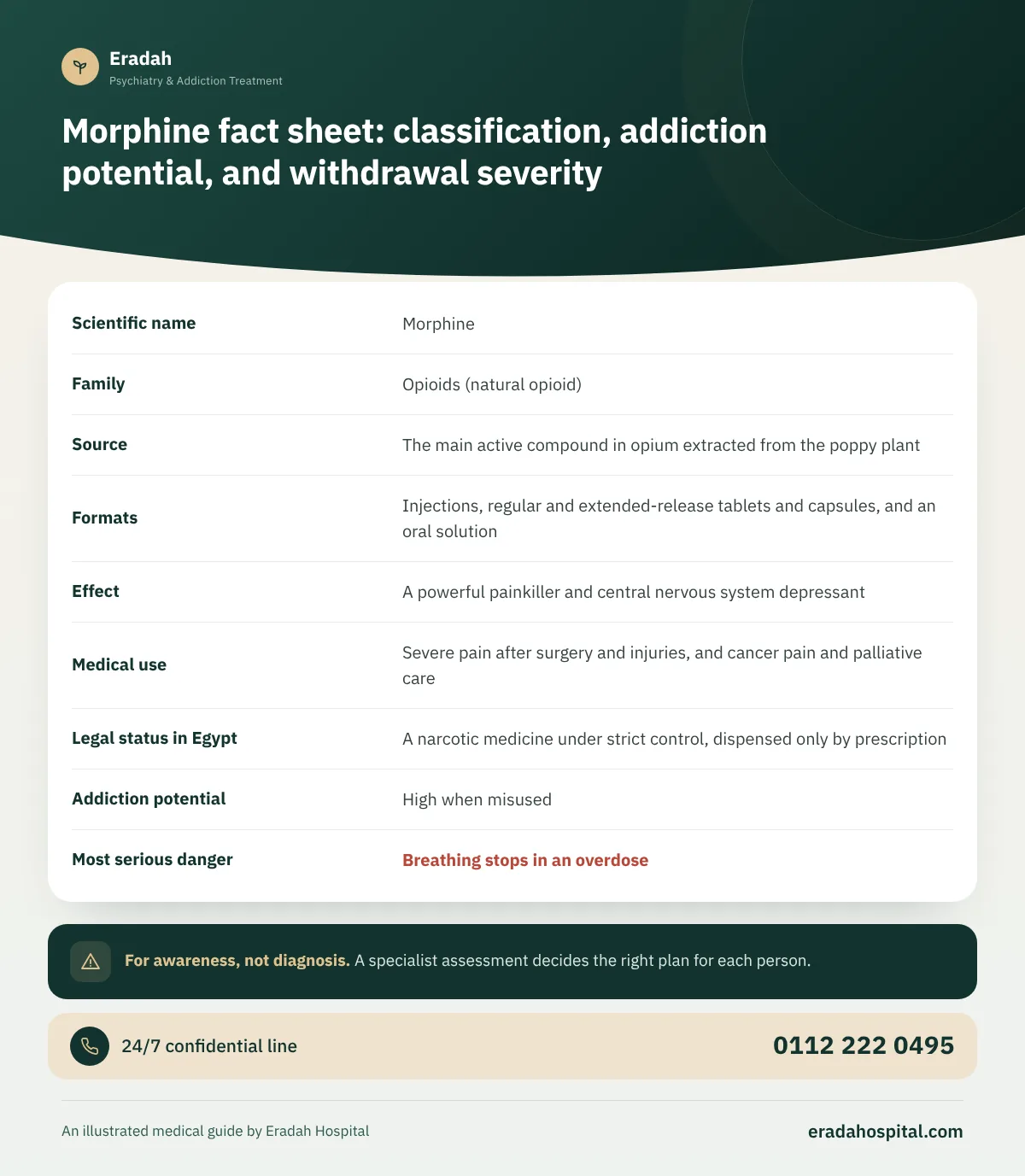
Morphine was first extracted from opium in the early nineteenth century and named after “Morpheus,” the god of dreams in Greek mythology, because of the drowsiness it causes. Since then it has become one of the most important pain medicines in the world, and the World Health Organization lists it among the essential medicines.
Morphine is directly related to other substances in the opioid family: heroin is made by chemically processing morphine and then turns back into morphine inside the body, and part of codeine is converted into morphine in the liver. That is why morphine is considered the “heart” of the opioid family.
It is important to distinguish between a patient who receives morphine in hospital, or by prescription, for real pain under follow-up, and someone who uses it without a prescription, in larger amounts, or for something other than pain relief. The substance is the same, but the danger differs greatly depending on the setting in which it is used and the monitoring that goes with it.
Pharmaceutical forms of morphine
Morphine is available in multiple forms, and the doctor chooses the one that suits the type of pain and the place of treatment:
Given in hospitals for acute severe pain, such as after surgery and injuries, under direct observation.
Used for severe pain that needs relatively fast relief, by prescription and with follow-up.
They release the drug slowly over many hours for chronic pain such as cancer pain, and breaking or chewing them is extremely dangerous.
Used to ease pain and shortness of breath in the advanced stages of some illnesses.
How does morphine affect the brain and body?
Morphine binds to opioid receptors spread throughout the brain, spinal cord, and intestines, the same receptors that the body's natural painkillers, known as endorphins, act on, but it works with far greater strength:
- In pain pathways: It reduces the brain's perception of pain and changes how it responds to it, which is its medical purpose.
- In reward circuits: It raises dopamine, causing a feeling of relief and euphoria, which is what makes it open to misuse.
- In the brainstem: It depresses the breathing centers, and this effect is the most dangerous one in overdose.
- In the intestines: It slows their movement, causing constipation, an effect that often does not lessen over time.
The liver clears morphine by converting it into products, one of which is active and leaves through the kidneys, so it builds up in people with kidney failure, who need special care when using it.
Morphine itself is not “the danger”; the danger lies in using it outside the setting and monitoring it was designed for.
The medical use of morphine: when do doctors prescribe it?
Morphine has an indispensable role in medicine, and doctors use it in cases such as:
- Severe pain after major surgery.
- Injuries, fractures, and severe burns.
- Moderate to severe cancer pain.
- Palliative care to ease pain and shortness of breath in advanced stages of illness.
- Some acute crisis pain in blood diseases such as sickle cell anemia.
In these cases the doctor determines the form, dose, and duration, and monitors breathing, level of consciousness, and side effects. No patient may change their dose or suddenly stop the medicine without consulting their doctor.
Morphine compared with other opioids
| Substance | Source | Medical use | Note |
|---|---|---|---|
| Opium | The dried latex of the poppy | Not used medically in its raw form | Contains morphine, codeine, and other substances |
| Morphine | Natural, from opium | Severe pain and cancer pain | The reference for measuring the strength of opioids |
| Codeine | Natural, from opium | Some cough medicines and painkillers | Partly converted to morphine in the liver |
| Heroin | Semi-synthetic, made from morphine | Not used medically in Egypt | Reaches the brain faster and then converts to morphine |
| Tramadol | Fully synthetic | Painkiller for moderate to severe pain | Adds a risk of seizures and serotonin syndrome |
| Fentanyl | Fully synthetic | Anesthesia and very severe pain | Dozens of times stronger than morphine |
All of these substances share the risk of dependence and respiratory depression, and the risk multiplies when any of them is mixed with sedatives, pregabalin, or alcohol.
Common myths about morphine
Many mistaken beliefs surround morphine, some of which push toward misusing it and some of which deprive patients of pain relief they need:
| Common belief | The truth |
|---|---|
| Morphine means the patient is in their last days | It is also used after surgery and injuries and for many pains unrelated to the end of life. |
| Everyone who takes morphine becomes addicted | Controlled, monitored medical use rarely turns into addiction, and physical dependence is not addiction. |
| Morphine is safe because it's a medicine | It is an effective medicine but a powerful one, and outside supervision it can stop breathing. |
| It can be stopped suddenly whenever you want | Stopping suddenly after long use causes withdrawal, and it should be gradual under a doctor's supervision. |
The legal status of morphine in Egypt
In Egypt morphine is a controlled narcotic medicine under strict control, used inside hospitals or dispensed by a special prescription under Ministry of Health rules. Possessing or trading in it outside the medical framework is punishable under Law No. 182 of 1960 on drug control and its amendments.
The Fund for Drug Control and Treatment of Addiction offers free, confidential treatment through the hotline 16023, alongside specialized centers.
This is general educational information and not legal advice.
The morphine guide: everything you need to know
We have gathered everything about morphine into 6 pages, each answering one question in detail. Choose what you are looking for:
Morphine harms
From respiratory depression, constipation, and itching to its effect on hormones, immunity, and mood, and why mixing with sedatives raises the danger.
Causes of morphine addiction
How does a medical painkiller turn into addiction? The role of the substance, the medical route, health care workers, and psychological and environmental factors.
Symptoms of morphine addiction
The physical and behavioral signs a family notices, and the difference between a pain patient who needs their medicine and a person who has lost control over it.
Morphine withdrawal symptoms
When they start and how long they last, the difference between fast-acting and extended-release forms, and why gradual stopping under medical supervision is necessary.
Morphine addiction treatment
Assessment, safe detox, approved medicines, and psychotherapy, with an alternative pain plan if there is pain.
How long morphine stays in the body
How long it remains in urine, blood, saliva, and hair, and why a positive result needs a confirmatory test.
A patient taking morphine at home: advice for the family
Morphine may be dispensed to a patient at home, especially for cancer pain and palliative care. This advice protects the patient and those around them:
- Stick exactly to the dose and times the doctor set, and do not add a dose on your own.
- Keep the medicine in a locked place away from children and visitors; a small amount can kill a child.
- Do not combine it with sedatives, sleeping pills, or alcohol except on the doctor's instructions.
- Watch for excessive drowsiness and slow breathing, and call an ambulance immediately if they appear.
- Dispose of leftover medicine after treatment ends in the way the pharmacist or hospital advises.
- If you notice that morphine is being used for something other than pain, or disappears faster than usual, talk to the doctor.
Signs of morphine overdose: call an ambulance (123) immediately
- Pupils that are extremely small, like pinpoints
- Very slow, irregular or stopped breathing
- Blue lips and fingernails and cold skin
- Loss of consciousness, or severe drowsiness with difficulty waking
- Gurgling or unusual snoring sounds
Call an ambulance on 123, place the person on their side so they do not choke, and stay with them until help arrives. Naloxone reverses the effect of morphine if given in time and is available in emergency departments, and the patient may need monitoring for hours because the effect of morphine can return.
Call the ambulance 123