“I only take tramadol, and Rivotril so I can sleep.” Many people who use don't see themselves as “mixing,” since in their eyes the second pill is just a sleep or calming aid. But medicine sees the picture very differently, because the danger of mixing drugs is among the most common causes of sudden death among people who use.
What is drug mixing, or polysubstance use?
By polysubstance use, doctors mean using more than one substance at the same time or within a short period, whether deliberately to boost or soften the effect, or unknowingly when the substance bought has been adulterated with another. It includes mixing a narcotic with a prescription medicine, with alcohol, or with another drug.
And in Egypt, according to a statement from the Fund for Drug Control and Treatment of Addiction published by Masrawy in June 2026, hashish came first among the substances reported by people calling to ask for treatment, followed by synthetic drugs, then tramadol, heroin, and cases of polysubstance use.
Why does mixing drugs raise the danger?
- Same direction: Two substances depress the breathing center together, so the effect is much greater than expected.
- Opposite directions: A stimulant masks the effect of a depressant, so the person takes more, then the stimulant wears off first and the depressant remains.
- Interaction in the liver: Some substances change how fast others are broken down, so their levels in the blood rise.
- New products: Such as cocaethylene, which forms when cocaine and alcohol are combined.
- Not knowing the contents: An adulterated substance may carry a second substance the person does not know about at all.
The most dangerous drug mixtures
Tramadol, heroin, or codeine with Xanax or Rivotril: the best-known path to stopped breathing.
Alcohol doubles the depression, and with it awareness of the danger fades.
The US Food and Drug Administration has warned of serious breathing problems with this combination.
Cocaethylene forms, and the load on the heart increases.
Shabu or Captagon with others: high blood pressure and pulse, fever, and psychosis.
May raise the risk of seizures and serotonin syndrome.
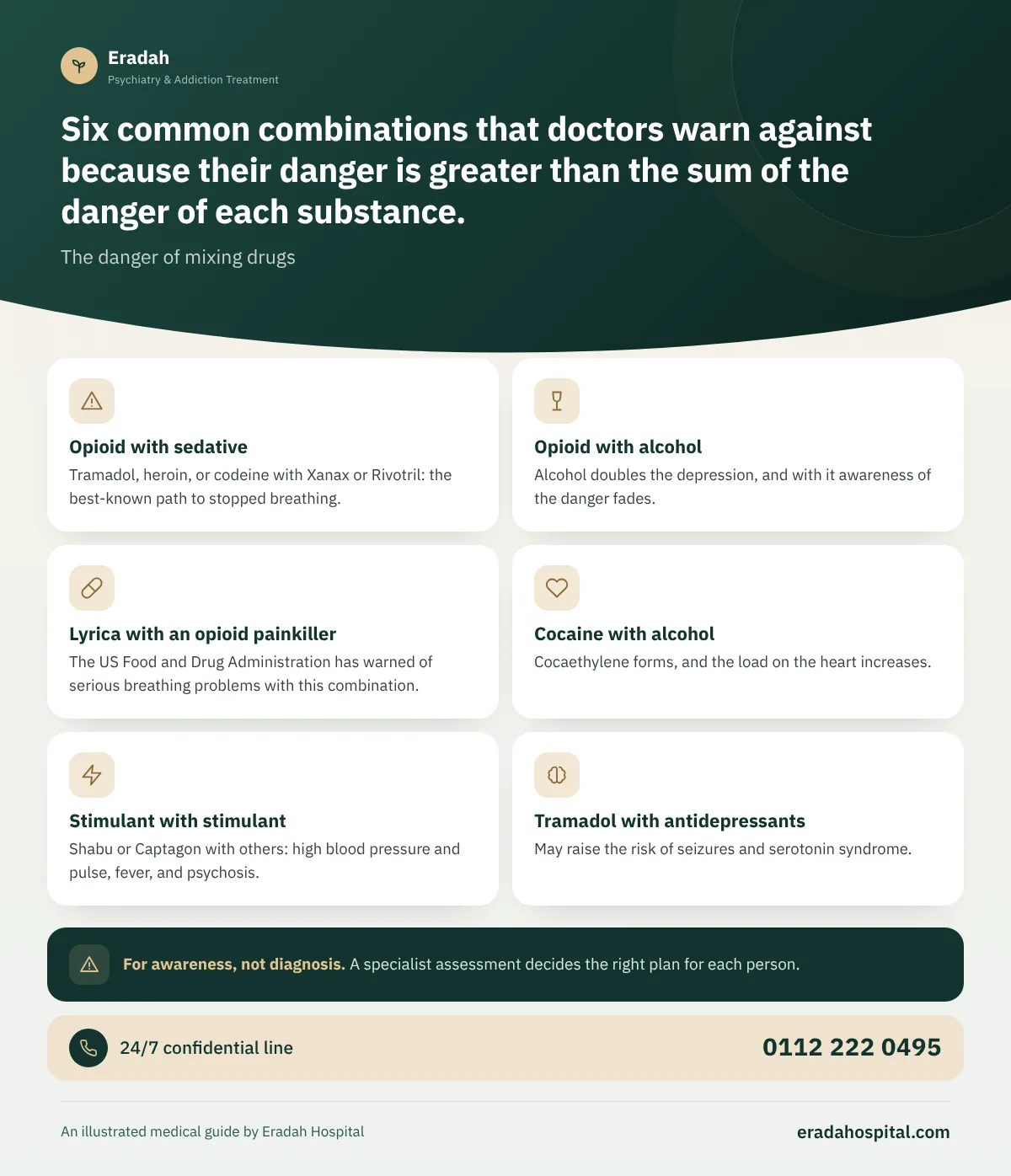
Mixing opioids with sedatives and alcohol: the most dangerous of all
Opioids such as tramadol and heroin depress the breathing center in the brainstem, and sedatives such as Xanax and Rivotril and alcohol do the same thing by another route. When they come together, breathing becomes slower and weaker, and it may stop during sleep without anyone noticing.
This is why the US Food and Drug Administration, in its 2020 update of benzodiazepine warnings, noted that prescribing them with opioids and other medicines that depress the nervous system led to serious effects including severe respiratory depression and death, and says it has warned against this combination since August 2016. The World Health Organization also counts using opioids with alcohol or other medicines that depress breathing among the main risk factors for overdose.
Mixing Lyrica and gabapentin with painkillers
In December 2019 the US Food and Drug Administration warned that serious breathing problems can occur with pregabalin and gabapentin in people with respiratory risk factors, including the use of opioids or other medicines that depress the central nervous system, as well as in older adults and people with lung disease. This matters in Egypt because pregabalin is sometimes mixed with tramadol in search of a stronger effect.
Mixing stimulants with alcohol and others
A review published in the journal Addiction in 2002 on mixing alcohol with cocaine notes that combining them raises heart rate by more than the sum of their separate effects, raises the cocaine level in the blood by up to 30%, and forms cocaethylene, which may increase cocaine's toxicity to the heart, and may also increase the tendency toward violence.
The same idea applies to other stimulants: alcohol dulls the person's sense of the stimulant's effect, so they repeat the dose while the heart bears the entire burden.
Tramadol with antidepressants and stimulants
Tramadol is special: it raises serotonin in addition to its opioid effect. A case series published in 2010 described serotonin syndrome after tramadol overdoses. For this reason anyone taking antidepressants needs to tell their doctor about any tramadol they take. You will find the details in tramadol harms.
Danger signs after mixing drugs
You will find the first aid steps in detail in the guide to overdose.
Why does polysubstance use often need treatment in a hospital?
Because detox from two substances is harder than from one; sedative withdrawal can cause seizures, opioid withdrawal causes pain and insomnia, and having both needs a careful plan and an order for what is withdrawn first. That is why detox under medical supervision is the safest option, followed by rehabilitation that addresses the reasons the person needed more than one substance, which sometimes include a psychiatric disorder that requires dual diagnosis.