Stages of Rohypnol addiction treatment
Treating dependence on flunitrazepam goes beyond “quitting the pills”: it begins with a safe stop and ends in a life in which the person does not need a sleeping pill to escape anxiety or insomnia.
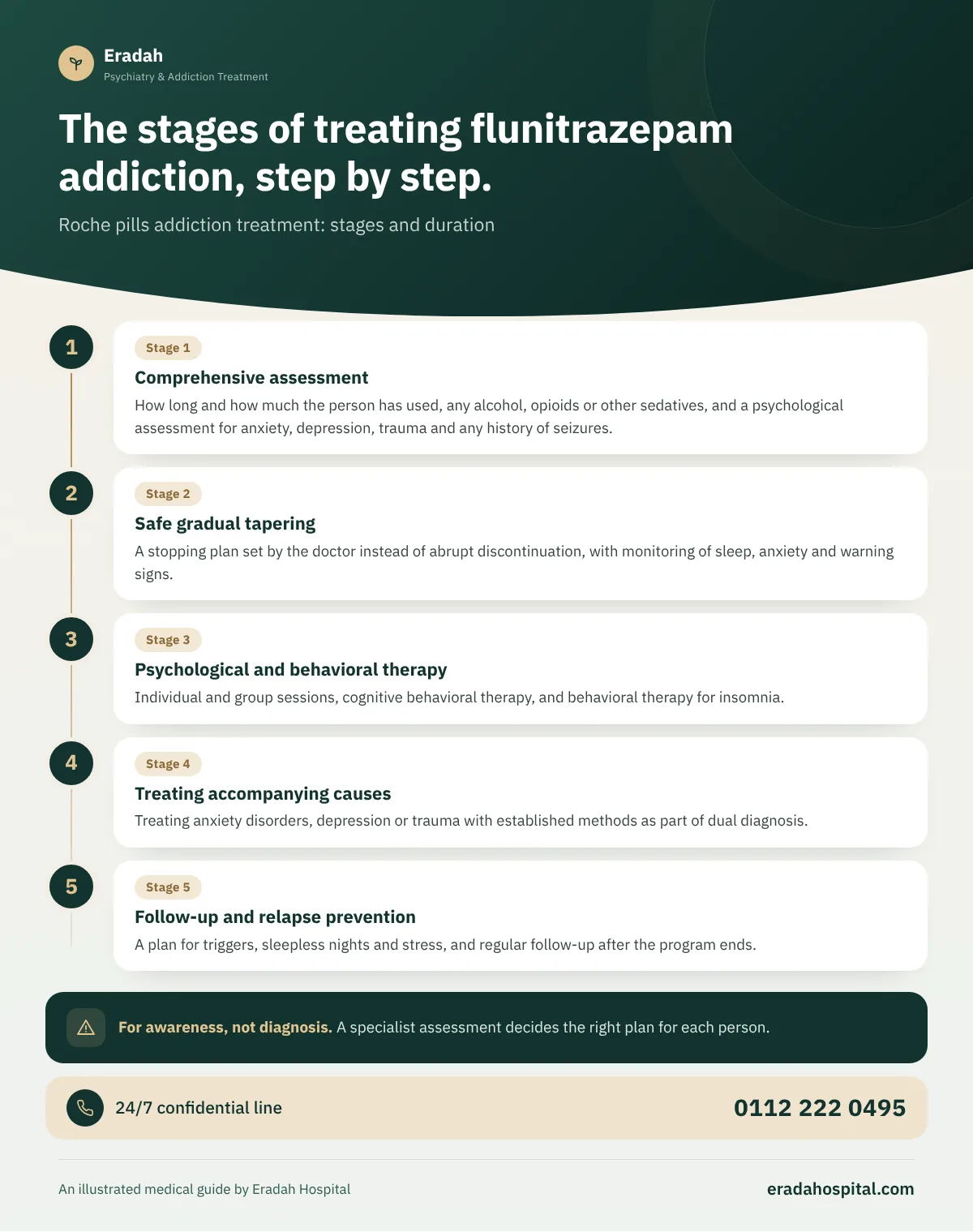
- Stage 1Comprehensive assessment
How long and how much the person has used, any alcohol, opioids or other sedatives, and a psychological assessment for anxiety, depression, trauma and any history of seizures.
- Stage 2Safe gradual tapering
A stopping plan set by the doctor instead of abrupt discontinuation, with monitoring of sleep, anxiety and warning signs.
- Stage 3Psychological and behavioral therapy
Individual and group sessions, cognitive behavioral therapy, and behavioral therapy for insomnia.
- Stage 4Treating accompanying causes
Treating anxiety disorders, depression or trauma with established methods as part of dual diagnosis.
- Stage 5Follow-up and relapse prevention
A plan for triggers, sleepless nights and stress, and regular follow-up after the program ends.
How is Rohypnol stopped safely?
The guidelines of the American Society of Addiction Medicine (ASAM), published in 2025, recommend not stopping benzodiazepines suddenly in people who are likely to be physically dependent on them, and that the tapering plan be tailored to each patient and adjusted to their response, with shared decision-making between doctor and patient and accompanying psychological support. The doctor sets the speed of tapering according to the length of use, the amount, general health and other substances.
Are there medications to treat Rohypnol addiction?
According to NIDA, there are so far no medications approved specifically for treating sedative, hypnotic, or anxiolytic use disorder. There is a medication approved to reverse a benzodiazepine overdose, but it is an emergency drug used with caution inside a hospital, not a treatment for addiction. Medications still have a supporting role that the doctor decides:
| Goal | How the doctor helps |
|---|---|
| Insomnia during and after tapering | Behavioral therapy for insomnia first, and suitable medication when needed, without swapping one substance for another. |
| Accompanying anxiety and depression | Medication and psychological therapy according to the assessment. |
| Accompanying opioids or alcohol | A separate plan for each substance; you will find the options in medications for addiction treatment. |
No medication should be started or stopped without a doctor.
Psychological and behavioral therapy
Understanding the thoughts and situations that drive the pills, and building new ways of coping with anxiety and stress.
Relearning to sleep without medication, which is key to preventing a return to use.
Tangible rewards for commitment and negative test results; NIDA lists it among the effective behavioral therapies.
Rebuilds trust and teaches the family to support without enabling.
Treating accompanying trauma and anxiety
Many people begin using sleeping pills to escape insomnia, anxiety or painful memories, and some were themselves drugged or harmed. Treating the addiction without treating these roots leaves the door open to relapse. For this reason the psychiatrist assesses the case and treats the anxiety or post-traumatic stress disorder (PTSD) within the same plan, under the concept of dual diagnosis.
How long does Rohypnol addiction treatment take?
| Stage | Approximate duration |
|---|---|
| Assessment | One day to several days |
| Gradual reduction | Weeks, and it may extend to months depending on the case |
| Psychological and behavioral rehabilitation | Several weeks to a few months |
| Follow-up and relapse prevention | Several months, and it may extend to a year or more |
The duration varies with how long and how much the person has used, the presence of other substances or psychological disorders, and the treatment team sets it according to each person's progress.
Does Rohypnol treatment require a hospital stay?
Outpatient treatment may suit stable cases with limited use and good family support. Residential treatment is recommended for long daily use, mixing with alcohol or opioids, a history of seizures, severe depression, or failed previous attempts.
Relapse prevention after Rohypnol treatment
- A clear plan for sleepless nights: what to do and whom to call instead of looking for a pill.
- Staying away from friends and places linked to the pills and to mixing.
- Continuing treatment for anxiety, depression or trauma and sticking to follow-up.
- Safely disposing of any pills left at home.
- Knowing the signs of relapse early and asking for support as soon as they appear.
Choosing a hospital for Rohypnol addiction treatment
So the first thing to look for in any facility treating Rohypnol addiction is a doctor who designs a slow taper suited to the case and adjusts it according to the response, and staff who monitor the patient overnight, especially since the drug is often mixed with alcohol, hashish or opioids. The person using it may also have started out of chronic insomnia or a painful memory, and this is where any program that only does the withdrawal fails. Ask the facility:
- Who decides the speed of tapering, and is the plan reviewed if anxiety or insomnia worsens?
- Is there nursing all night to watch for any seizure or confusion?
- Is insomnia treated with behavioral methods rather than a new sleeping pill replacing the old one?
- Are trauma and post-traumatic stress disorder assessed as part of the plan?
At Eradah, the doctor sets the tapering plan and follows it, doctors and nurses are present around the clock, and dual diagnosis treatment addresses anxiety and trauma at the same time. Residential treatment is for men only, and the first consultation is free, with its details kept within the treating team. Call us or message us on WhatsApp at 01122220495 at any hour, or start from the contact page. To know what a patient can expect, see Rohypnol withdrawal.
Rohypnol addiction treatment at Eradah
At Eradah we begin with a comprehensive medical and psychological assessment that identifies every substance in use, then set a safe gradual tapering plan under the supervision of psychiatrists with round-the-clock monitoring when needed. We treat insomnia, anxiety and trauma within the same plan, with psychological and family rehabilitation and follow-up after discharge, in complete confidentiality from the first call.