How does the body get rid of Valium?
In the liver, diazepam is converted by several enzymes into active metabolites, the most important being desmethyldiazepam, and part of these is then converted into oxazepam and temazepam, which are also sedative substances. Finally these metabolites are bound to other substances in the liver and most are excreted in urine.
This long chain of conversions is the reason Valium stays so long. The half-life of diazepam is about 46 hours, and about 100 hours for its main metabolite, according to clinical pharmacology references, and it is longer in older adults and people with liver disease.
How long Valium stays by type of test
Urine
Blood
Saliva
Hair
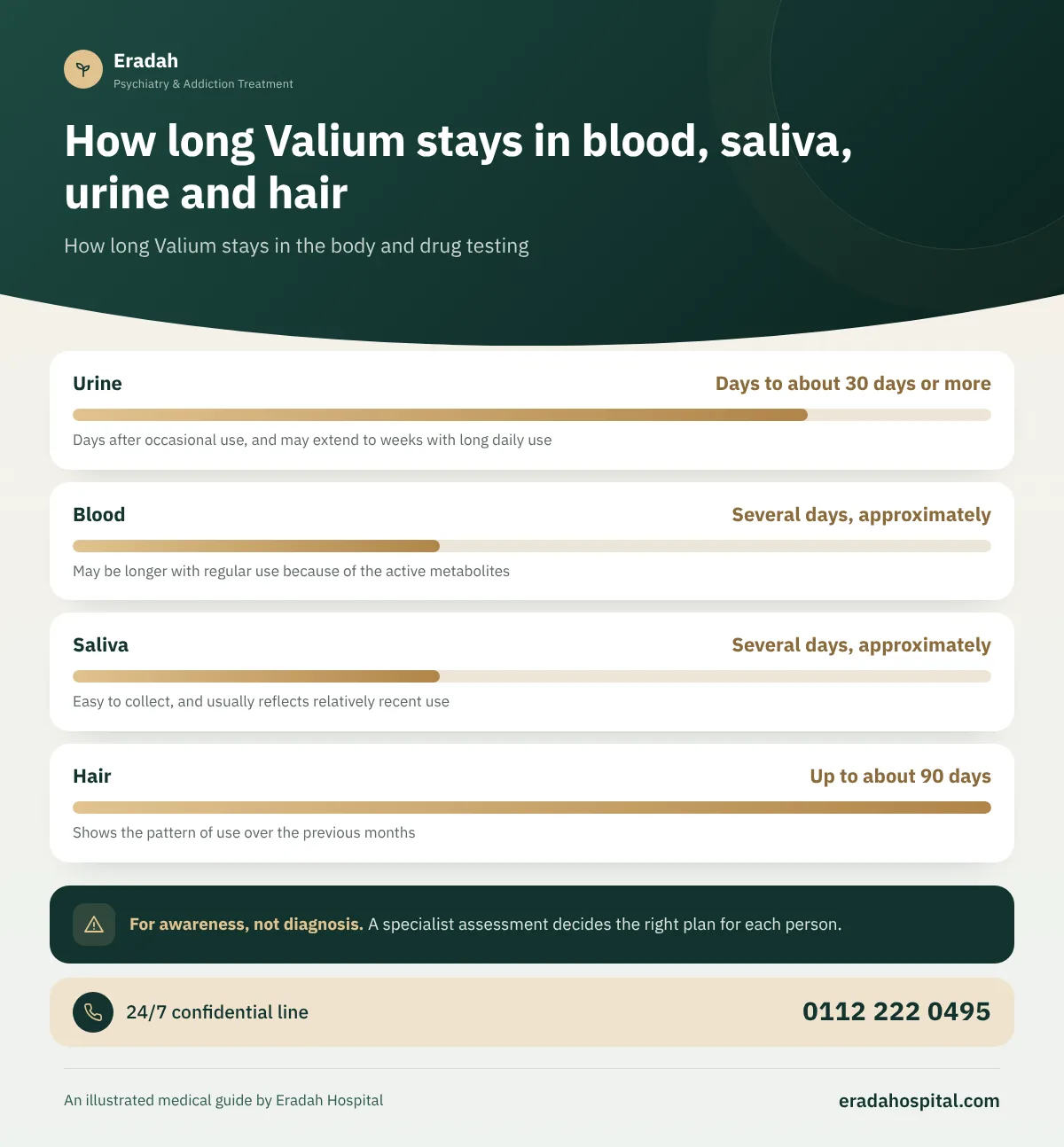
The durations are approximate and vary by laboratory, test sensitivity and pattern of use. For an accurate interpretation of a particular result, consult the doctor or the laboratory.
Why is Valium detected longer than Xanax?
Xanax is converted into metabolites with little effect and leaves within days, whereas Valium leaves behind active metabolites that stay a long time, are distributed into the body’s fatty tissues, and then return slowly to the blood. That is why urine-test interpretation references state that long-acting benzodiazepines may be detected for up to about 30 days, compared with a few days for short-acting ones.
What factors affect how long Valium stays?
- Duration of use: Daily use for months clearly lengthens the detection window because of accumulation.
- Age: Older adults clear diazepam and its metabolites much more slowly.
- Liver function: Weak function lengthens the stay of the medicine and its metabolites.
- Body fat percentage: Diazepam dissolves in fat, so it is stored there and leaves slowly.
- Other medicines: Some medicines slow the enzymes responsible for breaking it down.
- Test sensitivity: The minimum detection limit differs between laboratories.
Can the time of the last dose be known from the test?
Not precisely. The initial test only answers whether benzodiazepines are present or not, and the confirmatory test may give a general idea through the ratios of diazepam to its metabolites, but the build-up of the medicine and the differing speed of clearing it between people make pinning down the day of the last dose approximate at best. That is why no important medical or family decision is built on a single result, but on successive tests and a conversation with the person.
Screening test and confirmatory test
Detects the benzodiazepine group in general; Valium and its metabolites are usually detected well in it, but it does not identify the particular medicine.
Identifies diazepam and its metabolites precisely in a specialized laboratory, and is requested for any initial result that needs interpretation.
Can a medicine I did not take show up in the test?
This can happen with Valium in particular. Since some of its metabolites, such as oxazepam and temazepam, are themselves separate medicines sold under other names, the name of a medicine the person did not take may show up in the confirmatory test, when it is really a breakdown product of Valium. The laboratory interprets this through the pattern and ratios of the metabolites.
Are there false positive results?
Yes. Some common medicines can interfere with the initial benzodiazepine test, including the antidepressant sertraline and some HIV medicines. That is why the laboratory must be told about all medicines, and a confirmatory test requested if the result is unexpected.
What if I take Valium by prescription or stopped it recently?
A positive result is expected during treatment, and may continue for weeks after stopping, especially after long use. Keep a copy of the prescription and the date of the last dose, and tell the party requesting the test. Do not stop the medicine suddenly before a test; sudden stopping can cause dangerous withdrawal, and it would not hide the medicine from urine quickly anyway.
The role of testing during treatment of Valium dependence
In treatment programs, tests are used to monitor progress and make sure no sedatives or other substances are present. But the long stay of Valium means the result may stay positive for a while after stopping, so the doctor relies on tracking the change in results over time and on conversation with the patient, not on a single result.
The role of testing in the emergency room
When a person who is unconscious or very drowsy arrives at the emergency room, the medical team begins by securing breathing and vital signs before any test result. But testing then helps identify the substances present together, such as alcohol or opioids with Valium, which affects the treatment and monitoring plan. With Valium specifically, a positive result may reflect older use, which is why the test is interpreted with the medical history, not in isolation.
Are rapid home tests reliable?
Home test strips detect benzodiazepines as a group and differ in sensitivity, and their result is always preliminary. With Valium a positive result may appear weeks after the last dose and be wrongly understood as recent use. That is why it is preferable for testing to be part of a medical assessment that interprets the result and puts it in its right context.
What does the result mean for the family?
A positive Valium result may come from a medical prescription or from use that stopped weeks ago, and the result alone does not tell the whole story. It is best to discuss the result with the doctor within a calm assessment that sets a safe plan, instead of it becoming a reason for confrontation and accusation.