How does the body clear benzodiazepines?
The question “how many days do benzodiazepines show up in urine?” has no single answer, because this family includes drugs of which the body clears half in two hours, and others whose active product stays in the blood for days.
Most benzodiazepines are broken down in the liver and then leave in urine. The Ashton Manual defines the “half-life” as the time it takes for the drug's concentration in the blood to fall by half after a single dose, and gives the example of triazolam, with a half-life of 2 to 5 hours, versus diazepam at 20 to 100 hours, and its active product desmethyldiazepam, which can reach 36 to 200 hours. With daily repetition these drugs accumulate in the body, especially in fatty tissue.
For this reason the noticeable effect of the drug wears off long before it leaves the body, and it can show up on a test after the person feels completely “back to normal.”
How long benzodiazepines stay by type of test
| Short-acting | Long-acting | |
|---|---|---|
| Examples | Alprazolam (Xanax) and triazolam | Diazepam (Valium), clonazepam (Rivotril) and chlordiazepoxide |
| Urine test | Up to about 3 days | Up to about 30 days, especially with regular use |
| Blood test | Usually very recent use | Recent use, with longer times as the drug accumulates |
| What lengthens the time | Daily use and high doses | Accumulation, active products, and more body fat |
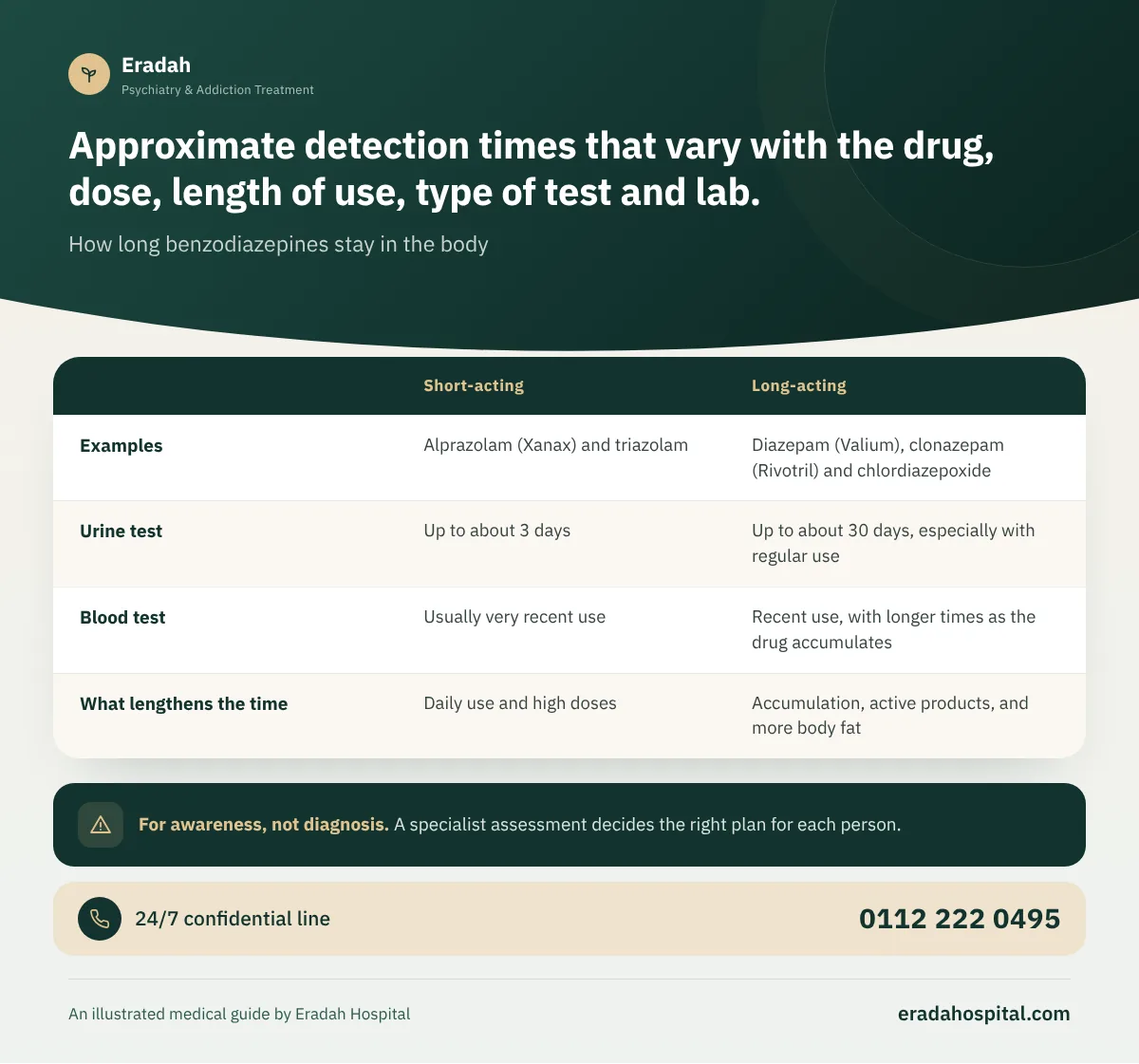
Urine times are from The Hospitalist review, the description of blood from Aegis Sciences labs, and accumulation from the Ashton Manual. They are approximate.
As for hair, the review by Hadland and Levy notes that a hair test may detect benzodiazepines for up to about 90 days, with exceptions; a single dose of lorazepam, for example, was not detected in hair in a French study, as the guide on how long lorazepam stays in the body explains. As for blood, Ashton reports that the concentration of benzodiazepines in it fell to unmeasurable levels within 3 to 4 weeks of stopping in people who were withdrawn from therapeutic doses after long-term use.
What factors lengthen how long benzodiazepines stay?
- Type of drug: Half-life and the presence of long-lasting active products.
- Pattern of use: Aegis Sciences labs note that detection time is shorter with as-needed use and low doses, and longer in cases of misuse.
- Body weight: Diazepam has been observed to stay longer in the urine of people with obesity.
- Age and liver function: Older adults and people with liver disease clear them slowly.
- Type of test: Precise confirmatory tests detect lower concentrations and extend for a longer period than strips.
Do all benzodiazepines show up on a drug test?
Not always, and this is the most important piece of information on the page. The Hospitalist review explains that older generations of rapid urine tests look for products resembling oxazepam and nordiazepam, so they do not pick up common drugs that are converted by another route, such as lorazepam, alprazolam and clonazepam. Some newer tests have improved at detecting alprazolam, but may not pick up the products of clonazepam, temazepam and lorazepam except at high concentrations.
In a study published in 2024 on an enhanced immunoassay, the test missed 27% of samples that were shown by mass spectrometry to contain benzodiazepines. For this reason, the American Society of Addiction Medicine guidelines say that immunoassay urine tests for benzodiazepines have limited sensitivity and more false negatives, and a confirmatory test is often needed. For details on each drug, see how long Rivotril stays in the body, how long Xanax stays in the body and how long Valium stays in the body.
Medications that may give a false-positive result for benzodiazepines
The reverse is also possible: a rapid test may show “benzodiazepines” in someone who has not taken them. Documented examples include:
- Sertraline: In a review of two years of records, 98 false-positive results were found that a benzodiazepine prescription did not explain, 26 of them in patients taking sertraline.
- Efavirenz: An HIV medication; in a German study, 49 of 50 patients taking it had a positive benzodiazepine result on at least one rapid test, because of one of its products.
- Oxaprozin: An anti-inflammatory painkiller with which false-positive results have been recorded since the 1990s.
In every case the solution is a confirmatory test that identifies the substance by name, and you can find a wider list in the guide to medications that show up on a drug test.
Rapid test and confirmatory test: what is the difference?
A rapid test, or immunoassay, gives a signal that a substance similar in structure to benzodiazepines is present, and does not identify which drug it is. A confirmatory test by chromatography and mass spectrometry identifies the substance and its concentration. Aegis Sciences labs explain that some drugs such as diazepam and chlordiazepoxide share the same products, so even with a confirmatory test it may be impossible to know the original drug, while alprazolam, clonazepam and lorazepam have distinctive products that make them easier to identify.
What if you take benzodiazepines by prescription?
Tell the lab or the party requesting the test about the medication and keep the prescription. Remember that hospitals may give benzodiazepines before procedures or in emergencies, which Aegis Sciences labs point to as a cause of unexpected results. Most importantly: do not stop a medication you take regularly in order to pass a test, because stopping suddenly can cause dangerous withdrawal, and there is no proven way to speed the drug's exit, as the guide on urine-cleansing myths explains.
What does a benzodiazepine test result mean for the family?
A positive result proves the presence of the substance, not addiction, and a negative result on a rapid strip does not rule out taking Rivotril or lorazepam. So do not base your judgment on a single strip; observe behavior, sleep and memory, and ask for a calm medical assessment. If dependence is confirmed, the next step is a treatment plan, not punishment, as the benzodiazepine addiction treatment guide explains.