Stage one: assessment
The doctor begins by understanding the whole story: why Valium was prescribed in the first place, since when, how the pattern of use has changed, whether other substances are involved such as alcohol, painkillers or additional sedatives, and whether seizures have ever occurred. The assessment covers physical health, especially the liver, and mental health including anxiety, depression or insomnia.
This assessment determines the right place for treatment and the speed of tapering, and shows whether Valium is the only problem or part of a wider picture.
Stage two: slow, gradual tapering
In the case of Valium, gradual tapering is the detox stage. Since diazepam is the medicine already preferred in sedative withdrawal plans because of its long action, the patient often does not need to be switched to another medicine, and the same medicine is reduced slowly.
- The pace is individual: It is set by the length of use, age, health and the patient’s response, and may pause temporarily when symptoms intensify.
- Slow is an advantage: Tapering over weeks or months reduces symptoms and protects against seizures.
- The patient is a partner: An important principle in the Ashton Manual is that the patient takes part in deciding the speed and feels in control.
- Regular follow-up: To monitor symptoms and adjust the plan instead of blindly sticking to a fixed schedule.
Treating Valium dependence with alcohol
A common picture is that dependence on Valium is linked to a problem with alcohol, whether the medicine began in an alcohol withdrawal program and then continued, or was used to ease the after-effects of drinking. In this case both are treated together under one plan, and residential treatment at the start is often the safest option.
Once the condition is stable, the doctor may prescribe approved medicines that help prevent a return to alcohol, such as naltrexone or acamprosate, depending on what suits each patient, along with a psychological program for both addictions together.
Are there supporting medicines in treating Valium addiction?
No medicine cancels dependence on benzodiazepines, but the doctor may use supporting medicines to treat what Valium was covering:
Some treat chronic anxiety and panic attacks without causing dependence.
Cognitive behavioral therapy for insomnia is the first choice, and medicines that do not cause dependence may be added when needed.
If Valium was used for spasms or pain, the doctor looks for alternatives and suitable physical therapy.
Approved medicines to prevent alcohol relapse when there is accompanying dependence.
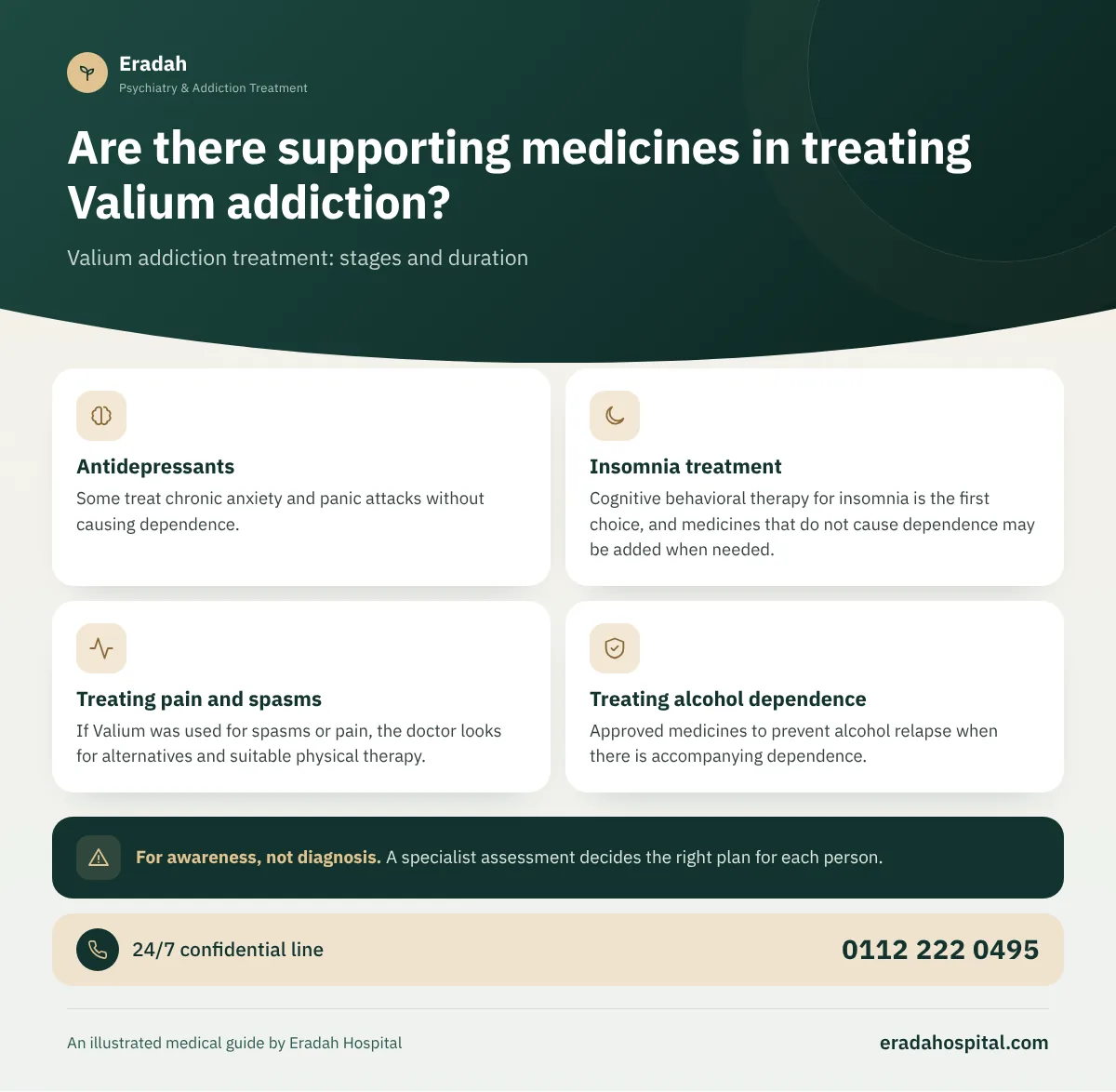
These medicines are dispensed by prescription only, and only the doctor decides what suits each patient and for how long.
Psychological therapy during and after the taper
- Cognitive behavioral therapy for anxiety, to learn to cope with stress without medicine.
- Cognitive behavioral therapy for insomnia, to restore normal sleep.
- Relaxation techniques, stress management and training in facing difficult situations.
- Group therapy and support groups for people recovering from sedative dependence.
- Family sessions to understand the stage and support the patient without pressure.
Psychotherapy helps the patient bear the symptoms of tapering and gives them practical alternatives for what they relied on the medicine for. Research indicates that combining gradual tapering with cognitive behavioral therapy raises the chances of successfully stopping compared with tapering alone.
How long does Valium addiction treatment take?
| Stage | Approximate duration |
|---|---|
| Assessment and planning | A few days |
| Gradual reduction | From several weeks to several months, and it may take longer after years of use |
| Psychological therapy | Starts with tapering and continues for months afterward |
| Follow-up and relapse prevention | At least one year |
Residential or outpatient treatment?
| Point of comparison | Residential treatment | Outpatient treatment |
|---|---|---|
| Suitable for | Accompanying alcohol dependence, large amounts, a history of seizures, or older adults with multiple illnesses | Use by prescription with dependence, no other substances, and good family support |
| Supervision | around the clock | Regular appointments and phone follow-up |
| Duration | The first weeks are the riskiest | Throughout the long tapering period |
| Daily life | Temporarily paused | Work can continue |
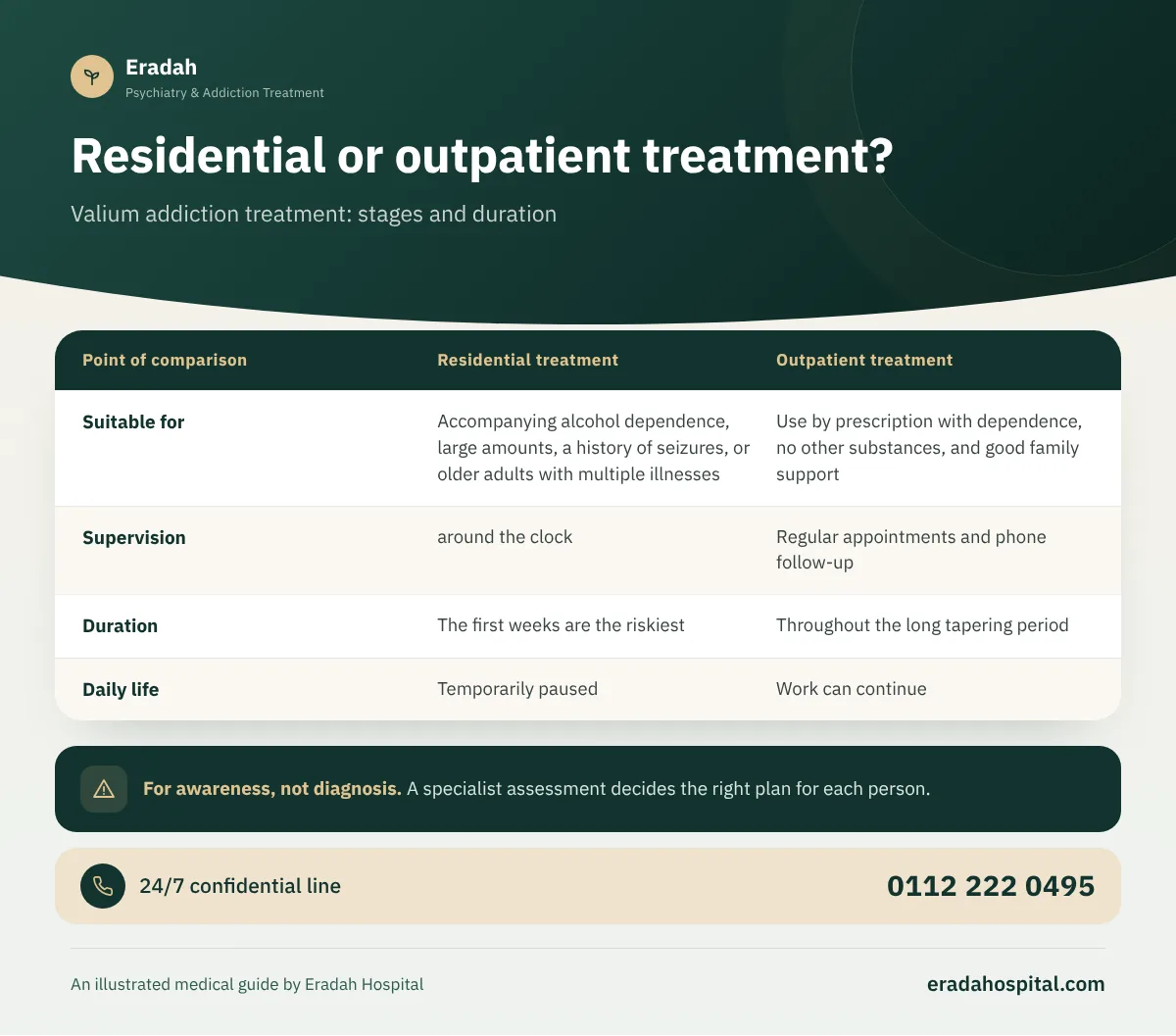
The two are often combined: a short stay to stabilize the condition and begin tapering safely, then completing it in the outpatient clinic over a longer period.
Treating Valium dependence in older adults
Many older adults have used Valium for many years, often on a prescription that has not been reviewed for some time. Tapering is possible and beneficial for them, as concentration and balance improve and falls decrease for many, but it is slower, takes chronic illnesses and other medicines into account, and involves the family in daily follow-up.
Relapse prevention after Valium treatment
- Safe disposal of any leftover tablets at home.
- Telling any new doctor about the history of dependence before any sedative is prescribed.
- Staying away from alcohol completely, especially if it was part of the problem.
- A written plan for sleepless nights and moments of severe anxiety.
- Continuing psychological follow-up even after tapering ends.
How do you choose a center for Valium addiction treatment?
- Officially licensed, with psychiatrists experienced in sedative withdrawal.
- Uses slow, gradual tapering, not rapid stopping.
- Able to treat accompanying alcohol dependence safely.
- Treats anxiety and insomnia with psychotherapy, not with a replacement sedative.
- Provides long outpatient follow-up after the stay ends.
Choosing a hospital for Valium addiction treatment
Valium is a long-acting sedative, which makes its withdrawal delayed and deceptive: two or three days may pass quietly, then anxiety, insomnia and tremor appear, and seizures may occur with sudden stopping after long use. What is needed is not a place that ends the sedative in a week, but a patient team that manages tapering that may extend over months and knows when a residential stay is safest.
| The situation | A suitable place | A place to be wary of |
|---|---|---|
| Pace of tapering | Sets it according to symptoms and slows it when needed | Promises to end the sedative within days |
| A patient who also drinks alcohol | Treats both together and starts with inpatient monitoring | Ignores the drinking and focuses on the tablets |
| An older patient | Reviews their other medicines and calculates the risk of falls | Applies the same plan as for a young person |
| The anxiety that came before the medicine | Offers cognitive behavioral therapy for anxiety and insomnia | Replaces Valium with another sedative |
At Eradah, psychiatrists supervise the tapering plan, and a doctor and nursing staff are available on site around the clock for those who need residential treatment in the first weeks; the plan is then completed with outpatient follow-up. If a medical condition arises that needs a general hospital, the patient is transferred by ambulance. Read about Valium withdrawal to know what to expect.
Valium addiction treatment at Eradah
At Eradah we begin with a comprehensive psychological and medical assessment, then set an individual gradual tapering plan under the supervision of psychiatrists, with residential treatment when needed or outpatient follow-up. We treat alcohol or any accompanying substance in the same plan, treat anxiety and insomnia with cognitive behavioral therapy, involve the family, and follow up after stopping, in complete confidentiality.