Stage 1: Comprehensive assessment
Treatment begins with an assessment that determines how long and in what pattern Xanax has been used, whether other substances such as alcohol or opioids are involved, any history of seizures, physical health, and any co-occurring anxiety, panic or depressive disorder. On the basis of this assessment, it is decided whether the patient is suited to outpatient treatment or residential care.
Stage 2: Safe, gradual tapering
This is the detox stage in the case of Xanax, but it differs from other substances: the aim is to reduce the drug slowly enough for the brain to adapt without dangerous withdrawal, not to stop it quickly.
- Switching to a longer-acting sedative: the doctor often switches the patient from Xanax to a long-acting benzodiazepine such as diazepam or clonazepam, because its blood level is steadier, so symptoms between doses are fewer.
- Individual plan: the pace of reduction is set according to the patient's response, and may be slowed or paused temporarily if symptoms intensify.
- Patient participation: the plan succeeds more when the patient takes part in setting its pace and understands what is happening.
- Regular follow-up: to monitor symptoms and psychological state and adjust the plan.
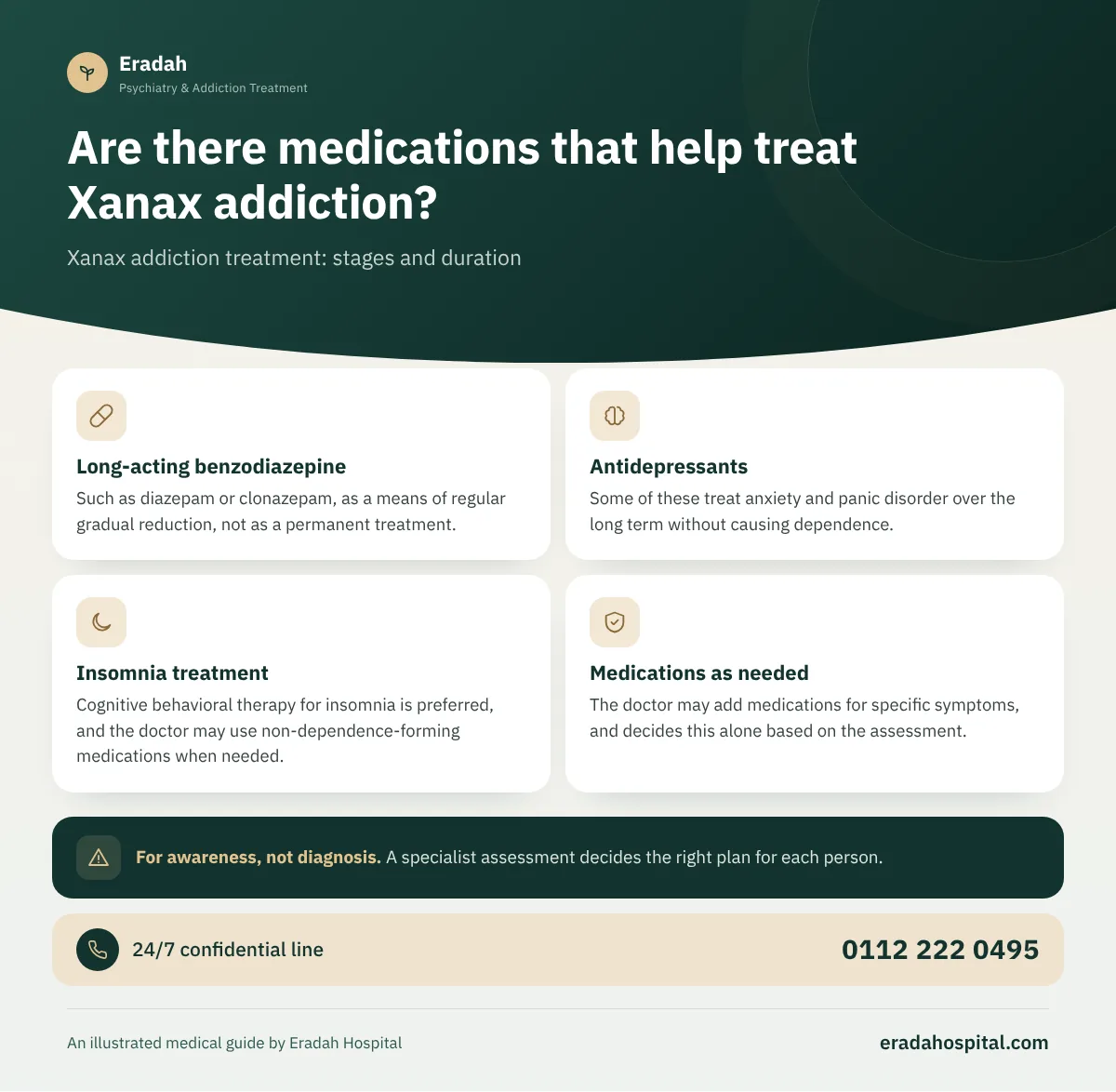
Are there medications that help treat Xanax addiction?
There is no medication approved specifically for treating benzodiazepine addiction, as there is for opioids, but the doctor may use supporting medications depending on the case:
Such as diazepam or clonazepam, as a means of regular gradual reduction, not as a permanent treatment.
Some of these treat anxiety and panic disorder over the long term without causing dependence.
Cognitive behavioral therapy for insomnia is preferred, and the doctor may use non-dependence-forming medications when needed.
The doctor may add medications for specific symptoms, and decides this alone based on the assessment.
Do not take any of these medications without a prescription; the choice, dose and duration are decided only by the treating doctor.
Psychotherapy after Xanax
Since Xanax usually began as a treatment for anxiety, real success depends on learning new ways of dealing with it:
- Cognitive behavioral therapy for anxiety disorder and panic attacks, one of the most effective treatments.
- Cognitive behavioral therapy for insomnia to restore normal sleep without pills.
- Relaxation and breathing exercises and gradual exposure to anxiety-provoking situations.
- Motivational therapy to strengthen the drive to keep going.
- Family therapy to improve communication and support the patient.
Psychotherapy usually begins during the taper, not after it, because the patient needs new tools for dealing with anxiety at the moment the drug is reduced. With each successful reduction step, their confidence grows in their ability to face stress without a pill, and this confidence is an essential part of recovery.
How long does Xanax addiction treatment take?
| Stage | Approximate duration |
|---|---|
| Assessment | A few days |
| Gradual reduction | From several weeks to several months depending on the case |
| Intensive psychotherapy | Starts with tapering and continues for months afterward |
| Follow-up and relapse prevention | At least a year, and it may extend longer |
Xanax addiction treatment often takes longer than treatment of other substances, because slow tapering is the safe path. Rushing can cause severe withdrawal that drives the patient back to the drug.
Treating Xanax addiction together with other substances
Xanax addiction often comes with another substance, such as alcohol, tramadol, opioids or hashish. In these cases each addiction is not treated separately; instead a single plan is set that takes into account the order of reduction and the risk of each withdrawal, and it often needs residential care in the first stage because having more than one withdrawal at once raises the risk.
Treatment also covers any co-occurring psychiatric disorder such as depression or post-traumatic stress disorder (PTSD), because leaving it untreated is one of the strongest causes of returning to sedatives.
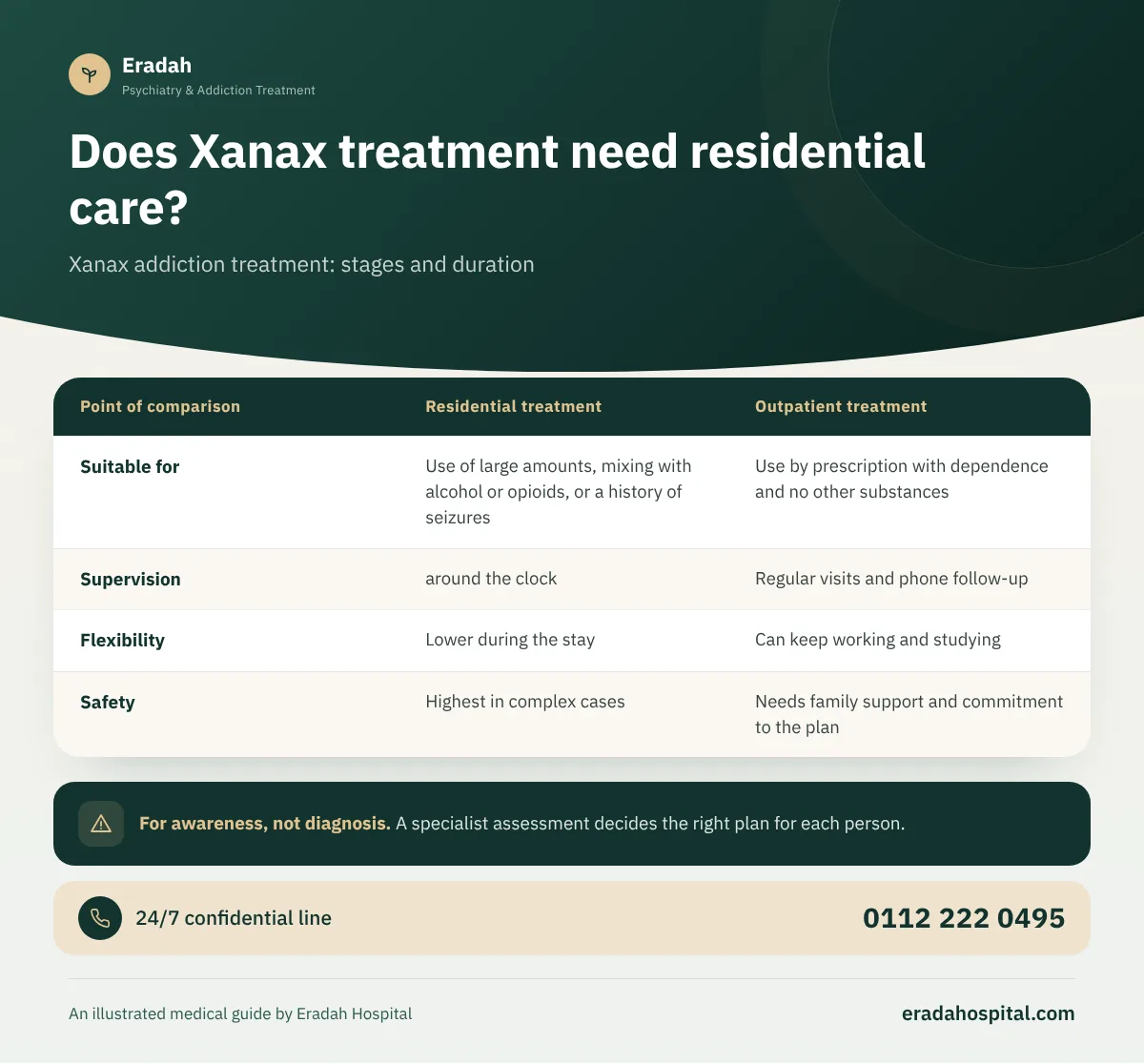
Does Xanax treatment need residential care?
| Point of comparison | Residential treatment | Outpatient treatment |
|---|---|---|
| Suitable for | Use of large amounts, mixing with alcohol or opioids, or a history of seizures | Use by prescription with dependence and no other substances |
| Supervision | around the clock | Regular visits and phone follow-up |
| Flexibility | Lower during the stay | Can keep working and studying |
| Safety | Highest in complex cases | Needs family support and commitment to the plan |
Relapse prevention after Xanax treatment
- Knowing the situations that trigger anxiety and having a plan to deal with them without pills.
- Not keeping any leftover sedatives at home.
- Telling any new doctor about the history of benzodiazepine dependence before any prescription.
- Avoiding alcohol, as it weakens judgment and opens the door to relapse.
- Continuing psychological follow-up even in good periods.
How do you choose a center for Xanax addiction treatment?
- Officially licensed, with psychiatrists who specialize in addiction treatment.
- Uses gradual tapering, not abrupt discontinuation.
- Treats co-occurring anxiety or panic disorder at the same time.
- Follows the patient after the taper ends.
- Respects confidentiality and explains the plan clearly.
Choosing a hospital for Xanax addiction treatment
- Does the center refuse abrupt discontinuation, and set a slow taper whose pace the doctor determines according to the patient's response?
- Does it ask about alcohol, tramadol and opioids, since their combination with Xanax multiplies the risk of seizures and respiratory depression?
- Who monitors the patient at night in the first weeks of tapering, when anxiety attacks and insomnia intensify?
- Does it treat the original anxiety or panic, or does it just remove the drug and leave the cause in place?
- Does it avoid replacing Xanax with another drug that can also be misused?
These questions are not as detailed as they seem; Xanax is a short-acting benzodiazepine, and stopping it quickly after regular use can cause seizures and severe confusion. So the speed a center promises you is not an advantage and may be a warning sign. And a patient who is tapered well also needs someone to teach them how to face anxiety without pills.
At Eradah the doctor sets the tapering plan according to the case. It may begin with residential care when substances are mixed or there is a history of seizures, or be continued as outpatient care in simpler cases, with cognitive behavioral therapy for anxiety. The dual diagnosis program treats anxiety and dependence together. To learn what happens during tapering, see Xanax withdrawal symptoms, and if it began with panic attacks, read panic attack treatment.
Xanax addiction treatment at Eradah
At Eradah we begin with a comprehensive psychological and medical assessment, then set an individual gradual tapering plan under the supervision of psychiatrists, in residential care or the outpatient clinic depending on the case. We treat the original anxiety or panic with cognitive behavioral therapy and suitable medications, involve the family, and follow up after the taper ends, with complete confidentiality from the first call.