Where does panic attack treatment begin?
The first step is confirming medical safety: a heart and thyroid check, and questions about stimulants and substances. Real treatment then begins, and its first part is for the patient to understand what is happening in their body during an attack and why it is not harming them.
NICE guidelines (CG113) recommend a stepped-care model for panic disorder, starting with recognition and diagnosis, then guided self-help for mild cases, then cognitive behavioral therapy or an antidepressant for moderate and severe cases, then referral to specialists for cases that do not respond. They also advise that a person who reaches the emergency room with a panic attack should have only the necessary tests, be given written information, and be referred for follow-up rather than simply reassured.
How does cognitive behavioral therapy work for panic?
NIMH describes cognitive behavioral therapy as the “gold standard” for treating panic disorder. NICE states that it is usually delivered over a total of 7 to 14 hours, in weekly sessions over no more than four months. It includes:
- Education: explaining the panic cycle and why the symptoms feel dangerous when they are not.
- Cognitive restructuring: examining catastrophic interpretations (“I will die,” “I will go insane”) and replacing them with realistic ones.
- Interoceptive exposure: safely and in a controlled way, bringing on sensations similar to an attack during the session, so the brain learns they are not dangerous.
- Situational exposure: gradually returning to avoided places, from easiest to hardest.
- Dropping safety behaviors: such as carrying a sedative “just in case” or always sitting near the door.
What medications are used to treat panic disorder?
The psychiatrist prescribes medication after an assessment, and we list the classes here for information only, without any doses:
| Category | Examples | Role and notes |
|---|---|---|
| SSRI antidepressants | Sertraline, paroxetine, escitalopram, fluoxetine | Often the first choice; the effect appears after weeks, and they may temporarily increase tension at the start |
| SNRI antidepressants | Venlafaxine | An alternative if there is no response or they are not tolerated |
| Tricyclic antidepressants | Imipramine, clomipramine | An option in NICE guidelines if SSRIs do not work, with monitoring for side effects |
| Beta-blockers | Propranolol | May ease some physical symptoms such as palpitations, but do not treat the disorder itself |
| Benzodiazepines | Alprazolam, clonazepam | NICE does not recommend them for treating panic disorder; if used, it is for a very short period and on the doctor’s decision |
Why are Xanax and Rivotril not advised for treating panic?
Benzodiazepine sedatives stop an attack quickly, which is why they seem like the ideal solution. But NICE guidelines state that they should not be prescribed to treat panic disorder, because they are linked to worse long-term outcomes. The reason is that they become a “safety behavior” that stops the brain from learning that the attack is not dangerous.
The FDA also warned in 2020 that this entire class carries risks of misuse, addiction and physical dependence, and that abrupt discontinuation can cause life-threatening withdrawal. With short-acting sedatives such as Xanax, rebound anxiety can appear between doses and be mistaken for a new attack. Read also about Rivotril.
What do I do during a panic attack?
If a doctor has diagnosed panic attacks and ruled out heart causes, these steps help the attack pass safely. But if you have new or different chest pain, call an ambulance (123):
- Remind yourself: “This is a panic attack, I have been through it before, and it will end within minutes.”
- Stay where you are if it is safe, instead of fleeing; fleeing teaches the brain that the place is dangerous.
- Breathe slowly: a gentle breath in through the nose and a longer breath out through the mouth.
- Focus on your surroundings: five things you can see, four you can touch, and three you can hear.
- Do not fight the sensations hard; let them rise and then fall like a wave.
How long does panic disorder treatment take?
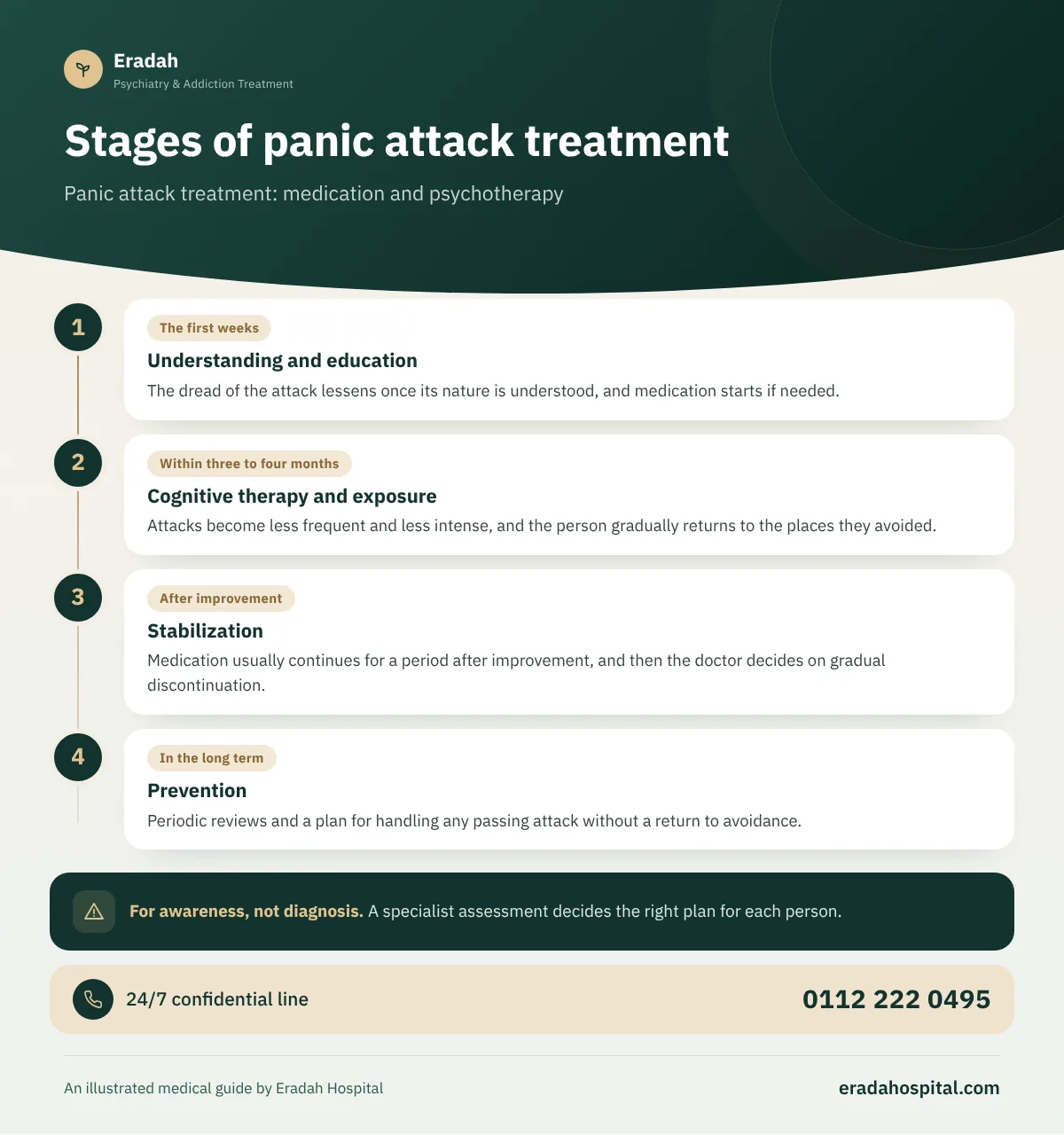
- The first weeksUnderstanding and education
The dread of the attack lessens once its nature is understood, and medication starts if needed.
- Within three to four monthsCognitive therapy and exposure
Attacks become less frequent and less intense, and the person gradually returns to the places they avoided.
- After improvementStabilization
Medication usually continues for a period after improvement, and then the doctor decides on gradual discontinuation.
- In the long termPrevention
Periodic reviews and a plan for handling any passing attack without a return to avoidance.
Does a person with panic need to be admitted to hospital?
Most patients are treated as outpatients. Residential care may be suggested if the panic comes with severe depression or thoughts of self-harm, or with dependence on sedatives or alcohol that needs safe withdrawal, or with severe agoraphobia that prevents getting to the clinic, in which case home or remote sessions may be used at first.
How do you prevent attacks from returning, and how can the family help?
- Expect passing attacks: an attack after improvement does not mean failure, but a chance to apply your skills.
- Do not go back to avoidance: keep going to the places you have regained.
- Cut down on stimulants and stay away from cannabis and stimulant drugs.
- For the family: encourage gradual confrontation, and gradually reduce constant accompaniment in agreement with the therapist.
- Do not take a sedative from the pharmacy when the symptoms come back; see your doctor.
Choosing a Hospital for Panic Attack Treatment
A panic attack resembles a heart attack so closely that many people go from one emergency department to another for months before reaching a psychiatrist. So the right facility starts by ruling out an organic cause once and convincingly, then moves straight to the treatment that changes the brain’s response to the attack: gradual exposure to feared sensations and places within cognitive behavioral therapy. Ask the following:
- Are previous ECGs and tests reviewed to avoid repeating unnecessary examinations, while completing whatever is missing?
- Does treatment include actual exposure exercises for a racing heart and shortness of breath, not just theoretical explanation?
- Does the doctor avoid relying on Xanax or Rivotril as the main treatment?
- Is there a plan for agoraphobia if the patient has become afraid to go out alone?
- Is the family involved so that constant accompaniment gradually decreases instead of becoming a safety behavior?
At Eradah, the psychiatrist assesses the case and sets a medication plan when needed, specialists lead the cognitive behavioral therapy sessions, and the dual diagnosis program treats panic and sedative dependence together. To reach us: 01122220495 by phone or WhatsApp, 24 hours a day, or tell us what you are going through. The first session is free and confidential, and residential treatment is for men only.
Panic attack treatment at Eradah
At Eradah we begin with a medical and psychological assessment that rules out organic causes and looks for depression and sedative use, then a plan that combines cognitive behavioral therapy and gradual exposure with medication follow-up when needed. If there is dependence on Xanax, Rivotril or alcohol, we treat the panic and the dependence together, with safe withdrawal under medical supervision and complete confidentiality.