How does the body get rid of Xanax?
Alprazolam is absorbed quickly and reaches its peak blood concentration within about one to two hours. It is then broken down in the liver, mainly by an enzyme known as CYP3A4, into products, chiefly alpha-hydroxy-alprazolam, and most of these are excreted through the kidneys in the urine.
The half-life of Xanax is about 11 hours in healthy adults, and is longer in older adults and people with liver disease. Half-life is the time it takes for the amount of drug in the blood to fall by half, and the body usually needs several times this long to clear it almost completely.
How long Xanax stays, by type of test
Urine
Blood
Saliva
Hair
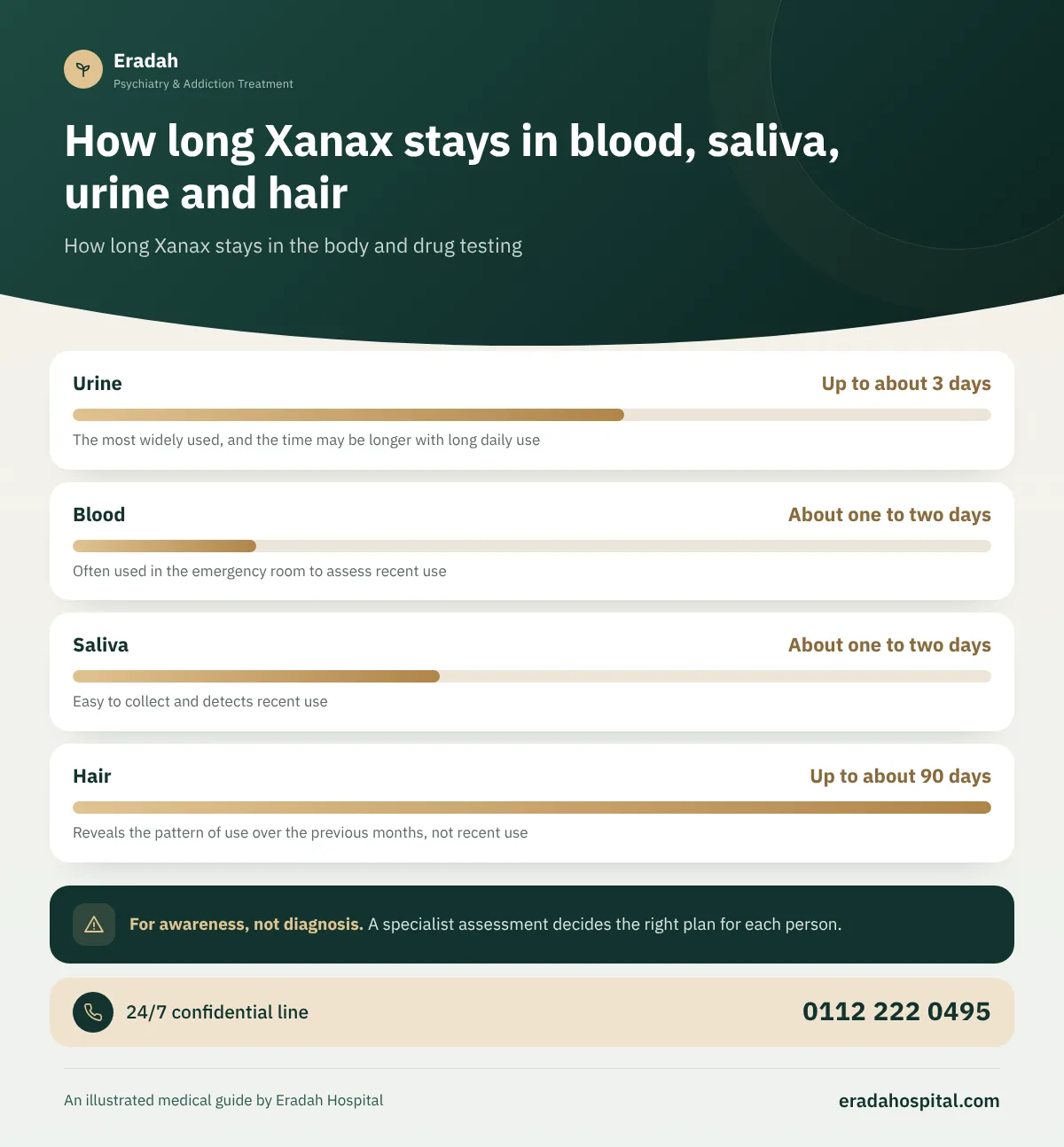
These durations are approximate and vary by laboratory and test sensitivity. For an accurate interpretation of a specific result, consult the doctor or the laboratory.
What factors affect how long Xanax stays?
- Length and frequency of use: daily use over a long period lengthens the detection time compared with a single dose.
- Dosage form: extended-release tablets stay relatively longer.
- Age: older adults clear the drug more slowly.
- Liver function: liver disease clearly slows its clearance.
- Other medications: some drugs slow the enzyme responsible for breaking it down, so it stays longer.
- Weight and body fat percentage: may affect how the drug is distributed and how quickly it leaves.
Does Xanax stay in the body for less time than other sedatives?
Usually yes. Xanax is a short- to intermediate-acting benzodiazepine and does not produce long-lasting active breakdown products, whereas long-acting sedatives such as Valium stay in the urine far longer. So the detection window varies a great deal within the same family:
| Medicine | Duration of action | Approximate urine detection window |
|---|---|---|
| Xanax (alprazolam) | Short to intermediate | A few days |
| Rivotril (clonazepam) | Long | Longer, and some rapid tests may not detect it |
| Valium (diazepam) | Very long, with active breakdown products | May extend to weeks with long-term use |
The comparison is general and approximate, and varies by laboratory, type of test and pattern of use.
When is a Xanax test ordered?
- In the emergency room: when someone has lost consciousness or poisoning is suspected, to identify the substances responsible and guide treatment.
- In treatment programs: to follow adherence to the reduction plan and make sure no other sedatives are being used.
- Before prescribing new medications: to avoid dangerous interactions with other depressants.
- In some workplaces or official procedures: according to each body's rules.
In treatment programs, testing is a tool for building trust and tracking progress, not a means of punishment. An unexpected result is discussed calmly with the patient to understand what happened and adjust the plan.
Screening test and confirmatory test
A rapid test that detects benzodiazepines as a group and does not identify any particular drug among them, and its positive result is preliminary.
Done at a specialized laboratory with precise instruments, it identifies alprazolam and its breakdown products specifically, and is requested for any preliminary result that needs confirmation.
Why might Xanax not show up on some tests?
Some older rapid benzodiazepine tests were designed to detect certain breakdown products that alprazolam does not produce, so they may give a negative result even when it is present. Newer generations detect it better, but sensitivity differs between laboratories and test manufacturers.
For this reason, a negative result on a rapid test does not always rule out use, and a positive result does not prove it on its own. Correct interpretation needs to know the type of test and the medical history, and sometimes a confirmatory test.
The role of testing in poisoning cases
In the emergency room the doctor does not wait for the test result before starting emergency care; the priority is breathing, consciousness and vital signs. But the test helps later to find out whether other substances were taken with Xanax, such as alcohol or opioids, which changes the treatment and follow-up plan. That is why bringing the medication box or the remaining pills with the patient is valuable information for the medical team.
Are there false positive results?
Yes, some common medications can interfere with the preliminary benzodiazepine test, including the antidepressant sertraline and some HIV medications such as efavirenz. So tell the laboratory about all the medications you take, and ask for a confirmatory test if the result is unexpected.
What if I take Xanax by prescription?
A positive result in this case is expected and does not mean misuse. Keep a copy of the prescription, and tell the party requesting the test before it is done. Do not stop the medication before the test thinking that is better; abrupt discontinuation can cause dangerous withdrawal symptoms.
What does a test result mean for the family?
If the family is thinking of doing a quick home test, it is important to know that these strips vary widely in their ability to detect alprazolam and that their result is always preliminary. It is better for testing to be part of a medical assessment that explains the result and puts it in context, rather than turning into a tense confrontation at home.
A test is a helping tool, not a verdict. A positive result may be due to a prescribed medication, and a negative result does not rule out a problem if the signs are clear. What matters most is a calm conversation and a specialized assessment that looks at the whole picture and sets a safe plan.